
Nowa Huta began in 1949 as a purpose-built workers’ city for the Vladimir Lenin Steelworks, designed on a pentagonal socialist-realist plan radiating from a grand central square. It grew rapidly from empty farmland to a population exceeding 100,000 within several years, became one of Poland’s most defiant strongholds against communist rule, and now stands as a protected historic district drawing visitors who want to see Cold War Europe made solid in stone and concrete.
TL;DR:
- The rapid growth of Nowa Huta from farmland to a population exceeding 100,000 occurred in just seven years, driven by the steelworks and industrial recruitment.
- Its pentagonal socialist-realist layout combines local Polish architectural traditions with Soviet monumentality, making it one of only two fully planned socialist cities built from scratch.
- The district’s community and infrastructure were deeply integrated with the steelworks, shaping daily life around shifts, company housing, and workplace institutions for decades.
- Residents’ protests in 1960 over the absence of a church led to the construction of Arka Pana, a landmark symbolizing popular resistance against state suppression.
- Nowa Huta’s industrial legacy persisted through the 20th century, with the steelworks becoming a central hub for opposition; its recent heritage status offers legal protection and renewed interest.
Table of Contents
- The founding of Nowa Huta: 1949 to 1956
- Socialist-realist design: the pentagon and its boulevards
- Steel, jobs, and everyday routine under the plan
- Faith versus the plan: the 1960 cross protests
- Solidarity’s stronghold: the 1980s labour movement
- From steel town to heritage district: change after 1989
- Visiting Nowa Huta: heritage status and what remains
- A local guide’s route through Nowa Huta’s history
- Who lived in Nowa Huta: a changing population
- Community life on the factory clock
- What the new city cost the surrounding countryside
- Building loyal citizens: propaganda and education
- The continuing significance of Nowa Huta
- Book a guided walk through Nowa Huta with ComFort Tours Cracow
- Sources
- FAQ
The founding of Nowa Huta: 1949 to 1956
The decision to build Nowa Huta was made in 1949, and it was never really about steel alone. Planners in Warsaw wanted an industrial counterweight to Kraków, a city they viewed as too bourgeois, too Catholic, and too attached to its own history. Dropping tens of thousands of steelworkers and their families onto the city’s eastern edge was meant to dilute that influence permanently, a point Britannica’s history of the district makes plainly when describing the scheme’s social engineering intent.
The chosen site sat on farmland belonging to villages including Mogiła and Pleszów, and building the new city meant clearing them. Thousands of farmsteads were expropriated, often for compensation that residents at the time and since have described as minimal, according to Culture. Entire farming communities that had worked this land for generations were relocated to make way for blast furnaces and apartment blocks.
What followed was rapid, almost frantic growth. The population grew steadily during the early 1950s, rising from the low tens of thousands to over 100,000 by the mid-1950s, across a site covering over 1,000 hectares, per Culture.pl’s figures
Nowa Huta was formally incorporated into Kraków in 1951, though for years it functioned almost as its own town within the city’s boundaries. The Lenin Steelworks itself began production in 1954, the moment the entire project had been building towards since the first surveyors arrived. Within two more years the population had doubled again, driven by a housing programme that struggled to match the pace of industrial hiring.
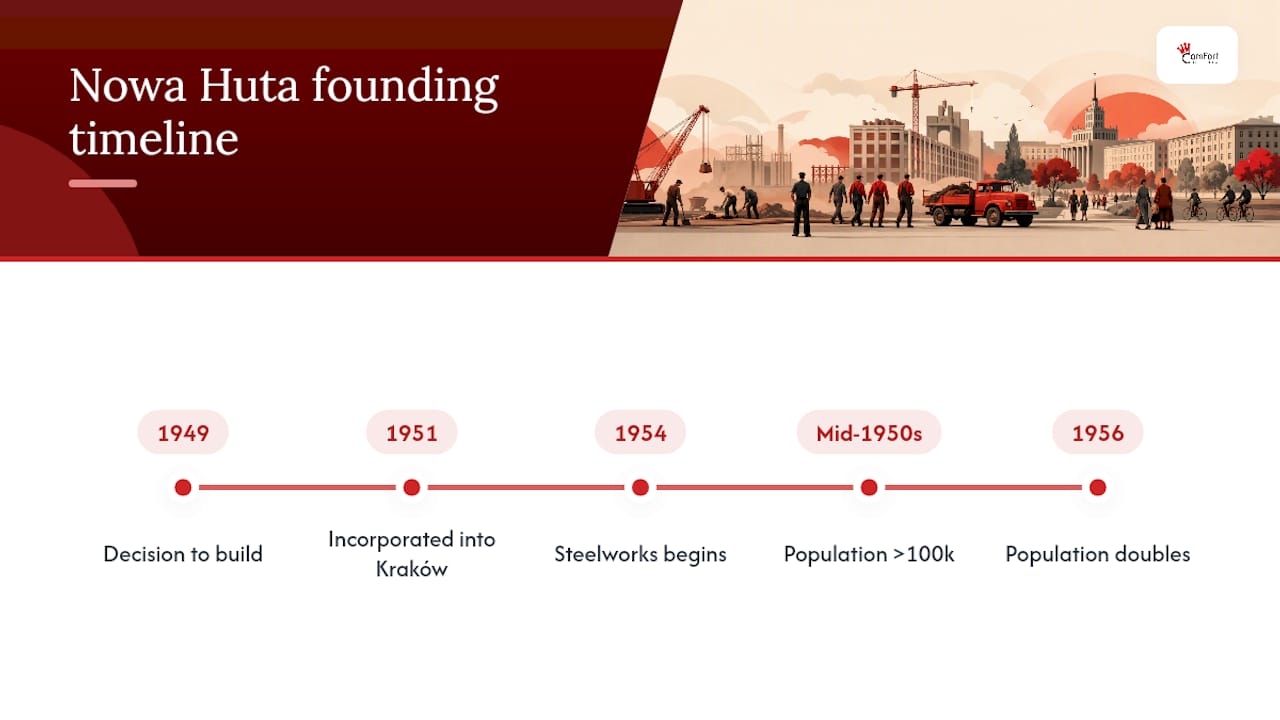
What makes this timeline unusual is the speed. Most European industrial towns grew over decades. Nowa Huta did it in seven years, built from nothing on land that had been ploughed fields the year before.
Socialist-realist design: the pentagon and its boulevards
Nowa Huta’s layout is not accidental sprawl. It follows a pentagonal plan with five broad boulevards radiating outward from a central square, now Plac Centralny, in a design meant to evoke both Renaissance civic order and Soviet monumentality at once. Britannica’s entry on Nowa Huta describes how Polish planners adapted historic Renaissance elements, arcades, cornices, proportioned facades, into a scheme that was ideologically socialist-realist but visually rooted in national tradition.
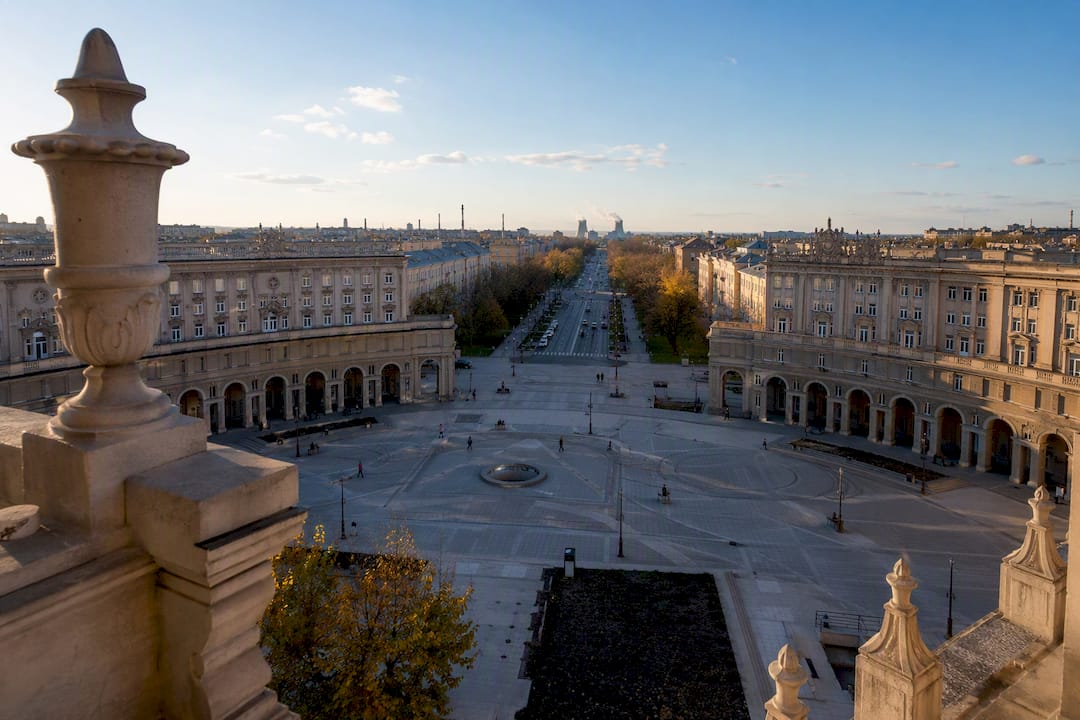
That combination was deliberate. Pure Soviet architecture might have alienated a Polish population; borrowing local historic forms made the new city feel less like an imposition and more like a continuation of Kraków’s own architectural lineage, even as it served an entirely different political purpose.
Nowa Huta is one of only two fully planned socialist-realist cities built entirely from scratch, the other being Magnitogorsk in the Soviet Union. That comparative rarity is why architectural historians treat the district’s core as internationally significant rather than merely a domestic curiosity, a point Britannica makes explicit.
Key structures from this first building phase include:
- The People’s Theatre, built as a cultural anchor for the new workforce
- A monumental administrative building framing the northern edge of the central square
- The earliest housing estates, arranged in enclosed courtyard blocks around communal green space
There is a catch in the story that most guidebooks skip. The original masterplan called for a much grander monumental core, but Stalin’s death in 1953 and the subsequent political thaw meant the scheme was never finished as drawn. That interruption left Nowa Huta with a layered, hybrid character: the finished socialist-realist heart giving way to plainer, more functional blocks from the later 1950s onward, a shift the university guide to the district identifies as physical evidence of a political turning point frozen mid-construction.
Steel, jobs, and everyday routine under the plan
The Lenin Steelworks, later renamed Tadeusz Sendzimir Steelworks, was the entire reason Nowa Huta existed, and its scale was genuinely vast. At its peak the plant employed approximately 38,000 people, producing several million tonnes of steel annually, according to the academic guide to Nowa Huta published by the Jagiellonian University’s Institute of Geography.
Those figures shaped daily existence far beyond the factory floor. The steelworks did not simply employ Nowa Huta’s residents; it organised much of their lives:
- Company housing tied to plant employment, meaning your flat and your job were often the same relationship
- Workplace clinics, canteens, and cultural clubs that reduced dependence on the wider city
- Shift patterns that structured whole neighbourhoods around production schedules rather than a conventional working day
This employer-centred model gave Nowa Huta a strong internal identity, almost a company town writ large, but it came at a measurable environmental cost. Academic studies of the district have documented significant air and soil pollution linked to steel production, along with occupational health impacts among long-serving plant workers. The same industrial concentration that gave Nowa Huta its purpose also left a lasting environmental footprint on the surrounding land.
Faith versus the plan: the 1960 cross protests
Nowa Huta’s original masterplan included no church. Planners regarded the district as a showcase for secular socialist life, and a Catholic parish had no place in that vision. Residents disagreed, and they pushed back for years through petitions and informal appeals that state authorities repeatedly rejected.
Matters came to a head on 27 April 1960. Here is how the confrontation unfolded:
- Authorities moved to remove a cross that residents had erected on land earmarked for a future church, triggering an immediate crowd response.
- Clashes broke out between demonstrators and security forces, escalating into one of the more serious public confrontations of the era in communist Poland.
- The episode drew wider attention to Nowa Huta as a site of genuine popular resistance, not merely industrial obedience.
- Campaigning for a church continued through the decade, with a young Kraków auxiliary bishop, Karol Wojtyła, lending his support to the parish cause.
- Construction of the Arka Pana, the Lord’s Ark church, finally proceeded between 1969 and 1977, and Wojtyła consecrated the completed building in 1977, as detailed in scholarship on Nowa Huta’s social history collected in Nowa Huta: Generations of Change in a Model Socialist Town.
The building itself, with its ship-like form and embedded fragments of stone from other sacred sites, became a physical monument to a fight that ordinary residents won against deliberate state planning. It remains one of the district’s most visited landmarks today.
Solidarity’s stronghold: the 1980s labour movement
Few workplaces anywhere in communist Europe organised as completely as the Lenin Steelworks did once Solidarity formed in 1980. Reports from the period cite very high membership in the plant’s workplace Solidarity chapter that year, a figure the BBC’s overview of Nowa Huta’s transformation highlights as evidence of just how total the shift against the regime became.
That density mattered enormously. A steelworks built explicitly to produce a loyal socialist workforce had, within a generation, turned into one of the most organised centres of opposition in the entire country. The irony was not lost on anyone at the time.
- Strikes and slowdowns at the plant fed directly into the national wave of industrial action that pushed Solidarity onto the international stage
- Nowa Huta’s workers coordinated closely with activity at other major industrial sites, reinforcing the movement’s reach beyond Gdańsk’s shipyards
- Security crackdowns through the 1980s, including periods of martial law enforcement, targeted the district specifically because of its organising strength
The legacy is still visible in how residents and historians talk about the place. Nowa Huta is remembered locally not just as a steel town, but as a district that helped end the system it was built to serve.
From steel town to heritage district: change after 1989
The collapse of communism hit Nowa Huta’s economy hard. The steelworks, renamed Tadeusz Sendzimir Steelworks, contracted sharply through the 1990s as state subsidies vanished and global steel competition intensified. Thousands of jobs disappeared, and the district’s population profile shifted as younger residents left for opportunities elsewhere in Kraków or abroad.
Through the 1990s and 2000s, Nowa Huta carried something of a reputational burden. Outsiders often characterised it as grey, depressed, and stuck in the past, an image that discouraged both investment and casual visitors for the best part of two decades.
That picture has changed considerably in recent years:
- Cultural institutions and public art projects have repositioned the central square as a destination rather than a relic
- Property interest has risen as buyers recognise the value of spacious, well-built prewar and midcentury apartments at prices below central Kraków
- Public space improvements, including restored greenery and pedestrian routes, have made the pentagonal core noticeably more walkable
The pivot has not erased the district’s industrial identity. It has simply added a second one, historical and cultural, sitting alongside the working plant that still operates on a reduced scale.
Visiting Nowa Huta: heritage status and what remains
Nowa Huta’s socialist-realist core received Historic Monument status in Poland recently, the country’s highest tier of heritage protection, according to recent conservation scholarship on the district’s contemporary status. That designation locks in legal safeguards against demolition or unsympathetic alteration, and it has accelerated interest in the district as a serious heritage destination rather than a curiosity for architecture obsessives.
The centrepiece for most visitors is the Museum of Nowa Huta, housed in the renovated Światowid cinema building just off the central square. Its exhibitions cover the district’s planning, its industrial peak, and its role in the political opposition, anchored by original documents and photographs from the period.
Beyond the museum, the district hides more than 250 Cold War era civil defence bunkers beneath its residential blocks, most closed to the public but occasionally opened for guided tours. Look out for these features when exploring:
- Plac Centralny (now Ronald Reagan Central Square), the pentagon’s ceremonial heart
- Arka Pana, the church born from the 1960 protests
- Original socialist-realist housing blocks along the main boulevards, with their Renaissance-inspired detailing still intact
- Marked walking trails connecting the square, the museum, and the steelworks viewing points
Pro Tip: Visit on a weekday morning if you can. Plac Centralny loses much of its atmosphere under weekend crowds, and the low midweek light does the socialist-realist facades far more justice for photography.
A local guide’s route through Nowa Huta’s history
Reading Nowa Huta well takes more than a map. Here’s a route that works for most first-time visitors:
- Start at Plac Centralny and take in the five boulevards before walking towards the Museum of Nowa Huta in the old Światowid cinema.
- Head to Arka Pana next, roughly a 20-minute walk, to see where resident protest reshaped the original plan.
- Finish near the steelworks viewing points, where the scale of the plant becomes obvious in a way photographs never quite capture.
Spring and autumn suit this walk best, since summer heat has little shade along the open boulevards. The route is flat and manageable for most fitness levels, which helps with accessibility.
Pro Tip: A small group with a guide who can point out where Renaissance cornices meet socialist iconography gets far more out of the central square than a solo visitor with a guidebook. Interpreting those details is exactly where a guided walk through Kraków’s Nowa Huta earns its keep.
Who lived in Nowa Huta: a changing population
The people who filled Nowa Huta in the 1950s were overwhelmingly rural migrants, drawn from villages across southern Poland by the promise of steady industrial wages and new housing. This was engineered deliberately: planners wanted a workforce with no prior attachment to Kraków’s existing social order, and recruiting heavily from the countryside delivered exactly that.
Over the following decades the district’s demographic profile matured. The first generation of steelworkers aged into a settled community, while their children grew up as Nowa Huta natives rather than transplants, something the original 1950s residents never were. By the 1980s the district had developed its own distinct identity, still working class but far more rooted than its origins as a hastily assembled migrant town.
Post-1989 deindustrialisation reversed some of that stability. Younger residents left for university or work elsewhere in Kraków and beyond, while the plant’s shrinking workforce meant fewer new families arriving to replace them. The district that once symbolised a manufactured future now carries a noticeably older population profile than much of the rest of the city, alongside a smaller but growing wave of newcomers drawn by cheaper housing and heritage interest rather than industrial jobs.
Community life on the factory clock
Daily life in socialist-era Nowa Huta revolved almost entirely around the steelworks calendar. Shift patterns dictated when neighbourhoods felt busy or quiet, and workplace institutions filled roles that might otherwise have belonged to independent civic life: canteens, clinics, sports clubs, and cultural centres all operated under the plant’s umbrella rather than the city’s.
That structure created genuine community cohesion, even if it was not the kind planners originally intended. Residents shared courtyards, queued at the same shops, and sent children to schools built specifically for the district’s growing families. Weekend leisure often meant plant-organised outings or events at the People’s Theatre, since Nowa Huta was designed with limited independent commercial life outside the state-run system.
Faith remained the sharpest point of friction with that intended order. The absence of an official church for years, and the eventual construction of Arka Pana, meant religious practice became one of the few areas where residents organised outside official channels, a habit of quiet self-organisation that would later feed directly into Solidarity’s rapid growth at the steelworks.
What the new city cost the surrounding countryside
Building Nowa Huta meant erasing farmland that had supported rural communities for generations. Villages including Mogiła and Pleszów lost their fields to expropriation, and the agricultural character of Kraków’s eastern edge disappeared within a few short years of construction beginning in 1949.
The environmental consequences compounded once the steelworks began production in 1954. Heavy industry on this scale introduced pollution loads the surrounding landscape had never carried, affecting air quality, soil condition, and water systems across a wide area beyond the plant’s fence line. Studies of the district’s industrial legacy point to lasting contamination linked directly to decades of steel production at full capacity.
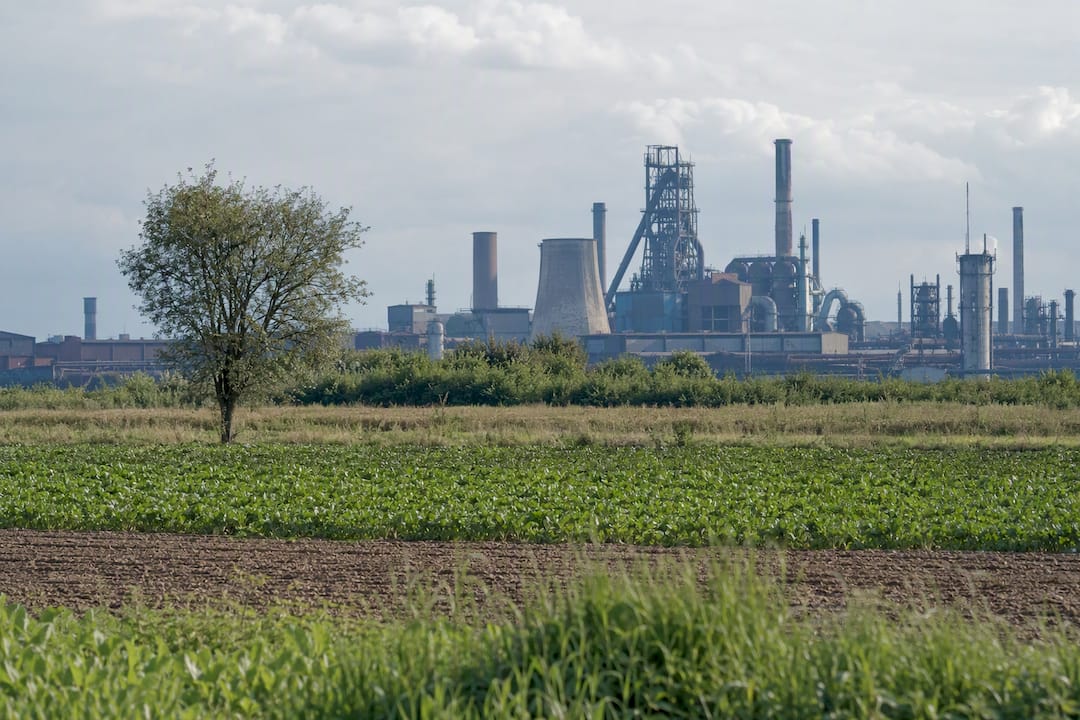
The human dimension of that loss deserves equal weight. Oral histories collected from early Nowa Huta residents describe farming families who had worked the same land for generations, displaced with compensation many considered inadequate, then resettled among strangers in a city built for an entirely different way of life. That is a harder story than the architecture alone tells, and one worth remembering alongside the boulevards and the central square.
Building loyal citizens: propaganda and education
Nowa Huta was never meant to simply house workers. It was built to produce a specific kind of citizen, and propaganda was woven into daily life from the outset. Workplace meetings, plant newspapers, and organised rallies at Plac Centralny reinforced state messaging about socialist achievement, framing the steelworks and the city around it as proof that the system worked.
Schools carried a similar weight. Children in Nowa Huta grew up within a curriculum and youth organisation structure designed to normalise socialist values from an early age, reinforced by a built environment with almost no space for independent civic or religious life outside state-sanctioned channels.
The strategy had obvious limits. Academic accounts of the district note that planners hoped monumental socialist-realist architecture, borrowing recognisable Polish historic forms, would make ideological messaging feel less foreign and more like a natural extension of national tradition. Instead, the very cohesion that propaganda tried to manufacture eventually turned against its architects: a workforce raised on collective identity and shared grievance became the organisational backbone of Solidarity within a single generation. Few urban planning projects have backfired quite so thoroughly on their own ideological terms.
The continuing significance of Nowa Huta
Nowa Huta rewards patience because its layers do not announce themselves. A visitor who only sees monumental facades misses the church built by defiance and the boulevards designed, in part, for crowd control. Guided interpretation matters here precisely because the site resists a single reading: it is propaganda, protest, industry, and faith stacked into the same street plan.
That layering is what makes Nowa Huta more than a Kraków curiosity. It is a working record of how twentieth-century Europe tried to engineer belief through concrete, and how belief, in the end, proved harder to plan than housing.
— Damian Fort
Book a guided walk through Nowa Huta with ComFort Tours Cracow
Visitors can see Nowa Huta with a guide who can explain what they’re looking at, not just where to stand for a photograph. Where a self-guided walk leaves the symbolism of the central square, the church, and the boulevards to a guidebook footnote, a small-group tour lets you ask questions on the spot and adjust the pace around what genuinely interests you.

Small groups matter here because Nowa Huta rewards conversation, not a rushed script delivered to fifty people at once. Groups are kept deliberately compact, and it is possible to arrange private walking tours for those who want a fully tailored itinerary, whether that means more time at Arka Pana or a detour through the steelworks viewing points. For visitors combining Nowa Huta with other Kraków heritage sites in a single day, private transport between locations can be arranged.
To build Nowa Huta into a wider itinerary, browse the full range of guided tours and get in touch to check dates and group availability.
Sources
For readers who want to dig deeper into Nowa Huta’s history beyond this overview, these sources cover the founding narrative, urban design, and political legacy in more depth:
- Culture
- Nowa Huta | Britannica
- Nowa Huta guide (university/academic guide)
- Nowa Huta: The city that went from communism to capitalism | BBC
FAQ
Is Nowa Huta worth visiting?
Yes. Its socialist-realist central square, the Arka Pana church, and the Museum of Nowa Huta together offer one of the clearest surviving records of Cold War era urban planning anywhere in Europe, and the district earned Historic Monument status in 2023 in recognition of that value.
Was there a communist area in Kraków?
Nowa Huta was built from 1949 as a planned socialist city on Kraków’s eastern edge, incorporated into the city in 1951, and it remains the clearest surviving example of communist era urban planning within the city’s boundaries.
Why did Nowa Huta not have a church for so long?
The original 1949 masterplan deliberately excluded a church because planners envisioned the district as a secular socialist showcase, a decision residents fought for years until the Arka Pana was finally built between 1969 and 1977.
What is the best way to see Nowa Huta’s history in person?
A short walking route linking Plac Centralny, the Museum of Nowa Huta, and Arka Pana covers the essentials on foot, though a guided walk with a small group, such as those run by ComFort Tours Cracow, makes the architectural symbolism far easier to read.