Yes, you can visit Auschwitz with a guide by reserving a personalised entry pass directly at visit.auschwitz.org or by booking a Kraków-based package that bundles the Museum’s licensed guide with round-trip transport. Standard guided visits cover both Auschwitz I and Birkenau and run for several hours, and slots sell out fast in peak months, so booking well ahead matters. For most UK travellers, the simplest route is flight to Kraków, transfer to the Memorial, and a confirmed licensed guide waiting at the gate.
TL;DR:
- Booking well in advance is essential, as most guided slots sell out quickly during peak months from April to October.
- A licensed guide-educator is mandatory for most daytime visits between April and October, with tours including headset rental and shuttle use.
- The most common guided option lasts 2.5 to 3.5 hours and covers Auschwitz I and Birkenau with included transport between sites.
- Transportation from Kraków to the Memorial can be shared or private, with private options offering direct hotel pickup and more flexibility.
- UK travelers should carry printed entry passes, book guides through reputable operators, and consider the physical demands and emotional intensity of the site.
Table of Contents
- How to book official entry passes and guided tours
- Which type of guided tour should you book?
- What to expect on the day of your visit
- Getting from the UK to the Memorial
- When to book: timing and avoiding a wasted trip
- Packing and preparing for the visit
- Do UK travellers need a visa for Poland?
- Can you visit Auschwitz with mobility or health limitations?
- How should you behave, and can you take photographs?
- Are English-speaking, specialist guides available?
- Where to stay: Kraków versus Oświęcim
- The ComFort Tours Cracow perspective on visiting well
- Book your Auschwitz visit with ComFort Tours Cracow
- Sources
- FAQ
How to book official entry passes and guided tours
Every visitor needs a personalised entry pass, and there are no ticket sales at the gate. Passes and guides are booked exclusively through Auschwitz, which displays available languages, times, and guide allocation for each day. Because demand regularly outstrips supply, the Museum recommends reserving well in advance and arriving at least 30 minutes before your tour starts.
Some off-peak time windows allow unguided entry, but a licensed guide-educator is compulsory for most daytime slots between April and October. Sale of language-specific tour passes ends shortly before departure, so a late arrival at the booking page can mean missing that day’s window entirely, as the Museum’s individual visitor guidance explains.
What a guided booking actually includes:
- A licensed Museum guide-educator assigned to your language and time slot
- Headset rental so you can hear the guide clearly across noisy, crowded areas
- Use of the internal shuttle running between Auschwitz I and Birkenau
- A hand luggage limit of 35 x 25 x 15 cm, with no exceptions at the gate
- A firm arrival time before your slot, to allow for the security check
Which type of guided tour should you book?
Not every visitor needs the same format. Here is how the main options break down:
- Standard guided tours (2.5 to 3.5 hours). The default choice for most first-time visitors, covering the core exhibitions at Auschwitz I and the vast, open grounds of Birkenau, with the shuttle transfer included between sites.
- Study tours (6 to 8 hours). Built for history students, researchers, or anyone who wants far deeper engagement with the archives and lesser-visited blocks. Worth it if you are travelling specifically for this purpose rather than combining it with a Kraków city break.
- Online guided tours (around two hours). A genuinely useful option if travel is not possible, split between Auschwitz I and Birkenau with live narration, archival material, and a Q&A element built in.
- Private tours. These give you a flexible pickup time, a much smaller group, and a pace that suits families or anyone who needs to stop, sit, or process what they are seeing without holding up a coach group.
What to expect on the day of your visit
Auschwitz I holds the main exhibition buildings, dense with artefacts and documentation. Birkenau, roughly a 15 minute shuttle ride away, is largely open ground: railway tracks, barrack foundations, and the scale of the site itself does much of the talking. Expect a security check at the entrance similar to airport screening, and be ready to spend long stretches outdoors regardless of the forecast, since facilities on site are limited.
Most guided visits split roughly 90 minutes at Auschwitz I and the remainder at Birkenau, though your guide sets the exact pace. Key practical points:
- Dress respectfully. This is a memorial site and a cemetery, not a tourist attraction.
- Photography is permitted in most outdoor areas but restricted inside certain exhibition blocks.
- Large bags and suitcases are not allowed inside; use the cloakroom near the entrance.
- Loud conversation, eating, and smoking within the grounds are discouraged out of basic respect for other visitors.
Pro Tip: Licensed guides are trained to read a group’s mood. If a section feels too heavy, most will slow down or pause rather than push through the script. Do not be afraid to tell your guide you need a moment.
Getting from the UK to the Memorial
Direct flights from several UK airports reach Kraków in around 2.5 to 3 hours. From Kraków, the Memorial sits 66 to 70 kilometres away, roughly 90 minutes by road depending on traffic.
You have two realistic options for that leg:
- Shared transfer, typically bundled with a group tour, picking up from a fixed central Kraków point rather than your hotel door.
- Private transfer, which costs more but allows genuine hotel pickup, since central Kraków’s traffic restrictions often stop coaches reaching some hotel entrances directly.
A tour listing worth checking should state clearly what is included: licensed guide, headset, air-conditioned transport, and entry pass coordination. A properly run operator will confirm your exact meeting point, transfer time, and a contingency plan in writing before the day, not scramble it together by text that morning. If you have mobility needs, ask specifically whether the vehicle and pickup point suit you, since not every meeting point is step-free.
When to book: timing and avoiding a wasted trip
Reserve entry passes and guides as early as you can, ideally up to two months ahead during the busy April to October season. The Museum’s own booking guidance confirms that language-specific tour sales cut off shortly before departure, so waiting until you land in Kraków is a genuine gamble.
- Check visit.auschwitz.org first to see what is realistically available for your travel dates.
- If slots are scarce, book a Kraków-based operator that bundles transport with a guaranteed Museum guide, since this removes the risk of arriving with transport but no entry pass.
- Look for operators that explicitly name “licensed Museum guide-educator” rather than vague wording like “expert guide”, which can signal an unauthorised or unofficial arrangement.
- If you book late, ask directly whether the operator holds confirmed guide allocation for your date, not just a transport seat.
Pro Tip: Travel insurance that covers cancellation is worth having for this specific trip. Guide allocations occasionally shift close to the date, and flexible plans absorb that far better than a fixed itinerary.
Packing and preparing for the visit
A day at the Memorial is physically demanding: long walks, minimal shelter, and few facilities. Pack accordingly.
- Comfortable, broken-in walking shoes, since you will cover several kilometres on foot
- A refillable water bottle and rainwear, as weather exposure at Birkenau is significant
- A small bag only, given the 35 x 25 x 15 cm limit
- A packed lunch or snacks, since on-site catering is limited and breaks are short
If you or a travelling companion need step-free access, mention this when booking so your operator can confirm the route and vehicle suit you. Emotionally, it is worth accepting in advance that this will not feel like a typical day out. Many visitors find it useful to plan something quiet for the evening rather than rushing straight into Kraków’s nightlife.
Do UK travellers need a visa for Poland?
British passport holders do not need a visa for tourist visits to Poland. Since Poland is part of the Schengen Area, UK citizens can stay for up to 90 days in any 180-day period for tourism without a visa, the same allowance that applies across most of the Schengen zone post-Brexit.
Your passport must be valid for the length of your stay and issued within the last ten years, and it is worth checking the expiry date before booking flights, since a passport close to expiry has occasionally caused boarding issues at UK airports. No additional Auschwitz-specific documentation is required beyond your entry pass confirmation, which is worth having printed or saved offline in case of patchy signal at the Memorial.
If you are travelling as part of a school or educational group, additional consent and safeguarding paperwork may apply depending on your institution’s own policy rather than any Polish requirement. Organisations arranging school visits sometimes work through established educational travel specialists, such as ECI’s school trips to Kraków, which handle group logistics and compliance documentation alongside the historical programme.
Keep a digital and paper copy of your entry pass confirmation, your accommodation booking, and any transfer confirmation together, since Polish border checks can occasionally request proof of onward travel or accommodation, though this is uncommon for UK arrivals.
Can you visit Auschwitz with mobility or health limitations?
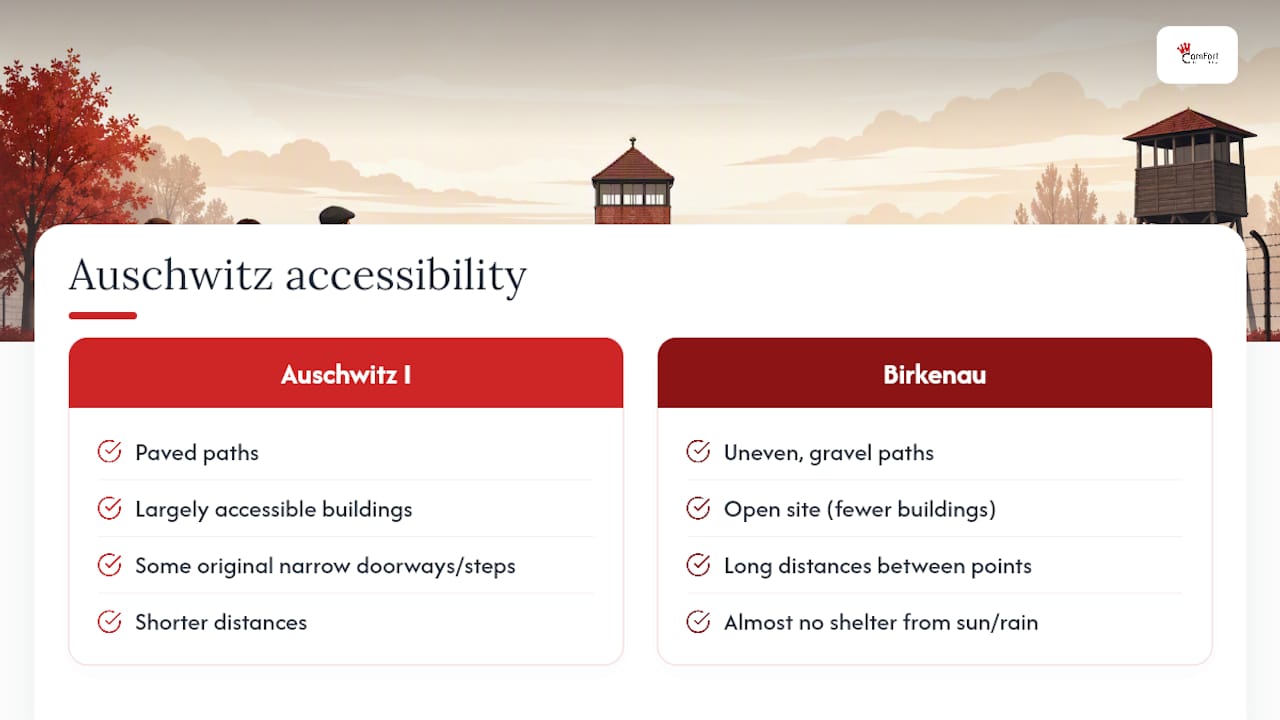
Auschwitz I has paved paths and largely accessible exhibition buildings, though some original structures have narrow doorways or steps that cannot be modified for preservation reasons. Birkenau is far more physically demanding: uneven ground, gravel paths, and long distances between points of interest, with limited shelter from sun or rain.
If you use a wheelchair or have limited mobility, request accessibility arrangements when booking rather than on arrival, so your guide and transport can be matched appropriately. Some group tours are not well suited to slower pacing, in which case a private tour with a flexible schedule tends to work better.
Visitors with heart conditions, anxiety disorders, or those who are pregnant should also consider the emotional intensity of the content alongside the physical demands. There is no medical facility on site beyond basic first aid, so anyone managing a chronic condition should carry necessary medication and inform their guide discreetly at the start of the visit. Hot summer days bring real heat exposure at Birkenau with almost no shade, so hydration and a hat matter more than most visitors expect. Guides are generally used to adjusting pace for visitors who need it, but they can only do that if you flag the need before or at the start of the tour, not partway through.
How should you behave, and can you take photographs?
Photography is generally permitted outdoors across both sites, including at the famous railway tracks and gatehouse at Birkenau. It is explicitly restricted inside certain indoor exhibition spaces, most notably areas displaying personal belongings and some of the more sensitive exhibition rooms at Auschwitz I, where signage marks the restriction clearly.
Selfies at the entrance gate or on the railway tracks have drawn public criticism in past years, and most guides will quietly discourage behaviour that reads as performative rather than reflective. This is not a legal rule so much as a matter of basic respect at a site that remains, functionally, a mass grave. Dress modestly: shoulders and legs covered is a sensible baseline, and swimwear, beachwear, or anything overtly casual is out of place.
Loud conversation, phone calls, eating, drinking, and smoking are not permitted within the grounds. Children under 14 are not recommended for the tour given the graphic nature of some displays, and the Museum leaves this judgement to parents but flags it clearly in its own visitor guidance. Group tours generally build in a moment of silence or reflection at key points, particularly near the memorial monuments at Birkenau, and staying quiet during these moments matters more than any formal rule.
Are English-speaking, specialist guides available?
Every guide licensed by the Museum has completed a formal educator training programme specific to the history of the camps, not a generic tourism qualification. English-language guides are among the most widely available languages on the official booking system, though slots in English still sell out during peak season, particularly for morning departures.
The distinction matters: a guide trained in Holocaust education handles difficult questions, survivor testimony, and the emotional weight of the material differently to a general tour guide reciting facts. This training also covers how to manage large groups moving through emotionally intense spaces without rushing or trivialising what visitors are seeing.
For UK travellers, booking English-language tours through either the Museum’s own system or a Kraków-based operator that guarantees a licensed educator gives you the same standard of guide either way. The difference between routes is really about group size, transport, and flexibility rather than the guide’s qualification itself, since both draw from the same pool of Museum-licensed educators.
Where to stay: Kraków versus Oświęcim
Nearly all UK travellers base themselves in Kraków rather than the town of Oświęcim itself, and this is the sensible choice for almost everyone. Kraków offers far more accommodation, restaurants, and transport links, plus the advantage of combining the Memorial visit with the rest of a Kraków city break.
Central Kraków, particularly the Old Town and Kazimierz districts, puts you within easy reach of pickup points for morning transfers and gives you flexibility if a tour time shifts. Staying overnight in Oświęcim is only worth considering if you specifically want to visit the Memorial at opening time before coach groups arrive, or if you are attending a multi-day study programme based there.
Whichever base you choose, book accommodation with flexible cancellation where possible, since guide allocation confirmations sometimes land closer to the visit date than travellers expect, and a rigid non-refundable booking can complicate rearranging plans around it.
The ComFort Tours Cracow perspective on visiting well
Booking a licensed guide is only half the job. The other half is everything around it: getting to the gate on time, understanding the site’s rules before you arrive, and not spending the morning worrying about transport logistics instead of preparing yourself for what you are about to see.
Some operators build Auschwitz visits around small groups and, where preferred, private transport, specifically because a coach of forty strangers is a poor way to absorb this history. Coordinating headset rental, the internal shuttle between Auschwitz I and Birkenau, and the Museum’s luggage rules is routine groundwork, handled before the visitor ever reaches the gate. That groundwork is what separates a visit that runs smoothly from one where a missed detail, a wrong-sized bag, a late arrival, turns into an avoidable problem on a day that deserves better.
— Damian Fort
Book your Auschwitz visit with ComFort Tours Cracow
ComFort Tours Cracow is the option for UK travellers who want the Museum’s official guide and transfer sorted in one booking, rather than juggling a separate entry pass reservation and a separate transport arrangement and hoping the timings line up. Some packages pair a licensed, English-speaking Museum guide with round-trip transport from Kraków, coordinated luggage and headset logistics, and the choice of a small group or fully private tour.
Booking this way removes the single biggest risk in a self-organised visit: turning up with a transfer confirmed but no matching entry pass, or the reverse. We handle the Museum-side coordination and the pickup communication so your morning starts with a guide at the gate, not a scramble at the booking page. If mobility, timing, or group size are a factor, tell us when you book and we will match the arrangement to suit. Check dates and reserve your place on the ComFort Tours Cracow tours page.
Sources
- Visiting / Auschwitz-Birkenau
- Auschwitz and Birkenau Memorial and Museum Guided Tour from Krakow – Viator
FAQ
How much does a guided tour of Auschwitz cost?
Admission to the grounds is free, but a personalised entry pass and guide-educator fee apply for guided visits booked through the Museum. Kraków-based packages that include transport, headset rental, and a licensed guide typically cost more than the Museum fee alone, reflecting the added transfer and logistics.
Is it worth getting a guided tour of Auschwitz?
Yes. A licensed guide-educator provides historical context you would otherwise miss and moves your group efficiently between Auschwitz I and Birkenau, which are too large and complex to navigate meaningfully alone in a single visit.
Is there a tour of Auschwitz available from the UK?
There is no direct tour departing from the UK, since the Memorial sits near Kraków in Poland. UK travellers fly to Kraków first, then join a guided visit either booked directly with the Museum or through a Kraków-based operator like ComFort Tours Cracow that arranges the transfer and guide together.
Which tour company is best for visiting Auschwitz?
The strongest option depends on group size and flexibility needs, but any reputable operator should guarantee a Museum-licensed guide, not a generic tour leader. ComFort Tours Cracow focuses on small groups and private transport specifically to give UK visitors a more personal, better-paced visit than a large coach tour typically allows.