
Kraków rewards a wheelchair user who plans route by route, not attraction by attraction. Modern museums like Rynek Underground and MOCAK are genuinely easy days out, while heritage sites such as Wawel, Wieliczka and Auschwitz-Birkenau can absolutely be visited, but only if you confirm lift status, book adapted slots, and send your chair’s dimensions ahead of time. Do those three things before you travel and you will have a trip that runs smoothly rather than one full of last-minute scrambling at a locked lift.
TL;DR:
- Newer museums like Rynek Underground, MOCAK, and Schindler’s Factory are well-equipped with lifts and level walkways, but ancient sites like Wawel and Wieliczka require pre-confirmed accessible slots and working lifts.
- Booking essential: confirm tailored access for sites such as Wawel, Wieliczka, and Auschwitz before visiting, including sending chair measurements and requesting specific accessible timeslots.
- Transport variability: check stop-by-stop lift availability on trams and request lift-equipped vehicles in advance for airport or city transfers, with a backup plan for steep approaches on hilltop sites.
- Schedule visits around slots for heritage sites and prioritize the modern venues first to avoid scheduling conflicts caused by limited accessibility slots.
- Using private tour operators specializing in accessible planning simplifies coordination and ensures a smoother experience through pre-arranged slots and tailored transport.
Table of Contents
- Krakow wheelchair accessible attractions: the quick shortlist
- What to confirm before you book or set off
- Attraction-by-attraction accessibility notes
- Getting around Kraków without the guesswork
- Sample itineraries for a wheelchair-friendly trip
- A local guide’s view on accessible planning in Kraków
- Beyond the tourist trail: everyday accessibility in Kraków
- Finding accessible places to eat near Kraków’s attractions
- Local support and accessibility resources in Kraków
- Managing the language gap around accessibility needs
- What UK travellers get wrong about accessible Kraków
- How ComFort Tours Cracow makes accessible planning easier
- Sources
- FAQ
Krakow wheelchair accessible attractions: the quick shortlist
If you only remember one thing from this guide, remember this: Kraków’s newer, purpose-built museums are far easier terrain than its cobbled, listed heritage sites. That is not a criticism of the city. It is simply how conservation and accessibility interact when a building is 500 years old versus 15.
Here is where I would send a first-time visitor using a wheelchair, ranked by how much friction you should expect:
- Rynek Underground (Muzeum Krakowa) – built as a modern subterranean exhibition beneath the Main Square, with lift access and level walkways throughout. It is one of the most wheelchair-friendly major museums in the city, though the lift can occasionally be out of service, so a quick call before you arrive is worth the two minutes.
- Schindler’s Factory Museum and MOCAK – both modern buildings with proper lifts and accessible toilets, and both sit close enough together to form one relaxed museum day.
- Galicia Jewish Museum and selected National Museum branches – generally good ground-floor access with elevators listed on the National Museum’s own facilities page, though the details genuinely vary branch to branch.
- Kościuszko Mound – ramps and lifts make most of the site reachable, and it is one of the better outdoor options for a change of pace from museum interiors.
- TAURON Arena Kraków – if there is a concert or match on while you are in town, the arena is built for accessible events with proper wheelchair bays.
Wawel Royal Castle, the Wieliczka Salt Mine and Auschwitz-Birkenau sit in a different category entirely. They are all visitable, and all three welcome wheelchair users seriously, but each requires you to work around fixed constraints: steep historic approaches, staff-operated lifts, or scheduled access slots that only run a few times a day. Treat them as planned excursions rather than casual drop-ins, and you will have a far better time.
What to confirm before you book or set off
A little homework before you leave the UK saves an entire wasted morning in Kraków. Here is the order I would work through it in.
- Check the specific route, not just the venue. A museum can be “accessible” overall while the one exhibition you actually want to see sits up a step, or its lift is mid-repair. Email or call ahead and ask about that day’s status.
- Confirm wheelchair-loan availability and lift dimensions. Several sites, including Wawel, lend wheelchairs free of charge but supply is limited, and platform lifts have maximum width and weight limits that can exclude larger powered chairs.
- Email Wieliczka and Auschwitz separately, and early. Both operate scheduled, appointment-style accessible visits rather than walk-up access, and slots fill.
- Send your exact chair measurements to any transfer provider. Width, length, total height and weight, plus whether you need to stay seated during loading, changes which private transport solutions for tourism agencies they send.
- Ask what proof is accepted for reduced-ticket discounts. Polish venues often ask for a disability card (the karta parkingowa or a national equivalent); UK documentation is not always recognised, so ask in advance rather than at the ticket desk.
Pro Tip: Keep a one-page PDF on your phone with your chair’s width, height, weight and a short note in English and Polish. Showing it to a driver or a ticket clerk is far faster than explaining it verbally through a language gap.
Attraction-by-attraction accessibility notes
This is the level of detail that actually changes how a day goes, so let’s take each site in turn.
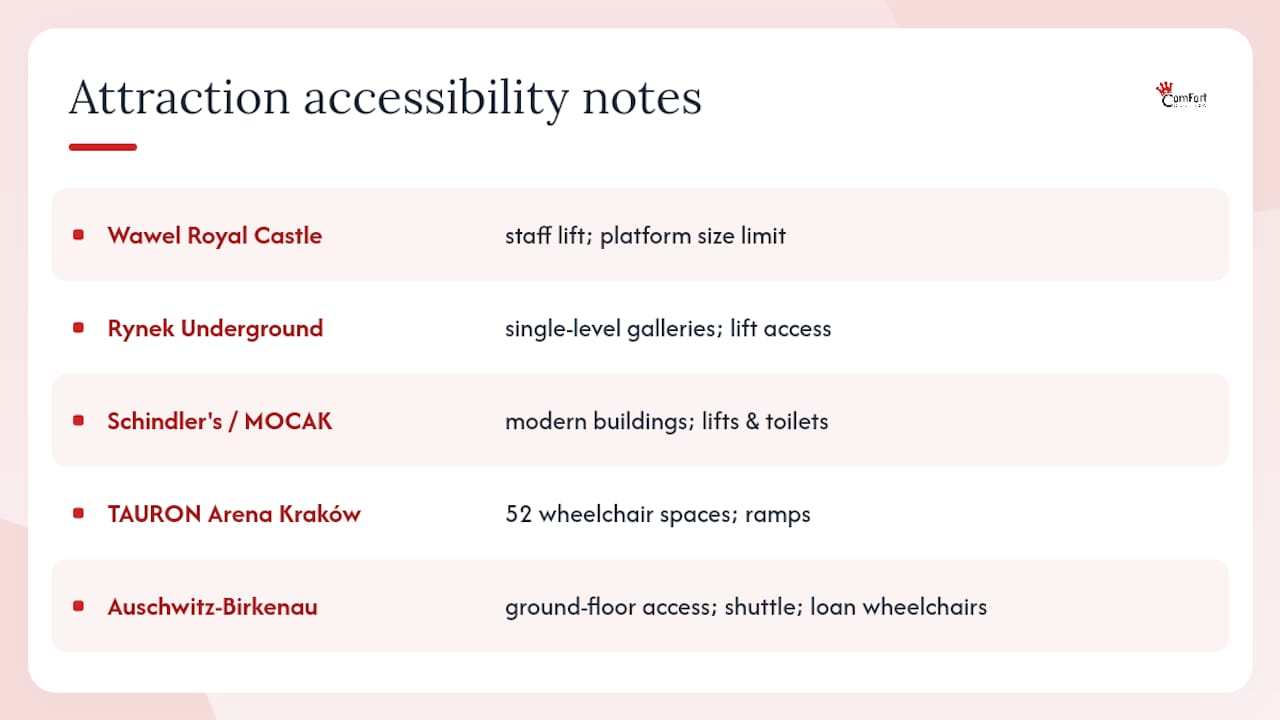
Wawel Royal Castle has a staff-operated external lift to help with the steepest approaches, plus a limited stock of loanable wheelchairs. The catch is the platform lift’s size limit. Wawel’s own guidance notes that approaches to the castle gates are steep and some exhibitions require staff to operate lifts or platforms, so measure your powered chair before you go and email the castle with those figures. Some interior exhibitions and outdoor terraces remain out of reach regardless, so set expectations before you arrive rather than on the day.
Rynek Underground (Muzeum Krakowa) deserves its reputation as an easy win. The museum was constructed from scratch as a modern underground space, with lift access straight from the Cloth Hall and smooth, single-level galleries throughout. It is genuinely one of the better accessible days out in the Old Town, though, as with any building with one working lift, ring ahead to confirm it is running that morning.
Schindler’s Factory Museum and MOCAK pair naturally into one day. Both are modern buildings purpose-fitted with lifts and accessible toilets, and both cover ground that rewards slow, thoughtful visits rather than rushing, which suits wheelchair users who need a bit more time between rooms anyway.
Galicia Jewish Museum and National Museum branches are a mixed bag, and that is the honest answer. Several branches list elevators, accessible toilets and clear routes on the National Museum’s facilities page, but “National Museum” covers multiple separate buildings across Kraków with different histories and different retrofits. Always check the specific branch page before committing a day to it.
Statistic to note: TAURON Arena Kraków lists 52 dedicated wheelchair spaces with adjoining companion seating, alongside ramps, lowered kerbs and staff assistance on request, making it one of the most explicitly quantified accessible venues in the city.
Wieliczka Salt Mine is where good planning pays off most. Adapted visits exist, but they run only during the first and last opening slots of the day, guided in Polish or English, and must be booked in advance by email. Treat this less like buying a standard entry ticket and more like booking an appointment, because that is functionally what it is. Many of the deeper underground chambers on the standard Tourist Route remain inaccessible regardless of which slot you book, so ask specifically what your adapted visit covers.
Auschwitz-Birkenau is accessible on the ground floors of its visitor areas, with a wheelchair-compatible shuttle connecting Auschwitz I and Auschwitz II-Birkenau, and free wheelchairs and walkers available to borrow on site. Conservation limits mean several historic blocks are ground-floor only, and the uneven, largely unpaved historic surfaces mean a companion’s help is often genuinely useful rather than optional. This is one of the clearest examples anywhere in the city of the gap between “the building is accessible” and “the whole visit is accessible.”
Kościuszko Mound offers ramps and lifts that get most visitors most of the way up, with the official accessibility page confirming accessible entrances throughout, though certain smaller exhibits inside have more limited reach.
TAURON Arena Kraków rounds out the list as the most purpose-built modern venue on it, with ramps, lowered kerbs, accessible parking and that dedicated wheelchair seating mentioned above. Seating allocations can shift depending on the event layout, so confirm your specific seat at the point of purchase rather than assuming.
Getting around Kraków without the guesswork
Transport is where UK visitors most often get caught out, mainly because “accessible” transport in Kraków is real but inconsistent from stop to stop and vehicle to vehicle.
- Kraków’s Main Railway Station and a number of tram lines run lifts and low-floor trams, but this varies stop by stop, so check your specific route rather than assuming the whole network is uniform.
- For airport transfers or day trips, always request a ramp- or lift-equipped vehicle by name, and ask exactly where the wheelchair is stored during the journey and whether you remain seated in it while loading.
- Wawel and much of the Old Town sit on a hill with genuinely steep approaches, so agree a specific drop-off point in advance, and ask your driver what the backup plan is if a lift is out of service that day.
- Carry a printed note with your chair’s dimensions in both English and Polish. A Kraków transport accessibility declaration confirms lifts exist at key stations, but a driver who cannot read your requirements in either language cannot help you efficiently.
Pro Tip: If a lift is down at one attraction, have a backup nearby already picked out. Pairing Rynek Underground with Schindler’s Factory or MOCAK means a broken lift costs you an hour, not your whole day.
Sample itineraries for a wheelchair-friendly trip
A well-sequenced trip beats a longer one. Building extra time into each day for staff-operated lifts and scheduled slots at Wieliczka or the Auschwitz shuttle is worth doing from the outset, since both naturally add waiting time you will want budgeted in rather than discovered on the day.
- One day in Kraków: Start at Rynek Underground, move to the Sukiennice’s ground floor for a quick look, then choose either MOCAK or Schindler’s Factory for the afternoon, depending on which era of history interests you more.
- Two days: Day one covers the modern museums above at a relaxed pace. Day two is dedicated entirely to Wawel, with extra time built in for the staff-operated lift and a companion on hand for the steeper approaches.
- Three days: Add a full separate day for either Wieliczka or Auschwitz-Birkenau, with a private transfer booked around your confirmed accessible slot rather than a shared coach that runs to someone else’s schedule.
Never try to combine Wieliczka and Auschwitz in one day. Both demand pre-booked slots at specific times, both involve significant travel from central Kraków, and stacking them all but guarantees you rush one or miss the other’s window entirely.
A local guide’s view on accessible planning in Kraków
A local guide arranges private transfers and tailored itineraries around exactly the friction points covered above: coordinating Wieliczka’s first or last adapted slot, liaising with Wawel staff on lift timing, and checking a client’s chair dimensions against a vehicle before it ever leaves the depot. These are small operational fixes, but they are the difference between a visit that runs on time and one that does not.
The single biggest accessibility failure in Kraków isn’t a lack of lifts. It’s the gap between a venue being technically accessible and a visitor actually knowing, in advance, whether today is the day it works.
Small-group, private arrangements solve this because there is one chair to plan around, not a coachload.
Beyond the tourist trail: everyday accessibility in Kraków
Away from the big-ticket sites, Kraków’s everyday accessibility is genuinely improving but still patchy. The Old Town’s cobbled streets and kerbs are the biggest daily obstacle, particularly around Rynek Główny, where centuries-old paving was never designed with wheelchairs in mind. Newer districts, including much of Kazimierz and the areas around Nowa Huta, tend to have better dropped kerbs and smoother pavements, simply because they were built or renovated more recently.
Public toilets with step-free access exist at most major museums and at the railway station, but standalone accessible public toilets on the street are thinner on the ground than in most UK city centres, so it pays to plan bathroom stops around venues rather than assuming you will find one nearby. Shopping centres like Galeria Krakowska tend to have reliable lifts and accessible facilities, and are a sensible fallback if you need a break from the Old Town’s uneven surfaces.
Trams and buses vary by vehicle age rather than by route, so a low-floor tram might turn up on one journey and an older, stepped one on the next. It is worth building a few minutes of slack into any tram journey for exactly this reason, rather than assuming every vehicle on a given line will be equally accessible.
Finding accessible places to eat near Kraków’s attractions
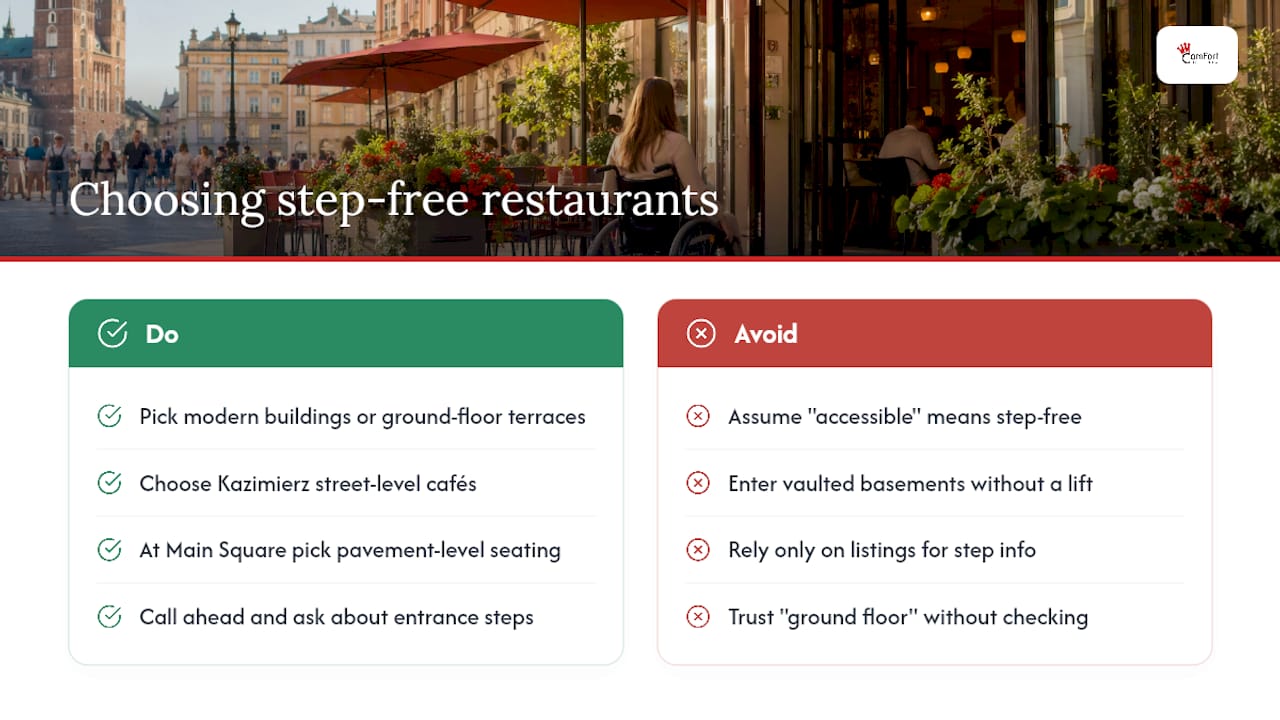
Kraków’s restaurant scene has grown up fast around its main attractions, and step-free access is now common in the newer venues clustered around Kazimierz and the Main Square, even though many of the city’s oldest, most atmospheric cellar restaurants remain genuinely unreachable by wheelchair.
As a general rule, restaurants in modern buildings or with ground-floor terraces are your safest bet. Kazimierz, home to the Galicia Jewish Museum, has a good concentration of street-level cafés and restaurants that suit a stop between museum visits. Around the Main Square, look for venues with outdoor seating at pavement level rather than those tucked into vaulted basements, since basement dining rooms are a Kraków speciality that almost never comes with a lift.
It is always worth calling ahead rather than trusting a listing, because “ground floor” in an old building can still mean a step or two at the threshold. Asking directly whether there is a step at the entrance, rather than asking generally if the place is “accessible,” tends to get you a more honest answer from a busy member of staff.
A knowledgeable guide can suggest a step-free lunch stop that fits your afternoon plans, since local knowledge of which specific doorway has a lip and which does not is hard to get from a listings site alone.
Local support and accessibility resources in Kraków
Beyond individual attractions, a handful of resources are worth having saved on your phone before you land. The city’s own transport authority publishes its accessibility declaration, covering which stations and stops have lifts, which is worth checking again a day or two before travel since works can change things at short notice.
Each major venue’s own accessibility page, rather than general travel forums, is consistently the most reliable source for current information, because lift outages and renovation work get updated there first. Wawel, Auschwitz-Birkenau and Wieliczka all publish dedicated accessibility pages with contact details for advance enquiries, and using those direct emails rather than a general booking line tends to get a faster, more specific answer.
For anything unusual, whether that is a query about loaning a wheelchair, confirming a chair’s compatibility with a specific lift, or adjusting a booked accessible slot, a guided tour operator familiar with the venue can act as a go-between, which is often faster than waiting on a generic customer service queue.
Managing the language gap around accessibility needs
Polish is not always the barrier people expect it to be. Most major venues in Kraków, including Wawel, Auschwitz-Birkenau and Wieliczka, run their accessibility pages and booking correspondence in English, so the practical planning stage is usually straightforward if you use the venue’s own site rather than a translated summary.
The gap tends to show up on the day, at ticket desks or with drivers who have less English than the person who answered your booking email. A translation app such as Google Translate’s camera or conversation mode handles most everyday exchanges well, particularly for reading signage or menus. For anything involving your specific access needs, though, a written note beats a live translation attempt every time, because it removes the chance of a mistranslated word causing confusion about something as important as chair dimensions or medical requirements.
Carrying that short bilingual note mentioned earlier does double duty here: it is both your accessibility reference and your language workaround, and it means a driver or ticket clerk with limited English can still understand exactly what you need without a stumbling conversation.
What UK travellers get wrong about accessible Kraków
Most guides treat Kraków’s accessibility as a single yes-or-no question, and that is the core mistake. The honest answer is that accessibility here is a property of the specific route on the specific day, not of the city or even of a given attraction as a whole. Wawel is neither accessible nor inaccessible; it depends on whether the staff-operated lift is running and whether your chair fits the platform.
The conventional advice, book everything the night before or wing it on arrival, works fine in most European capitals with dense, uniform infrastructure. It does not work well in a city where the biggest draws are a medieval castle, a salt mine and a former concentration camp, each with its own scheduling logic rather than standard walk-up entry.
If I had to give one piece of advice above the rest, it would be this: prioritise the email over the itinerary. Confirm access at Wieliczka and Auschwitz first, build your days around whatever slots you get back, and let the modern museums fill the gaps. That order of operations, not the destinations themselves, is what separates a trip that runs smoothly from one that does not.
— Damian Fort
How ComFort Tours Cracow makes accessible planning easier
Some tour companies specialize in bridging the gap this guide keeps pointing at: the difference between a venue being technically accessible and a visitor actually getting through the door on the day they show up. Small-group and private tours mean one chair to plan around, not a full coach working to someone else’s timetable.
Booking directly means the coordination happens before you land, not on the day. For Auschwitz-Birkenau and the Wieliczka Salt Mine, that means confirming accessible slots and pairing them with a private vehicle rather than a shared transfer, so your day runs on your schedule. For airport or hotel transfers, request a ramp- or lift-equipped vehicle when you book the Cracow airport transfer and send your chair’s exact width, length, height and weight in advance, so the right vehicle turns up the first time. If you would rather explore the Old Town at a relaxed pace with a guide who already knows which doorways have a step and which do not, the small-group Cracow city tours are built around exactly that kind of local detail. Whichever route suits your trip, the full range of Kraków tours is worth a look before you book anything elsewhere, particularly if flexibility around timed accessible slots matters to you.
Sources
- Architectural accessibility – Wawel Royal Castle – official website – tickets, informations, reservations
- Auschwitz-Birkenau Memorial and Museum – accessibility information
- Wieliczka Salt Mine – tourist route accessibility information
- Muzeum Krakowa / Rynek Underground (site overview)
- Facilities in the branches – Muzeum Narodowe w Krakowie
FAQ
Is Kraków wheelchair friendly?
Kraków is partially wheelchair friendly. Modern museums like Rynek Underground and MOCAK offer smooth, level access, while heritage sites such as Wawel involve steep historic approaches that need staff-operated lifts and advance planning.
Is there a wheelchair-accessible tour of Auschwitz?
Auschwitz-Birkenau can be visited by wheelchair users, with a wheelchair-compatible shuttle connecting the two main sites and free wheelchairs available to borrow. ComFort Tours Cracow’s private Auschwitz transport service can coordinate the shuttle and pickup logistics for you in advance.
What is the most wheelchair-friendly city in Europe?
There is no single official ranking, and comparisons vary by source. Within Kraków specifically, purpose-built modern venues like Rynek Underground and TAURON Arena Kraków, which lists 52 dedicated wheelchair spaces, rank among the city’s most consistently accessible options.
What are some activities that are suitable for wheelchair users in Kraków?
Rynek Underground, Schindler’s Factory Museum, MOCAK, the Galicia Jewish Museum and Kościuszko Mound all offer solid step-free or lift-assisted access. Heritage sites like Wieliczka Salt Mine and Auschwitz-Birkenau are also visitable, but only with advance-booked accessible slots rather than walk-up entry.
Do I need to book accessible transfers in advance in Kraków?
Yes. Transfer providers need your chair’s exact dimensions and weight beforehand to send the right vehicle, and ComFort Tours Cracow’s Cracow airport and city transfer service is priced from 100 to 150 PLN one way depending on route, with vehicle details confirmed at booking.