
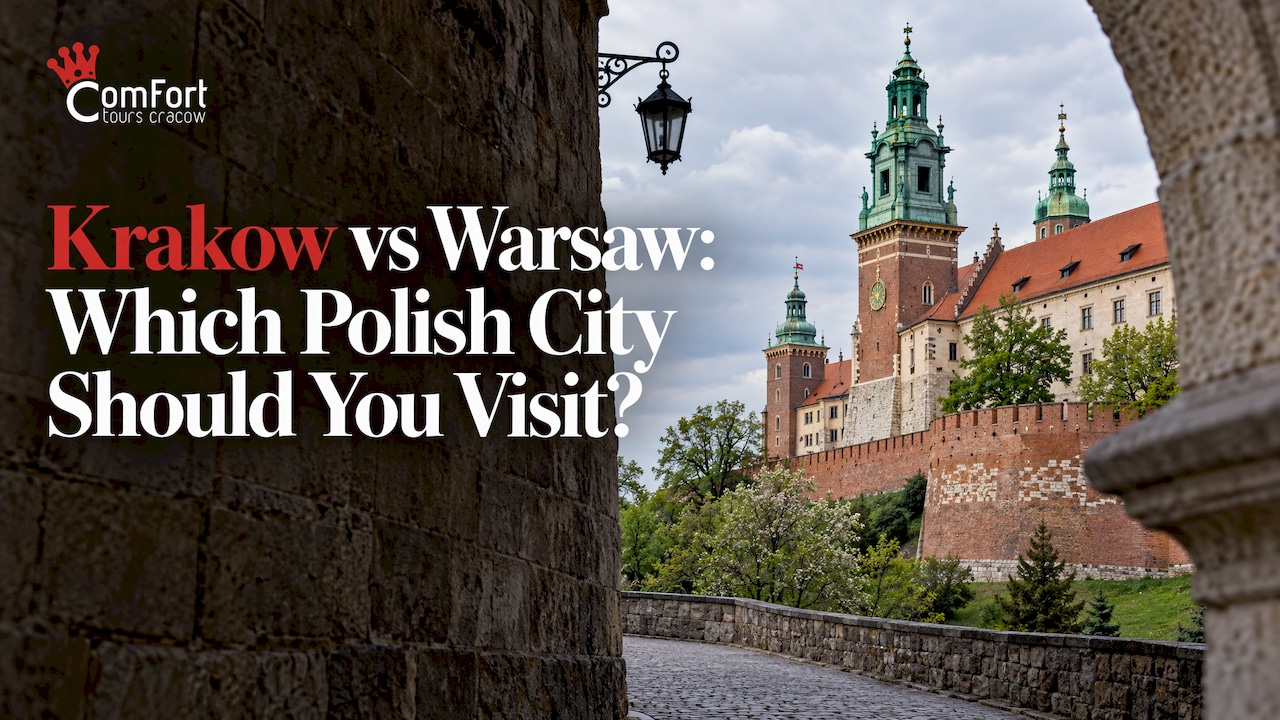
If you have a few days and want storybook streets, an intact medieval centre and sights you can walk between, choose Krakow. If you care most about modern Polish history, big museums and a livelier contemporary scene, choose Warsaw. If you have more than four days, do both: the two cities are linked by a fast train. We live and work in Krakow, so we will tell you where we are biased, and we will also tell you where Warsaw wins.
Key Takeaways
- Krakow is compact, walkable and has an intact historic centre. It suits a first visit of two to four days.
- Warsaw is a sprawling capital with a rebuilt Old Town, serious museums and a modern, creative feel. It rewards visitors who want 20th-century history and contemporary culture.
- Krakow is the base for Auschwitz-Birkenau, Wieliczka Salt Mine and the Tatra Mountains, which are easy day trips.
- The Pendolino train takes roughly 2 hours 20 minutes between the cities, so a combined trip is practical.
- Costs are broadly similar, so let interests and trip length decide, not the budget.
Table of Contents
- The short answer: how the two cities differ
- Which is easier on a short visit?
- History: two very different stories
- Food, nightlife and atmosphere
- Costs: closer than you think
- Day trips: Krakow’s big advantage
- Families, solo travellers and business visitors
- So which should you choose?
- Our perspective
- Make the most of Krakow with us
- FAQ
- Sources
The short answer: how the two cities differ
Think of Krakow as a village-sized city with a grand past, and Warsaw as a capital that rebuilt itself and never stopped moving. Krakow is compact with an intact historic centre, while Warsaw is spread out with a reconstructed centre and contemporary culture. That one difference shapes everything else: how you spend your days, how much you use public transport, and even how you feel at 9 pm.
Lonely Planet’s comparison puts it neatly: Krakow suits travellers who want storied Old Town streets, Wawel Castle and klezmer nights, while Warsaw suits the forward-looking. Both cities have excellent dining, culture and nightlife, so you are not choosing between good and bad. You are choosing between two different moods.
| Krakow | Warsaw | |
|---|---|---|
| Feel | Romantic, medieval, intimate | Big, modern, restless |
| Historic centre | Intact, the Main Market Square at its heart | Rebuilt after WWII, UNESCO-listed |
| Getting around | Mostly on foot | Trams, buses and metro for the spread-out sights |
| Best for | First visits, short breaks, day trips | Museums, 20th-century history, contemporary food and arts |
| Day trips | Auschwitz-Birkenau, Wieliczka, Zakopane, Ojców | Fewer headline excursions |
| Ideal stay | 2 to 4 days | 3 days or more |
Which is easier on a short visit?
Krakow, by a distance. The city centre has kept a regular urban layout since the Middle Ages, with the Main Market Square at its centre, and most first-timer sights sit within a short stroll of it: Rynek Główny, St Mary’s Basilica, the Cloth Hall, Wawel Hill and the lanes of Kazimierz. You can walk from breakfast to dinner without ever checking a map.
Warsaw asks more of you. Its headline sights, such as the Warsaw Rising Museum, the Old Town and the Praga district, are spread across a much larger urban area and usually need public transport or longer walks. That is not a flaw, it is just a different way to travel, and it is why Warsaw needs a little planning.
How long do you need? Lonely Planet’s first-time guide to Poland says two, or ideally three, days is the minimum for a city break in either place. Our own view after years of guiding: in Krakow, three days lets you enjoy the city and still fit in one big day trip. If you only have a weekend, Krakow is the safer choice. Our Krakow 3 day itinerary for first-timers shows how to spend those days without rushing.

History: two very different stories
This is where the choice gets interesting, because the history you want to feel should steer you.
Krakow: the survivor
Krakow is the old royal capital and a much older city than Warsaw in terms of what you can actually see. The centre was not flattened, so you walk through real medieval and Renaissance streets. Visitors can see Rynek Główny, Wawel Castle and Kazimierz all in one compact area. Kazimierz, the former Jewish quarter, tells the story of a community that shaped the city for centuries. If that is your interest, our guide to Jewish Krakow, its synagogues and tours is a good place to start.
Krakow also anchors the Second World War story for many visitors: the former ghetto area, Oskar Schindler’s factory and, an easy trip away, Auschwitz-Birkenau. We have put together a two-day Memory Trail for UK visitors that links these places respectfully and at a sensible pace.
Warsaw: the city that rose again
Warsaw’s Old Town was reconstructed after World War II and is now UNESCO-listed, and the city centre mixes rebuilt historic buildings with later towers. The story here is about destruction and resilience, told through institutions such as the Warsaw Rising Museum and the POLIN Museum of the History of Polish Jews. These are large, absorbing museums. Give each of them a good half day.
So the honest split is this: Krakow lets you walk through history that survived, Warsaw lets you study history that was almost erased. Both are moving, in different ways.
Food, nightlife and atmosphere
Both cities eat very well. In Krakow, you will find cosy cellar restaurants, pierogi, zapiekanki on Plac Nowy and old-school milk bars, all within walking distance of each other. Evenings are atmospheric rather than wild: a glass of wine in a candlelit courtyard, or a folk show with dinner. If you like to eat your way into a city, our piece on whether a Krakow food tour is worth it will help you decide.
Warsaw is the bolder, more experimental table. It has a varied food scene, including the Hala Gwardii food hall, and Praga has a creative, independent feel. If you enjoy exploring neighbourhoods through their cafés and markets, the ideas in this piece on local cuisine in tourism fit Warsaw’s food halls and Praga especially well.
In short: Krakow for charm after dark, Warsaw for variety and a younger, more creative buzz.
Costs: closer than you think
Many people assume one city is far cheaper. In practice, they are close. Krakow is often described as slightly pricier for accommodation in the busy season, and Warsaw can edge ahead in some categories, so do not choose on money alone. Check current hotel rates for your own dates, as they swing with events and seasons.
One thing we can state precisely is Krakow’s public transport. From 2 March 2026, a normal single ticket costs 6 PLN, a 24-hour Zone I ticket 20 PLN, a 48-hour ticket 40 PLN and a 72-hour ticket 55 PLN. Most visitors barely need it, because the centre is walkable. The city publishes its official ticket tariff if you want to check the current rules.
A practical safety note for both cities: the UK Foreign, Commonwealth & Development Office advises that you keep valuables out of sight in crowded areas, tourist spots and main rail stations, avoid unofficial taxis and validate public transport tickets at the start of your journey. That last point catches out many first-timers, so punch your ticket as soon as you board.

Day trips: Krakow’s big advantage
This is where Krakow pulls ahead for most visitors. From the city you can reach, in a single day:
- Auschwitz-Birkenau, the memorial and museum that many people travel to Poland to see. Read our Auschwitz visiting guide before you go.
- Wieliczka Salt Mine, with its underground chapels carved from salt. See our Wieliczka Salt Mine guide.
- Zakopane and the Tatra Mountains, for hiking, thermal pools and mountain air. Our Zakopane day trip itinerary helps you choose between town and mountain.
- Ojców National Park, a gentler day of limestone cliffs and castles.
Warsaw has pleasant excursions too, but nothing with quite this pull. Another source agrees that Krakow is preferable for a stay of five days or fewer, or if you want Auschwitz-Birkenau and mountain excursions, while Warsaw is preferable for WWII and Jewish-history museums, nightlife and contemporary city life.
Families, solo travellers and business visitors
Families. Krakow’s compactness is a gift with children: short distances, the Dragon’s Den under Wawel, horse-drawn carriages on the Market Square and easy day trips. Warsaw’s interactive museums can be great for older children, but you will cover more ground by tram or metro. If you need step-free routes, our wheelchair accessible Krakow guide covers the practicalities.
Solo travellers. Krakow is easy to settle into alone. The centre is lively, the walking routes are simple and small-group tours make it easy to meet people. Warsaw suits solo travellers who like to wander, visit museums at their own pace and explore neighbourhood by neighbourhood.
Business visitors. Warsaw is the capital and the larger business hub. Krakow is a popular choice for team events and incentive trips, thanks to its atmosphere and the range of things to do within an hour. If you are organising a group, we can help with conference and private driver transport.
So which should you choose?
Use this quick decision guide:
- First time in Poland, two to four days: Krakow. GoPoland recommends Krakow for a first visit of three or four days because it is compact, medieval and walkable.
- Museums and modern Polish history are the main purpose: Warsaw. Warsaw is the better choice when substantial museums and modern Polish history are the main purpose.
- Auschwitz-Birkenau, salt mines or mountains on the list: Krakow, as your base.
- Romantic city break: Krakow.
- Contemporary food, street art and nightlife: Warsaw, with Praga as your neighbourhood.
- More than four days: both. The Pendolino links Krakow Główny and Warsaw Centralny in roughly 2 hours 20 minutes, so you lose very little time.
If you combine them, give Krakow the longer share of your stay and finish with Warsaw’s museums, or start in Warsaw and end somewhere quieter. Both orders work.
Our perspective
We are a family-run team in Krakow, so yes, we are fond of this city. But after years of showing visitors around, we have noticed something simple: people remember Krakow because they could feel it. You step out of the hotel, and within minutes you are standing in a square that has been a meeting place for centuries.
That is why we keep our groups small. Krakow’s stories are best told quietly, in a courtyard in Kazimierz or on the street outside Schindler’s factory, not shouted over a crowd. A small group means you can ask the questions that matter to you, and your guide can slow down when a place deserves it.
We also know that a short trip is precious. Most of our guests want one big excursion, such as Auschwitz-Birkenau or the Wieliczka Salt Mine, plus time to wander. We arrange private transport, hotel pickup and flexible itineraries so the logistics disappear and you can simply be there. Warsaw is a fascinating city, and we would happily send anyone with a long break to see it. But if you ask us where to start with Poland, we will say Krakow, every time.
Damian Fort
Make the most of Krakow with us
If Krakow wins your vote, we would love to show you around. We run small-group and private guided tours in and around the city, including Auschwitz-Birkenau with transport and hotel pickup, the Wieliczka Salt Mine, Zakopane and the Tatras, Jewish Kazimierz, Nowa Huta and Schindler’s Factory. Our guides speak several languages, and we can tailor an itinerary to your interests, whether you are travelling as a family, solo or as a group.
Browse all of our tours on the ComFort Tours Cracow website, see our Krakow city tours or read about Krakow walking tours. Arriving by air? Our airport transfer between Krakow and the airport is priced at 100-150 PLN one-off.
FAQ
Is Krakow or Warsaw better for a first visit to Poland?
For most first-timers, Krakow. Its historic centre is intact, its main sights are close together, and it is the starting point for trips to Auschwitz-Birkenau, Wieliczka and the Tatra Mountains. Warsaw is the stronger pick if museums and modern history are your priority.
How many days do I need in each city?
Plan on at least two, preferably three, days in either city, in line with Lonely Planet’s guidance. In Krakow, add a day if you want to include a day trip. In Warsaw, add time for the large museums and the sights that are spread across the city.
Can I visit both Krakow and Warsaw on one trip?
Yes. The fast Pendolino train takes about 2 hours 20 minutes, so a combined trip is practical with four or more days. Book your train in advance and check the current timetable with the operator.
Which city is more expensive?
They are close, and prices depend heavily on season and dates. Compare hotel rates for your own travel dates rather than relying on a general rule. In Krakow, a single public transport ticket costs 6 PLN from 2 March 2026, and many visitors walk most of the time.
Is Krakow safe for tourists?
Both cities are popular with visitors, and the usual city precautions apply. The UK FCDO advises keeping valuables out of sight in crowded places, avoiding unofficial taxis and validating transport tickets when you start your journey.
Sources
- Warsaw vs Kraków: Which Polish City Suits Your City Break?
- Warsaw vs Kraków: which Polish city will win your heart? (Lonely Planet)
- Krakow vs Warsaw (The Poland Guide)
- Kraków Travel: Main Market Square
- A first-time guide to Poland (Lonely Planet)
- Nowa taryfa biletowa ZTP (Fakty Krakowa)
- Karta Krakowska: Taryfa biletowa
- Safety and security: Poland travel advice (GOV.UK)
- Kraków vs Warsaw 2026 (GoPoland)
- Warsaw vs Kraków: Which Polish City Should You Visit? (Warsaw-Trip)
- Krakow or Warsaw? Costs, Sights and UK Flights (TravelFieldBook)
- The Role of Local Cuisine in Tourism: A Traveler’s Guide