
The Morskie Oko hike is a 9 km one-way trail in Poland’s Tatra Mountains, gaining 500 meters of elevation from the trailhead at Palenica Białczańska to one of the most spectacular alpine lakes in Central Europe. The route is moderately challenging, accessible to hikers with average fitness, and open year-round, though winter conditions demand serious preparation. A full day including breaks runs 5–9 hours. This guide covers everything you need to plan a safe, rewarding visit in 2026.
What to expect on the Morskie Oko trail: route details and terrain
The trail begins at Palenica Białczańska, the only legal starting point for hikers. From there, a paved road climbs steadily for 9 km before transitioning to a rocky path for the final 0.5 km to the lake shore. The pavement makes the route stroller-friendly for most of its length, but do not mistake “paved” for “easy.” The steady 9 km gradient is physically taxing, and fatigue builds well before any technical difficulty appears.
Trail stage summary
| Stage | Distance | Terrain | Elevation change | Duration |
|---|---|---|---|---|
| Palenica Białczańska to Wodogrzmoty Mickiewicza | 2.5 km | Paved road | Gradual ascent | ~45 min |
| Wodogrzmoty Mickiewicza to Włosienica clearing | 4.5 km | Paved road | Steady climb | ~60 min |
| Włosienica to mountain hut at Morskie Oko | 2 km | Paved, then rocky | Steeper ascent | ~35 min |
| Descent total | 9 km | Same route | 500 m down | ~1h 50m |
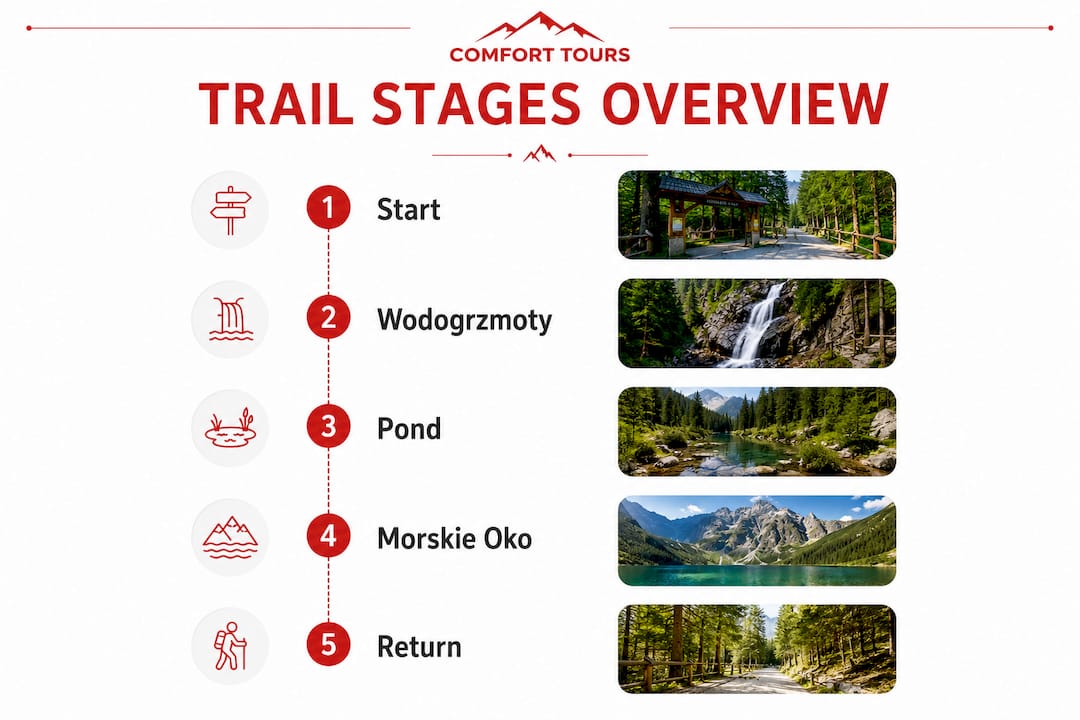
Key landmarks break the climb into natural rest points. The Wodogrzmoty Mickiewicza waterfalls appear roughly 2.5 km in and offer a genuine reason to stop. The Włosienica clearing sits at the midpoint and marks where horse-drawn carriages turn around. The mountain hut at the lake sells hot food and drinks, which matters after a two-hour climb.
The descent deserves as much respect as the ascent. The downhill return stresses the knees significantly, especially on the long paved sections. Trekking poles reduce that strain considerably.
How to prepare for the Morskie Oko hike: gear, timing, and logistics
Good preparation separates a great day on the trail from a miserable one. The most common mistake hikers make is underestimating the physical demand of 18 km round-trip on a paved incline. Proper gear and early timing fix most problems before they start.
Essential gear checklist
- Footwear: Broken-in hiking boots or trail shoes with ankle support. Sneakers cause blisters and ankle rolls on the rocky final section.
- Trekking poles: Optional in summer, strongly recommended for the knee-heavy descent.
- Water: Carry at least 1.5 liters. The mountain hut sells drinks, but you will want water on the climb up.
- Food: Pack lunch or snacks. The hut is popular and can have long lines during peak season.
- Layers: Mountain weather shifts fast. A waterproof shell and a mid-layer cover most summer scenarios.
- Sun protection: Sunscreen, sunglasses, and a hat. The open paved road offers little shade.
- Headlamp: Required if there is any chance you finish after dark.
Timing and logistics
Starting between 8 and 9 AM at Palenica Białczańska is the single most effective way to avoid parking chaos and trail crowding. Tatra National Park requires advance online parking reservations during peak periods. Arriving without a reservation can mean being turned away even at dawn. Purchase entry tickets online as well to skip the ticket line entirely.
Hikers traveling from Krakow can reach Zakopane by bus or train in roughly two hours, then take a local bus or taxi to Palenica Białczańska. Comforttours offers a full-day guided trip from Krakow to the Tatra Mountains that handles all transport logistics, which removes the parking problem entirely.
Pro Tip: Book accommodation in or near Zakopane the night before. Starting from Zakopane rather than Krakow saves 90 minutes of travel and lets you hit the trailhead by 8 AM without a predawn wake-up.
In 2026, horses travel a reduced 2.5 km route from Palenica to Wodogrzmoty Mickiewicza, and electric buses are planned for parts of the route to reduce congestion. These changes improve flow on busy summer weekends.
How does the Morskie Oko hike change in winter?
Winter transforms the trail completely. The paved road becomes an icy corridor, and the same surface that makes summer hiking straightforward turns into a serious hazard. Winter hiking adds 30–60 minutes to the total time due to ice and snow. That means a full winter day on the trail runs 6–10 hours, which matters enormously given shorter daylight hours.
Winter gear you cannot skip
- Microspikes (raczki): Standard safety equipment for every winter visitor. Slip-on traction devices attach to regularly hiking boots and prevent falls on icy pavement.
- Crampons: Needed for harder ice conditions, particularly later in the season.
- Headlamp: Non-negotiable. Starting after 9 AM in december or january risks a return in full darkness.
- Thermos: Hot drinks matter at altitude in cold temperatures.
- Layered clothing: A moisture-wicking base layer, insulating mid-layer, and waterproof shell is the standard system.
- Goggles or glacier glasses: Bright snow reflection causes eye fatigue on clear days.
Winter safety warning: The Żleb Żandarmerii avalanche zone crosses the trail directly. TOPR, Poland’s mountain rescue service, advises checking avalanche bulletins before every winter visit. The trail closes when avalanche risk is high. Ignoring a closure is not a calculated risk. It is a preventable danger.
Many hikers underestimate winter risks on paved trails precisely because the surface looks familiar. The trail’s paved nature creates a false sense of security. Ice on a smooth road surface is more dangerous than loose rock on a mountain path, because there is nothing to grip. Slipping on the icy paved road is the most common cause of winter injuries on this route.
Pro Tip: Check both the Tatra National Park (TPN) website and the TOPR avalanche bulletin the morning of your hike. Conditions change overnight. A clear forecast the evening before does not guarantee a safe trail at 8 AM.
What are the scenic highlights and side trips from Morskie Oko?
The lake itself is the reward. Morskie Oko sits at 1,395 meters elevation with a surface area of 34.93 hectares. The view from the mountain hut terrace takes in the full lake and the face of Rysy, Poland’s highest peak at 2,499 meters. On clear days, the reflection of the surrounding peaks on the water is the kind of view that justifies every step of the climb.
A walking trail circles the entire lake and takes roughly 45–60 minutes at a relaxed pace. The path is mostly flat and offers changing perspectives on the surrounding ridgeline. Most hikers do this loop before or after lunch at the hut.
Extended hiking options
- Czarny Staw pod Rysami: A second alpine lake sitting 300 meters above Morskie Oko. The trail up is steep and rocky, adding roughly 1.5–2 hours to the day. The views from the upper lake are even more dramatic, with Rysy looming directly overhead.
- Five Polish Lakes Valley (Dolina Pięciu Stawów Polskich): A longer extension requiring a full separate day or an overnight stay at the valley shelter. This is one of the best hikes in the Tatras for experienced hikers who want true alpine terrain.
- Rysy summit: Poland’s highest peak is accessible via a marked trail from Czarny Staw. This is a serious mountain route requiring experience, proper gear, and an early start. Not suitable as a same-day addition to the Morskie Oko walking route for most hikers.
The Morskie Oko trekking experience rewards those who pace themselves. Rushing the ascent to reach the lake quickly leaves nothing in reserve for the lake loop, the descent, or any side trip. Treat the climb as the experience, not just the approach.
Key Takeaways
The Morskie Oko hike rewards prepared hikers with one of Poland’s most spectacular alpine views, but early starts, proper footwear, and seasonal gear are non-negotiable for a safe and enjoyable day.
| Point | Details |
|---|---|
| Trail distance and time | The route is 9 km one-way with 500 m elevation gain, taking 2h 20m up and 1h 50m down. |
| Start early | Arrive at Palenica Białczańska by 8–9 AM to avoid parking issues and finish in daylight. |
| Book parking in advance | Tatra National Park requires online reservations during peak periods; no reservation risks being turned away. |
| Winter demands extra gear | Microspikes, a headlamp, and layered clothing are required; check TOPR avalanche bulletins before every winter visit. |
| Side trips add serious time | Czarny Staw adds 1.5–2 hours; the Five Polish Lakes Valley requires a full separate day. |
Why the Morskie Oko trail surprised me every single time
I have walked this trail in july heat, october fog, and february ice, and it has never felt the same twice. The first thing that surprises most people is how much the paved road deceives them. They see asphalt and think “easy walk.” By kilometer 6, their feet are burning and their knees are asking questions. The trail does not punish you with technical difficulty. It punishes you with relentless, steady effort.
The single piece of advice I give every hiker before this route is to slow down in the first hour. The temptation to move fast on a flat-looking paved road is strong. Resist it. The people who arrive at the lake feeling good are always the ones who held back early. The ones who push hard at the start are the ones sitting on rocks at kilometer 7, wondering if they made a mistake.
Winter visits are a different category entirely. I have seen hikers in sneakers and jeans attempting this trail in january. Some make it. Many do not, and the ones who turn back are the lucky ones. The Żleb Żandarmerii avalanche zone is not a theoretical risk. It is a real, mapped hazard that closes the trail every season. Respect it.
The lake view from the hut terrace is worth every step. Rysy reflected in still water on a clear morning is one of those images that stays with you. The Morskie Oko scenic views are not just pretty. They feel earned.
— Damian Fort
Guided Tatra Mountain tours with Comforttours
Planning the logistics of a Tatra Mountains visit from Krakow takes real effort. Parking reservations, early starts, transport connections, and seasonal conditions all need to line up. ComFort Tours Cracow handles all of it.

ComFort Tours Cracow runs small-group guided tours to the Tatra Mountains from Krakow, including access to the Morskie Oko trail area. Every tour includes private transport, a knowledgeable local guide, and a tailored itinerary built around your group’s pace and interests. For winter visitors, the Zakopane Tatra Mountains experience adds regional culture and mountain scenery to the day. Skip the parking stress and arrive at the trailhead ready to hike.
FAQ
How long is the Morskie Oko hike?
The trail from Palenica Białczańska to Morskie Oko is 9 km one-way, with a total round trip of 18 km. Including breaks, most hikers spend 5–9 hours on a full day trip.
Is the Morskie Oko trail suitable for beginners?
The trail is accessible to hikers with moderate fitness. The paved surface makes it manageable, but the 9 km steady incline and 500 m elevation gain require good endurance and proper footwear.
Can you hike Morskie Oko in winter?
Yes, but winter conditions add 30–60 minutes to the total time and require microspikes or crampons, a headlamp, and layered clothing. Always check TOPR avalanche bulletins before a winter visit, as the trail closes during high avalanche risk.
How do you get to Morskie Oko from Krakow?
Travel from Krakow to Zakopane by bus or train, then take a local bus or taxi to Palenica Białczańska. Comforttours also offers guided day trips with private transport directly from Krakow.
Do you need to book parking for Morskie Oko in advance?
Tatra National Park requires advance online parking reservations during peak periods. Arriving without a reservation can result in being turned away, even early in the morning.