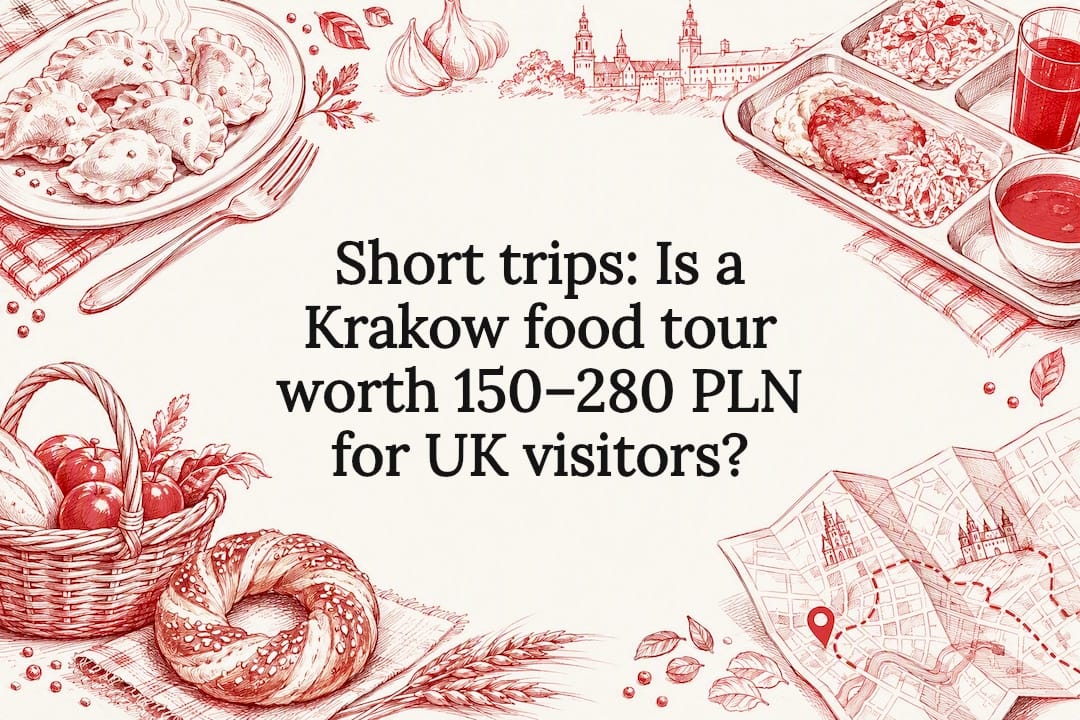
For first-time visitors and short stay travellers in Krakow, a good food tour condenses the experience of local eating and provides access that might be difficult independently, adding cultural context to the meal. The catch: quality swings wildly, so pick one with named venues, small groups, and guides known for storytelling, not just feeding you.
TL;DR:
- Small-group tours capped at 8 to 12 participants offer better interaction and a more personalized experience than larger groups of 20 or more.
- Most quality tours include 6 to 10 tastings over 2.5 to 4 hours at specified venues like milk bars, pierogarnie, and market stalls, with drinks usually paid separately.
- Tour prices range from 150 to 280 PLN for groups, covering food, while private tours start around 400 PLN for two, offering more flexibility and route customization.
- Booking early is essential in peak summer months, and verifying specific stops, venue names, and dietary accommodations beforehand prevents disappointment.
- The best tours combine storytelling, cultural context, and curated stops at reputable venues rather than just general restaurant rotations.
Table of Contents
- What does a good Krakow food tour actually include?
- Who actually gains value from a Krakow food tour?
- How do you pick a good food tour and avoid the duds?
- What does a Krakow food tour cost, and is it good value?
- What are the practical, dietary and accessibility considerations?
- What do reviews and testimonials actually say about Krakow food tours?
- How do Krakow food tours compare with similar tours elsewhere?
- Are food tours in Krakow safe and hygienic after the pandemic?
- What kind of group and atmosphere should you expect?
- Why we recommend a food tour as an orientation activity
- Book a Krakow food tour built around small groups and real stories
- Sources
- FAQ
What does a good Krakow food tour actually include?
A quality Krakow food tour runs 2.5 to 4 hours and covers between four and ten tasting stops, depending on format and price. That range comes from how operators structure their routes. A shorter street-food crawl might hit four or five stalls; a comprehensive afternoon tour typically pushes past eight, ending with something warming like a vodka flight or a craft beer pour.
The stops themselves follow a fairly consistent pattern across reputable operators, and knowing that pattern helps you judge a listing before you book:
- A milk bar (bar mleczny), the Communist-era canteen style still serving cheap, hearty Polish staples
- A pierogarnia for a proper pierogi tasting, usually several varieties
- Street food from Plac Nowy, Kazimierz’s round market square known for zapiekanka (open-faced baguette pizza)
- Obwarzanek vendors, the twisted bread rings sold from carts across the Old Town
- A market stall stop for pickles, cured meats, or seasonal produce
- A closing tasting at a vodka bar or craft beer spot
A typical quality Kraków food tour covers exactly this range, six to ten stops in 2.5 to 4 hours, for roughly 150 to 280 PLN. What that price includes matters as much as the stop count. Food tastings are almost always covered. Drinks beyond a single tasting pour, and any “extra” dish you order on the side, usually are not, so check the listing rather than assuming an open bar.
Group size shapes the whole experience more than most people expect. A tour capped at 8 to 12 people lets the guide actually talk to you, answer questions mid-bite, and negotiate a proper table at a cramped milk bar. Push that number to 20 or more and you are mostly queuing, listening to a guide project over a crowd, and eating standing up. If a listing does not mention a cap, assume it is large.
Who actually gains value from a Krakow food tour?
Not every traveller needs one, and being honest about that is part of giving good advice. Here is who tends to get real value, roughly in order of how strong the case is:
- First-time visitors with two or three days in the city. A single comprehensive tour can cover ground that would otherwise take a full extra day of independent exploring, which matters enormously when your whole trip is short.
- Solo travellers. Eating alone at a milk bar, where you order at a counter in Polish-heavy signage, is a small but real friction point. A guide removes it and adds company for a few hours.
- Travellers who want context, not just calories. If you actually want to understand why milk bars exist or what a particular pierogi filling signals about the region, a guide who treats food as an anchor for history delivers something a menu never will.
- Groups wanting a lively evening. Tipsy or evening tasting formats lean social, built around shots and atmosphere rather than deep cultural explanation, and suit party-minded groups better than solo cultural travellers.
Who can reasonably skip it? Locals, obviously, and travellers with genuine food expertise who already know how to navigate a milk bar queue and order zapiekanka without a translation crutch. Strict budget travellers can also do well eating the same venues independently for a fraction of the cost, provided they are comfortable with a bit of awkward pointing and Google Translate.
The trade-off is straightforward: you are paying for curated access, sequencing, and explanation. You give up some freedom and a chunk of the savings you would get eating solo. For a short trip, that trade usually favours the tour. For a longer stay where you can explore at leisure, it favours going it alone, at least for some meals.
How do you pick a good food tour and avoid the duds?
Most disappointing food tours share the same warning signs, and they are visible in the listing before you ever book. Vague language is the biggest one. If a description says “tastings at local favourites” without naming a single venue, milk bar, or square, that vagueness is often hiding a rotation of tourist-facing restaurants rather than the real spots locals actually queue at.
Run any listing through this checklist before paying:
- Named venues. Look for specific mentions of a milk bar, Plac Nowy, or a named pierogarnia, not just “traditional Polish food.”
- Group size cap. Anything advertising 8 to 12 people is a good sign; anything silent on group size, or openly running 20-plus, is a caution flag.
- Explicit stop count. A clear list of six to ten tastings beats a fuzzy “multiple tastings” promise.
- Review language about the guide. Reviews that mention the guide’s stories, jokes, or historical asides are worth more than reviews that only praise the food. The best-value tours pair five or more distinct stops with an experienced guide, and operators with weaker guiding tend to just walk you between restaurants with little context.
- Clear inclusions and exclusions. A good listing states plainly whether drinks are included and what tipping looks like.
Booking timing matters more than most guides admit. During June to August, popular tours can sell out three to seven days ahead, so book early if your dates fall in peak summer. Outside that window, same-week booking is usually fine. Whatever the season, message the operator about dietary restrictions before paying, not after confirmation.
Pro Tip: Before booking, message the operator one direct question: “Which milk bar and which market stalls are on the route?” A confident, specific answer separates a genuine local operator from a reseller running a generic restaurant crawl.
Ask about the refund policy, whether the menu flexes for allergies, and the exact meeting point before you pay. A tour that cannot answer those three questions clearly is not one worth your evening.
What does a Krakow food tour cost, and is it good value?
Group food tours in Krakow typically run 150 to 240 PLN per person, roughly £30 to £48 at current exchange rates, for a 2.5 to 4 hour experience. Private tours start around 400 PLN for two people and scale from there depending on group size and route customisation.
In numbers: A standard group food tour costs 150 to 280 PLN (around £30 to £56) and covers 6 to 10 tastings across 2.5 to 4 hours, according to a Kraków food tours guide. Private options begin near 400 PLN for two people, per Tour Verdict’s 2026 pricing breakdown.
That price almost always covers the food tastings themselves. Drinks are the variable. Some tours bundle a beer or vodka pour into the final stop; most charge separately for anything beyond that single tasting. Tipping is not built into the price and is left to your discretion, which we cover in the next section.
Is it good value against eating the same spots yourself? Financially, no, DIY is always cheaper. A milk bar meal alone might cost you 15 PLN. But the tour price buys three things independent exploring does not: a sequenced route that avoids dead time, a guide who can order and explain unfamiliar dishes, and access to context you would not get from a menu translated by phone. For a short trip, that combination tends to be worth the premium.
Private tours become genuinely cost-effective once you have four or more people. Split 400 PLN or more across four travellers and the per-head cost lands close to a standard group tour, but you get flexible timing, a route built around your interests, and no waiting on strangers who show up late.
What are the practical, dietary and accessibility considerations?
Most Krakow food tours involve two to three kilometres of walking across cobbled streets in the Old Town and Kazimierz, so comfortable shoes matter more than anything else you pack. Skip a heavy breakfast; the tastings add up faster than they look on paper, and you will want the appetite for the closing stops.
Dietary accommodation is generally workable but needs advance notice. Vegetarian requests are almost always manageable given how many Polish dishes are naturally meat-free (potato pierogi, certain soups). Vegan and coeliac requests are harder, since pierogi dough and many traditional dishes contain gluten and dairy by default, so flag these when you book rather than on the day.
Accessibility realities are worth stating plainly. Milk bars often have basic, cramped seating with little room for wheelchairs or mobility aids, and Kazimierz’s pavements are uneven in places. If mobility is a concern, ask the operator directly whether the route can be adapted or shortened before booking.
A few etiquette notes make the tasting stops smoother:
- Vodka tastings usually follow a shot-and-chase custom; you are never obligated to finish a pour.
- Tipping guidance for guides sits around 15 to 20 PLN per person for a standard group tour.
- Watch for drinks ordered outside the included tasting. They are the most common source of an unexpectedly higher bill.
Pro Tip: If you have a significant dietary restriction, ask for the exact menu items in writing before you pay, not a general “we can accommodate” reply. Vague reassurances often mean the operator will improvise on the day.
What do reviews and testimonials actually say about Krakow food tours?
Genuine satisfaction on well-run Krakow food tours tends to cluster around a specific theme: reviewers praise the guide’s storytelling and historical framing at least as often as they praise the food itself. That pattern matters because it signals the tour is delivering cultural context, not just a meal ticket disguised as an activity.
The most common criticism runs the other way. Travellers who book a cheap, high-volume tour often report that the guide simply walked the group between restaurants with little explanation, effectively presenting food without context. That gap in guiding is exactly what separates a memorable afternoon from one that felt like a slightly expensive queue for lunch.
A secondary complaint worth knowing about is portion size. Because a tour packs in six or more stops, individual tastings are deliberately small, and some reviewers arrive expecting full meals at each stop rather than samples. Reading the stop count in advance sets the right expectations.
Group size complaints appear consistently too. Reviews of tours with 20 or more participants mention crowding, difficulty hearing the guide, and rushed stops, while smaller groups of eight to twelve draw far more positive feedback about pacing and personal attention.
How do Krakow food tours compare with similar tours elsewhere?
Krakow’s food tour market sits in a distinctive middle ground compared with cities like Prague or Budapest, both popular add-ons to a Central European trip. Prices are broadly similar across the three cities, but Krakow’s milk bar tradition gives its tours a genuinely unique anchor stop that neither Prague nor Budapest can replicate, since bary mleczne are a specifically Polish institution.
Within Krakow itself, the real comparison is not city versus city but format versus format. A 2.5 hour street-food crawl and a 4 hour comprehensive tasting tour target different appetites, literally and figuratively, and comparing their per-hour value only makes sense once you decide which experience you actually want. A short crawl through Plac Nowy suits travellers with limited time; a longer comprehensive tour suits anyone treating the food tour as their main cultural activity for the day.
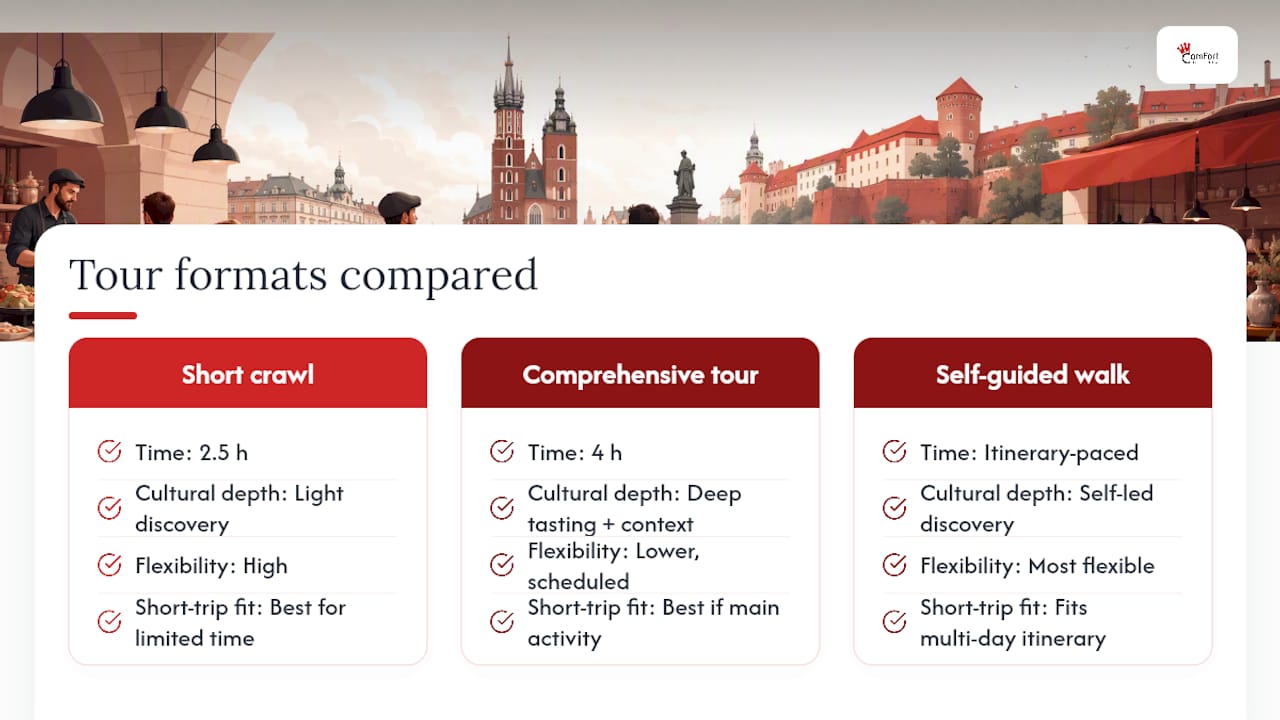
Compared with a self-guided walk covered in a Krakow 3 day itinerary for first-timers, a guided tour front-loads the discovery work. You get the same venues faster, with explanation attached, at a price premium that reflects the guide’s time and local knowledge rather than the food itself.
Are food tours in Krakow safe and hygienic after the pandemic?
Hygiene standards at Krakow’s established food tour venues, milk bars, market stalls, and sit-down pierogarnie, generally follow the same food safety regulations as any licensed Polish food establishment, regardless of tour involvement. Reputable operators source from the same regulated venues locals eat at daily, rather than pop-up stalls with looser oversight.
Group size again plays a quiet role in perceived safety. Smaller groups of eight to twelve naturally allow more spacing at counters and tables than a crowd of twenty pressed into a small milk bar. If crowding concerns you, that is one more reason to prioritise operators who publish a group cap.
Outdoor stops, obwarzanek carts, Plac Nowy stalls, carry the lowest exposure risk simply by being outside and quick. Indoor stops involve more time in enclosed spaces, though this is no different from dining in any Krakow restaurant independently. If you have specific health concerns, asking the operator about ventilation or seating arrangements at indoor stops before booking is reasonable and most established companies will answer directly.
What kind of group and atmosphere should you expect?
Krakow food tour groups skew heavily towards couples and small groups of friends in their late twenties through fifties, with a noticeable seasonal shift towards families during UK school holidays. Solo travellers are common enough that operators rarely make you feel out of place joining alone.
The atmosphere depends entirely on format, which is worth checking before you book if social fit matters to you. Daytime cultural tours tend to run calmer and more conversational, better suited to travellers prioritising explanation over energy, while evening tipsy tours lean social and performative, built around shots and a livelier group dynamic that suits travellers looking for a fun night out over deep cultural context.
Language is rarely a barrier on tours themselves, since guides run in English by design, but it is worth knowing going in that English fluency among Krakow’s older service staff outside tourist-facing venues can be patchy. That is precisely where a guide’s presence smooths things over at milk bar counters and market stalls you would otherwise navigate alone.
Nationality mix tends to be broad rather than dominated by any one country, largely because Krakow draws a wide spread of European and North American short-break visitors. If you are hoping to specifically meet other British travellers, a food tour is not the reliable route to that; it is a route to meeting whoever else booked that day.
Why we recommend a food tour as an orientation activity
The strongest argument for a Krakow food tour has nothing to do with food quantity and everything to do with orientation. Give a first-time visitor three hours with a good guide and they leave understanding the city’s rhythm, its Communist-era food culture, its Jewish quarter history, in a way that three hours of solo wandering rarely achieves.
The milk bar stop is the clearest example. Walk into a bar mleczny alone and you face a counter system, cash-only signage, and a queue etiquette that assumes you already know the drill. A guide removes that friction entirely and, more importantly, explains why the place still exists, turning a confusing lunch stop into the most memorable part of the afternoon for many visitors.
Not every tour delivers this. The difference between a guide who narrates history and one who just points at plates is the entire difference in value discussed throughout this piece. That gap is real, and it is exactly why the checklist above matters more than the price tag.
— Damian Fort
Book a Krakow food tour built around small groups and real stories
Some local tour operators run small-group experiences built around criteria such as curated stops rather than generic restaurant rotations, guides who treat food as a way into the city’s history, and group sizes kept deliberately manageable so you actually get to ask questions mid-tasting. If you have read this far wanting proof that a tour can deliver storytelling and not just a queue of plates, that is the standard we build towards.
Our Cracow local city tours fold food and culture together rather than treating them separately, and dietary notes are handled at booking so nothing gets missed on the day. If you would rather explore Krakow’s creative side alongside its food scene, our street art trail makes a strong pairing for a second day in the city. For groups of four or more, private tours often offer more flexibility with timing and route options.
Check available dates and book a tour directly through our booking page, and you will get a confirmation with your exact meeting point, stop list, and any dietary arrangements already noted.
Sources
The price bands, stop counts, and format guidance in this article draw on a detailed Kraków food tours guide, which breaks down typical inclusions and durations across operators. Pricing comparisons and private tour thresholds come from Tour Verdict’s 2026 review of Krakow food tour value. Group size and guide quality benchmarks reference a Kraków food tour review comparing operators directly.
For a broader view of what defines a genuine culinary experience beyond Krakow specifically, Wild Foodz’s traveller guide offers useful context on curation and storytelling as value drivers. Readers planning their wider trip may also find our best pierogi in Krakow guide useful for independent eating between tours.
- Kraków food tours: which one is actually worth it
- Krakow Food Tours: Worth It? 2026 Verdict | Tour Verdict
FAQ
Is a Krakow food tour actually worth the money?
For first-time visitors or short trips of three days or fewer, yes: a tour with 6 to 10 tastings, a small group cap, and a storytelling guide typically justifies its 150 to 280 PLN cost through time saved and context gained.
What is a must-eat dish in Krakow?
Pierogi and zapiekanka (open-faced baguette pizza from Plac Nowy) top most lists, alongside obwarzanek, the twisted bread rings sold from street carts across the Old Town.
Do restaurants in Krakow serve English-style food?
Most Krakow restaurants focus on Polish and international cuisine rather than British staples; if you specifically want familiar English dishes, expect limited options outside a handful of expat-oriented pubs.
How English-friendly is Krakow for tourists?
Central Krakow is generally very English-friendly, with menus and signage in English throughout the Old Town, though older service staff at local, non-touristy venues like milk bars may have limited English, which is exactly where a guided tour smooths things over.
What should I avoid doing on a Krakow food tour?
Avoid booking a tour with no named venues or group size listed, skip large-group tours of 20-plus if you want genuine guide interaction, and never assume all drinks are included without checking the listing first.