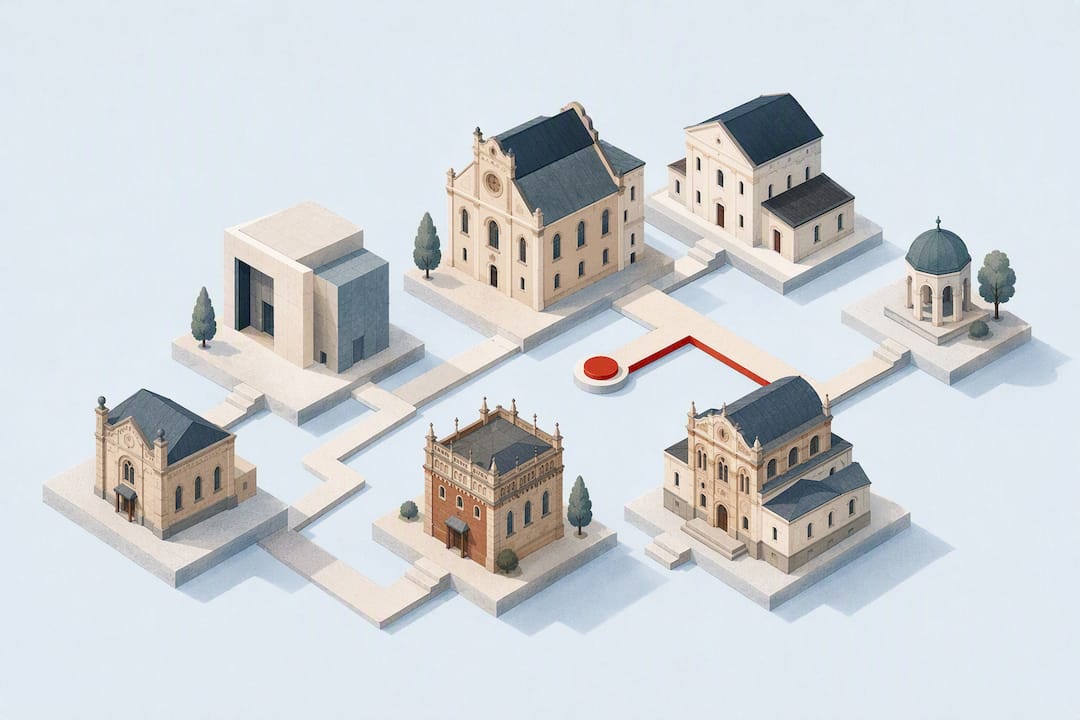
Start in Kazimierz: it holds the seven surviving synagogues and the Galicia Jewish Museum, making it the obvious first stop for anyone exploring Jewish heritage in Kraków. Give it half a day at minimum, then cross into Podgórze for Ghetto Heroes Square, the Eagle Pharmacy and Schindler’s Factory Museum. Auschwitz-Birkenau deserves a separate day entirely.
TL;DR:
- Visiting Kazimierz requires at least half a day to explore its seven historic synagogues, museums, and Jewish cultural sites thoroughly.
- The distinction between Kazimierz, the old Jewish quarter, and Podgórze, the site of the wartime ghetto, is crucial for understanding the full history of Jewish Kraków.
- The Old Synagogue, Remuh Synagogue, and Galicia Jewish Museum are the main highlights, with museum admission times requiring early planning.
- Full immersion involves at least one full day covering both districts, including Ghetto Heroes Square, Schindler’s Factory, and cultural activities.
- Respectful visits should prioritize guided tours, support local heritage work, and avoid treating memorial sites as casual photo backgrounds.
Table of Contents
- Kazimierz and Kraków’s Jewish past: a quick history
- What to see in Kazimierz: synagogues and museums
- Podgórze and the wartime sites: Ghetto Heroes Square and Schindler’s Factory
- How much time should you plan for Jewish heritage sites?
- Where is Jewish culture in Kraków still alive today?
- Who is preserving Kraków’s Jewish heritage?
- ComFort Tours Cracow: what a local guide adds to this visit
- Jewish life in Kraków before, during and after the war
- How do you book a guided Jewish heritage tour in Kraków?
- Where can you find kosher food and Jewish cuisine in Kraków?
- What architectural styles define Kraków’s Jewish buildings?
- What educational programmes exist for visitors?
- A note on visiting Kazimierz respectfully
- Book a guided Jewish heritage tour with ComFort Tours Cracow
- Sources
- FAQ
Kazimierz and Kraków’s Jewish past: a quick history
King Casimir the Great founded Kazimierz in 1335 as a separate town beside Kraków, and over the following centuries it became the city’s Jewish heart. By the late 1930s, roughly 60,000 to 65,000 Jewish residents lived in Kraków, about a quarter of the entire population. That number collapsed after the war to around 5,900 by 1948, and to barely 600 by 1978, a scale of loss that no single memorial can fully convey.
Two districts carry very different weight in this story, and confusing them is the single most common mistake visitors make.
- Kazimierz was the long‑established Jewish quarter, with religious, commercial and intellectual life stretching back six centuries.
- Podgórze, across the Vistula, became the site of the Nazi-imposed ghetto in 1941, a forced confinement with no historical connection to the pre-war Jewish community there.
Keeping that distinction clear changes how the whole visit reads. Kazimierz tells you how Jewish Kraków actually lived. Podgórze tells you how that life was destroyed. Seeing both, in that order, gives you the full arc rather than a single flattened impression of tragedy.
What to see in Kazimierz: synagogues and museums
Kazimierz packs an extraordinary density of sites into a few walkable streets, and the seven surviving synagogues form the backbone of any visit.
The Old Synagogue on ulica Szeroka 24 is the oldest of the group and now houses a permanent Judaica collection covering religious life, festivals and customs. A standard ticket runs 22 PLN, and the museum enforces a strict final-entry cutoff, so check the timetable before you set off rather than arriving twenty minutes before closing.
Statistic Callout: Museums across Kraków’s Jewish quarter typically stop admitting visitors 30 minutes before closing for individuals and 60 minutes for group bookings. Build that buffer into your day, especially in winter when opening hours shrink.
The Remuh Synagogue and cemetery remain active places of worship, not museum pieces frozen in time. Modest dress is expected, voices stay low, and access can be restricted during services, particularly around Jewish holidays. The cemetery itself, with its weathered tombstones dating to the 16th century, feels quieter and more personal than the grander Old Synagogue.
The Galicia Jewish Museum, at ulica Dajwór 18, takes a different approach entirely. Its permanent exhibition, Traces of Memory, pairs photography of former Jewish sites across the wider Galicia region with active cultural programming, treating Jewish heritage as a living culture rather than only a record of loss. It’s typically open daily from 10:00 to 18:00.
The remaining synagogues each earn a shorter stop:
- Tempel Synagogue, ornate and Moorish-influenced, hosts concerts alongside religious use.
- Popper Synagogue, one of the smallest, now serves cultural functions.
- Kupa Synagogue, near the old kosher market square, doubles as an event space.
- High (Wysoka) Synagogue, notable for its elevated prayer hall.
- Isaac (Izaaka) Synagogue, which runs an evocative multimedia presentation on pre-war Jewish life.
Groups should book ahead at every site; individual visitors can generally walk in, though queues build fast during festival season.
Podgórze and the wartime sites: Ghetto Heroes Square and Schindler’s Factory
Podgórze sits directly across the Vistula from Kazimierz, a fifteen-minute walk that carries enormous historical weight despite the short distance. This was where the Nazi authorities forced roughly 15,000 Jewish residents into a walled ghetto in 1941, cutting them off from the Kazimierz community that had thrived there for centuries.
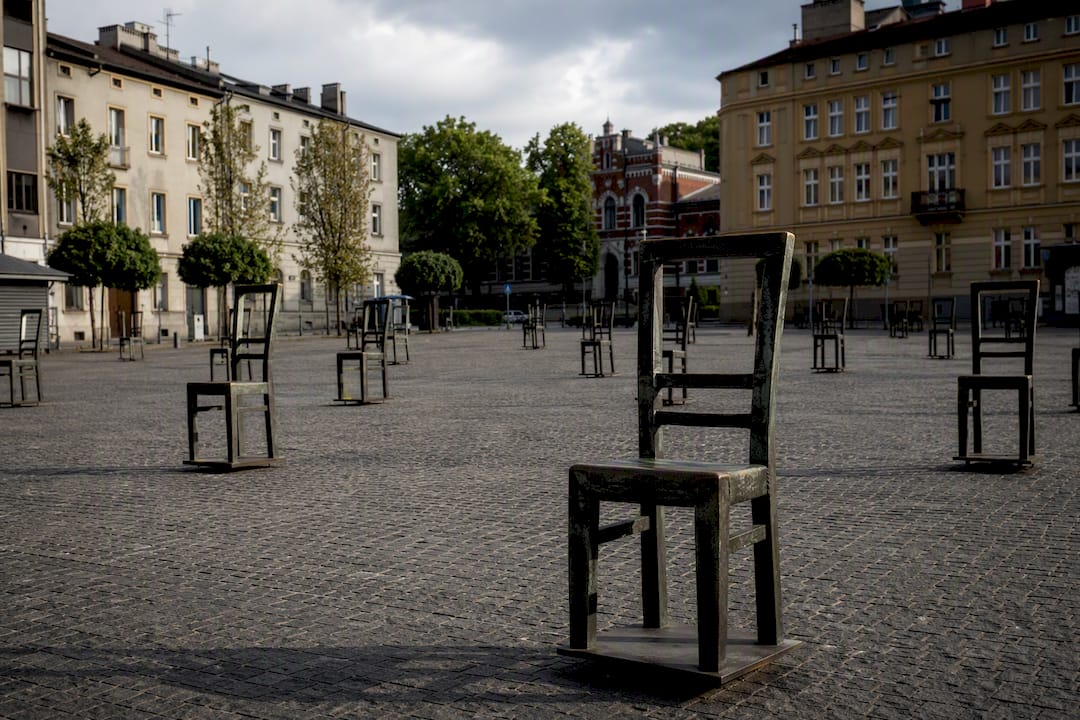
Ghetto Heroes Square (Plac Bohaterów Getta) is the emotional centre of the district. Seventy empty bronze chairs stand scattered across the square, each one representing the deportees forced to gather their belongings there before transport to the camps. It’s a striking, unusually restrained memorial, best visited slowly rather than photographed quickly and moved past.
A short walk away, the Eagle Pharmacy Museum (Apteka pod Orłem) tells a quieter story: a Polish pharmacist who supplied medicine, forged documents and information to ghetto residents at enormous personal risk. Allow 30 to 45 minutes.
The Schindler’s Factory Museum, housed in the former enamel works, covers Kraków’s occupation more broadly through immersive room reconstructions. Budget at least two hours; it rewards a slow pace.
Pro Tip: Visit Ghetto Heroes Square before Schindler’s Factory, not after. Seeing the empty chairs first gives the factory’s exhibits far more emotional context, rather than the other way round.
Treat this district with the same quiet respect you’d bring to a cemetery. These are not simply historical attractions.
How much time should you plan for Jewish heritage sites?
Realistic pacing matters more here than almost anywhere else in Kraków, because rushing these sites defeats the point of visiting at all.
Half-day option (Kazimierz only): Old Synagogue, Remuh Synagogue and cemetery, then the Galicia Jewish Museum. Roughly four hours including a coffee break on ulica Szeroka.
Full-day option (Kazimierz and Podgórze): Add Ghetto Heroes Square, the Eagle Pharmacy and Schindler’s Factory in the afternoon. A full day is a sensible allocation for covering both districts properly.
Two-day option: Spread the sites above across two mornings, using the afternoons for the remaining synagogues, a slower cemetery visit, and time to simply sit in Plac Nowy, the old Jewish square now ringed with cafés and the famous zapiekanka food stalls.
- Check individual museum websites the morning of your visit, since hours shift seasonally and around religious holidays.
- Book Schindler’s Factory tickets online in advance during summer, when queues at the door regularly exceed an hour.
- Wear comfortable shoes; Kazimierz’s cobbled streets and Podgórze’s longer walking distances add up quickly.
- Carry a scarf or light layer for synagogue visits, since modest dress is expected at Remuh in particular.
- If visiting during the Festival of Jewish Culture, book accommodation and tours well ahead. The quarter gets genuinely busy.
Auschwitz-Birkenau, roughly 90 minutes from Kraków, needs its own day entirely and should never be squeezed onto the same schedule as Kazimierz and Podgórze. For that separate trip, a detailed visiting guide is worth reading before you book.
Where is Jewish culture in Kraków still alive today?
Kazimierz isn’t a preserved relic. It hosts one of Europe’s larger Jewish cultural events, the Jewish Culture Festival, which typically runs across nine days in late June or early July. Expect klezmer concerts spilling into the streets, workshops on Yiddish song and traditional cooking, and a closing concert that draws thousands to Szeroka Street.
Outside festival week, the culture continues on a smaller scale:
- Regular klezmer performances in restaurants along ulica Szeroka, some genuinely excellent, others aimed squarely at tourists.
- Cooking demonstrations and cultural talks organised through the Galicia Jewish Museum’s education programme.
- Shabbat dinners occasionally open to visitors through community organisations, usually requiring advance contact.
Food plays its own role in how cultural tourism works here, and live events shape the experience just as much as static exhibitions do, something cultural tourism research consistently points to across European heritage cities.
Who is preserving Kraków’s Jewish heritage?
The Galicia Jewish Museum does more than run an exhibition space. Its founders built the photographic archive behind Traces of Memory specifically to document surviving Jewish sites across the wider Galicia region before they disappeared entirely, and the museum still runs school programmes and teacher training on Holocaust education.
Synagogue restoration work continues under Poland’s heritage protection framework, with several buildings in Kazimierz undergoing structural conservation in recent years. Remuh cemetery, in particular, remains an active site of pilgrimage, and its upkeep depends partly on visitor donations alongside institutional funding.
You can support this work simply by visiting respectfully, paying entry fees rather than seeking free workarounds, and choosing guided experiences that employ local historians rather than generic city-wide tour scripts.
ComFort Tours Cracow: what a local guide adds to this visit
A knowledgeable guide changes how these sites connect. Rather than seeing Kazimierz and Podgórze as separate stops on a map, a good guide walks you through the actual route deportees took, pointing out where pre-war life ended and forced confinement began.
Some local tour operators run Jewish heritage tours in small groups, which matters enormously at sites like Remuh cemetery where a crowd of thirty changes the atmosphere entirely. Guides weave personal storytelling through the historical timeline, connecting individual buildings to the wider arc from 1335 to the present day, with transport and pacing arranged around the emotional weight of Podgórze rather than a fixed tourist schedule.
Jewish life in Kraków before, during and after the war
Pre-war Kazimierz was genuinely diverse, home to Orthodox communities, secular intellectuals, Zionist organisations and Yiddish theatre, all within a few streets. Synagogues ranged from the strictly traditional Remuh to the Reform-leaning Tempel, reflecting a community that was never monolithic.
The German occupation from 1939 dismantled this rapidly. Jewish residents were forced from Kazimierz into the newly created Podgórze ghetto in 1941, stripped of property, and subjected to escalating restrictions before mass deportations to Bełżec and Auschwitz-Birkenau began in 1942. Oskar Schindler’s factory, on the ghetto’s edge, became one of the rare sites where a German industrialist actively worked to protect Jewish workers rather than exploit them.
Post-war Kraków saw a small number of survivors return, but most emigrated in successive waves through the late 1940s and again after 1968, driven by continued antisemitism and political pressure. The population figures tell the story starkly: from tens of thousands before the war to a few hundred by the late 1970s. What remained was largely buildings, archives and memory, until Kazimierz’s revival as a cultural and heritage destination began in earnest during the 1990s.
How do you book a guided Jewish heritage tour in Kraków?
Independent visits work well for confident travellers with time to research each site beforehand, but a specialised guide adds context that plaques and audio guides rarely capture, particularly around Podgórze’s wartime geography.
ComFort Tours Cracow’s Explore Jewish Kazimierz and the Ghetto walking tour covers both districts in one guided route, connecting the synagogues to the ghetto sites with the historical narrative intact rather than split across separate bookings. Tours run in small groups, which keeps the pace flexible and allows time to actually absorb a place like Ghetto Heroes Square rather than being hurried through it.
Booking typically works through the tour operator’s website, where you select a date and group size, and multi-language guiding is available for visitors who prefer a language other than English. It’s worth booking a few days ahead during summer and festival season, when small-group slots fill first. For anyone combining this with the separate Auschwitz-Birkenau day, checking both bookings early avoids scheduling conflicts, since the two experiences shouldn’t be rushed together.
Where can you find kosher food and Jewish cuisine in Kraków?
Plac Nowy, the square at Kazimierz’s centre, is the best starting point for food with genuine Jewish culinary roots, even though many stalls now sell the famously non-kosher zapiekanka alongside more traditional options. Restaurants along ulica Szeroka and the surrounding streets serve Ashkenazi staples: chopped liver, cholent, gefilte fish and various pierogi variants with Jewish culinary origins.
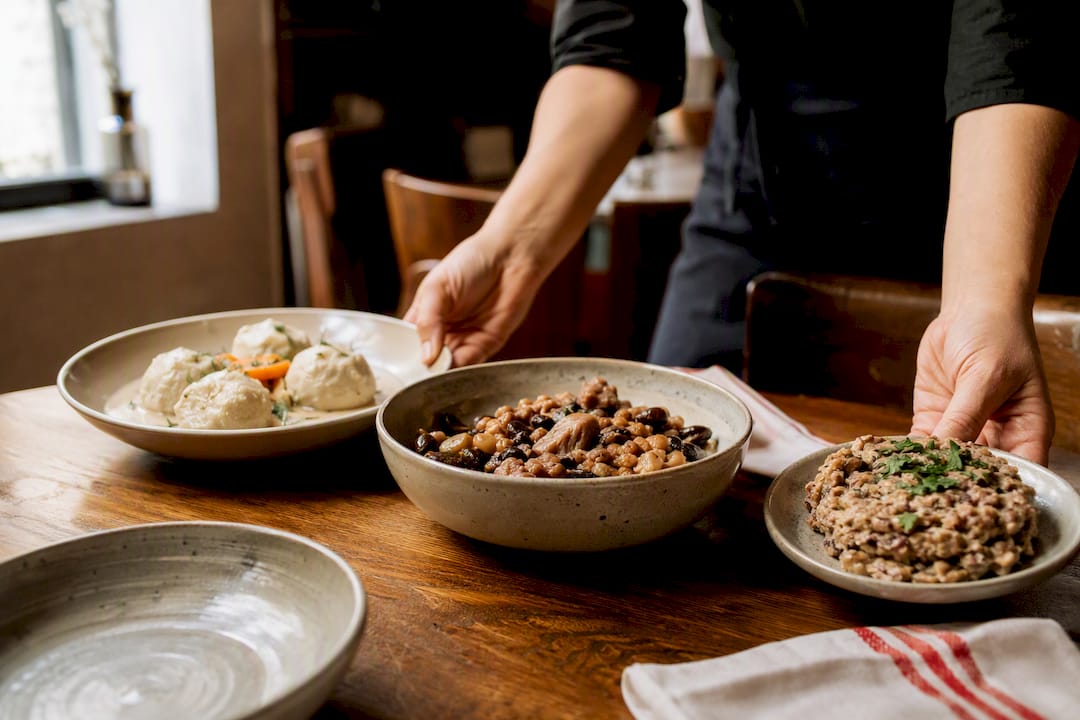
Genuinely kosher-certified dining is limited in Kraków compared with larger European Jewish communities, so it’s worth checking current certification directly with a restaurant before assuming a “Jewish-style” menu meets kosher standards. Several establishments in Kazimierz brand themselves around Jewish heritage cuisine without formal certification, which suits most heritage tourists but matters considerably to observant visitors.
Klezmer restaurants combining live music with a set menu of Jewish dishes remain popular, particularly for evening visits after a day of museum-going. Booking ahead is sensible during festival week, when tables along Szeroka Street fill quickly. For a broader sense of how food experiences shape cultural travel generally, culinary tourism guidance offers useful framing beyond Kraków specifically.
What architectural styles define Kraków’s Jewish buildings?
Kazimierz’s synagogues span several centuries of architectural fashion, which is part of what makes walking between them so interesting. The Old Synagogue reflects a Gothic-Renaissance style typical of the earliest European synagogues, with a fortress-like solidity that hints at its original defensive function during less tolerant centuries.
The Remuh Synagogue, smaller and plainer, follows a modest vernacular style suited to an active neighbourhood congregation rather than a grand civic statement. Compare that with the Tempel Synagogue, built far later in the 19th century in an ornate Moorish Revival style, with horseshoe arches and elaborate stencilled decoration reflecting the Reform movement’s more assimilated, cosmopolitan aspirations.
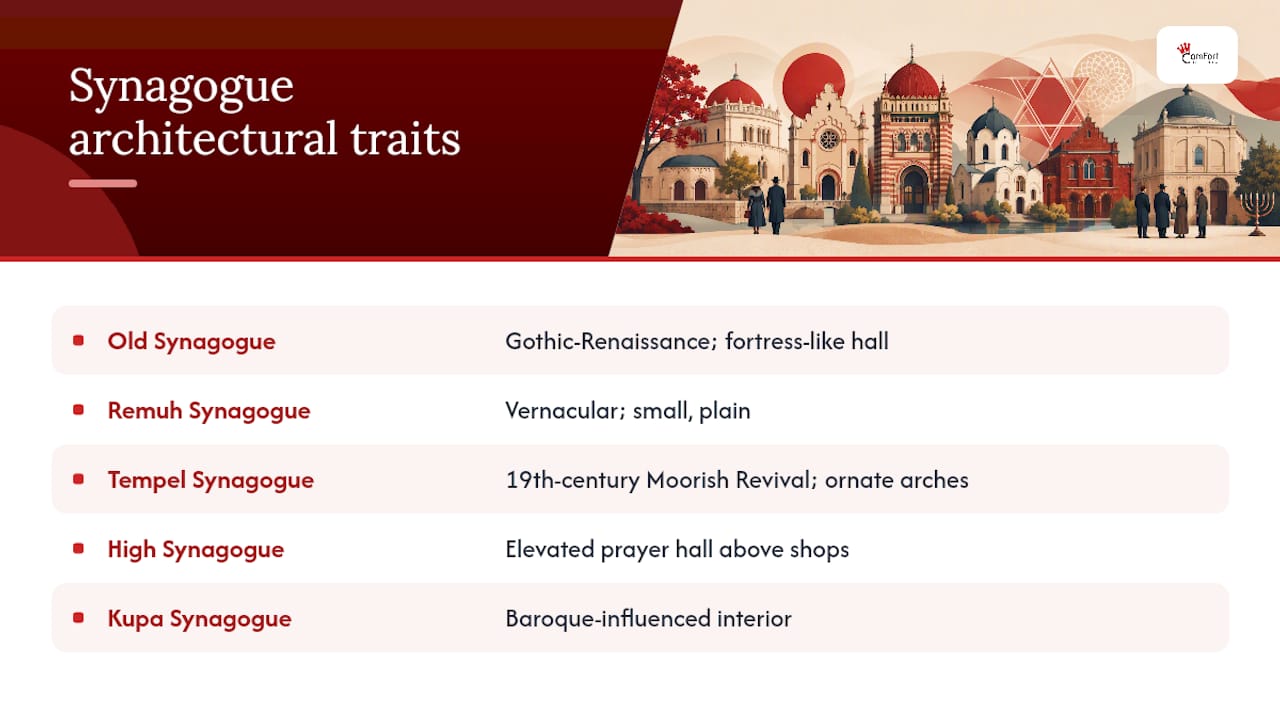
The High Synagogue’s name comes from its elevated prayer hall, built above ground-floor commercial space, a practical layout that let the congregation generate rental income. Kupa Synagogue’s Baroque-influenced interior, meanwhile, reflects the wealth of the kosher merchants who funded it.
Beyond the synagogues, Kazimierz’s residential architecture matters too: the narrow courtyard buildings, once home to multiple Jewish families and workshops, still line ulica Józefa and ulica Meiselsa, giving the district its dense, lived-in texture rather than a museum-like emptiness.
What educational programmes exist for visitors?
The Galicia Jewish Museum runs the most structured programming aimed at visitors, including guided thematic tours, teacher training sessions and workshops tied to its Traces of Memory exhibition. Sessions on Jewish history, Yiddish culture and Holocaust education run throughout the year, not just during festival season.
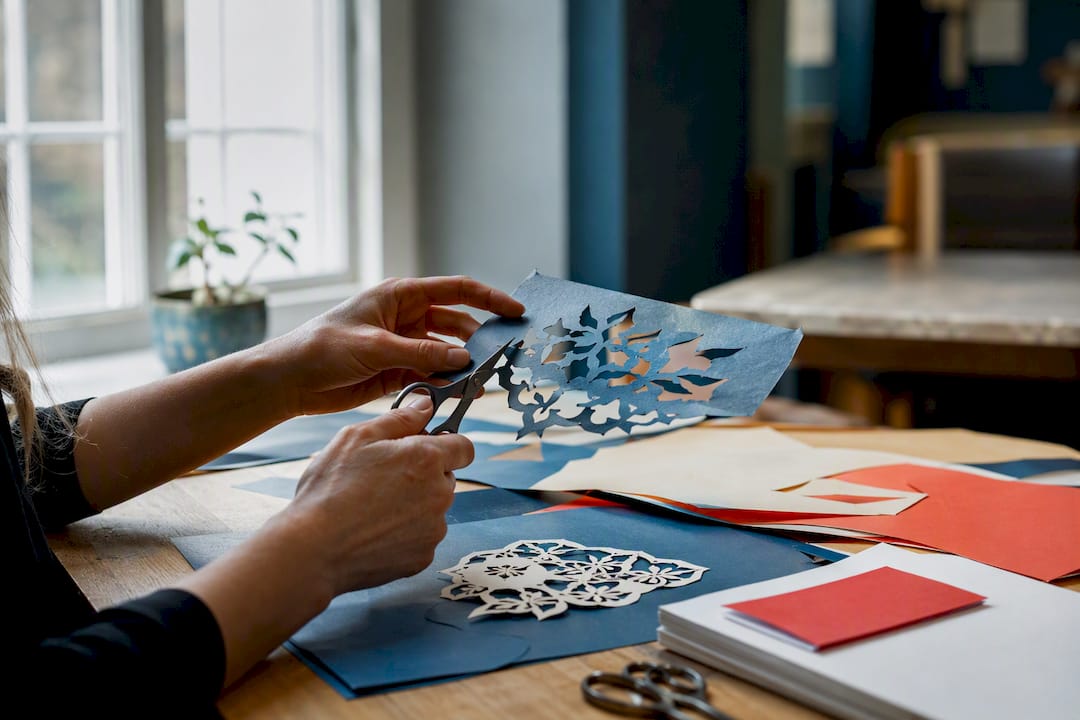
Several Kazimierz-based organisations offer hands-on workshops during the Jewish Culture Festival specifically: traditional cooking classes, Yiddish song sessions, and calligraphy or paper-cutting demonstrations rooted in Jewish folk art traditions. These sit alongside academic lectures aimed at a more scholarly audience.
For visitors wanting deeper engagement beyond a single afternoon, some tour operators build half-day or full-day themed experiences around specific topics, such as ghetto history or synagogue architecture, rather than a general overview. Booking these ahead is sensible, since group sizes for hands-on workshops tend to be small by design.
A note on visiting Kazimierz respectfully
Kazimierz is a lived neighbourhood, not an open-air museum, with residents, shops and a genuine local rhythm. Visit during quieter hours where you can, support Jewish-led cultural programmes over generic tourist traps, and resist treating memorial sites as photo backdrops.
— Damian Fort
Book a guided Jewish heritage tour with ComFort Tours Cracow
Some tour operators run Jewish heritage tours with small groups, knowledgeable guides distinguishing Kazimierz’s pre-war life and Podgórze’s wartime confinement, and a pace that allows time at Ghetto Heroes Square.
The Explore Jewish Kazimierz and the Ghetto walking tour covers the synagogues, the Remuh cemetery and the wartime sites in one connected route, with transport and pacing built around the emotional weight of each stop rather than a fixed checklist. If you’re also planning the separate Auschwitz-Birkenau day, browse the full range of tours to see how the two fit together without overlapping your schedule. Check current availability and book your date directly through the site.
Sources
- Old Synagogue — Museum of Krakow
- Galicia Jewish Museum — museum page
- Kazimierz – the Jewish quarter Kraków (VisitMałopolska)
FAQ
Is there still a Jewish community in Kraków?
Yes, a small active Jewish community remains in Kraków, centred around the Remuh Synagogue and supported by organisations like the Galicia Jewish Museum’s cultural programming. It’s far smaller than the pre-war population of roughly 60,000 to 65,000, but it’s genuinely active rather than purely historical.
Can you recommend a Jewish heritage trip to Poland?
Kraków is the strongest single-city starting point, combining the seven surviving Kazimierz synagogues, the Galicia Jewish Museum and Podgórze’s wartime memorials within walking distance of each other. A guided walking tour such as ComFort Tours Cracow’s Kazimierz and Ghetto route covers the essentials in a single day, with Auschwitz-Birkenau best added as a separate day trip.
Which Polish city has the most Jewish history?
Kraków and Warsaw both carry major Jewish historical significance, but Kraków’s Kazimierz district is unusual in how much physical heritage survived the war intact, including all seven historic synagogues. Warsaw’s Jewish quarter suffered far more extensive wartime destruction, which makes Kraków’s built heritage comparatively rare in Poland.
What are Polish Jews called?
Polish Jews are generally referred to simply as Polish Jews or, historically, as part of the Ashkenazi Jewish tradition that developed across Central and Eastern Europe. Within Kraków specifically, the community that built Kazimierz from 1335 onwards is often described in historical sources as Kraków’s Jewish community rather than by any separate ethnic label.