
The Wieliczka Salt Mine’s Tourist Route has around 800 steps in total, with roughly 380 of them packed into the first descent alone. You walk down through wooden spiral staircases and ride an elevator back up, so the hard work happens early. Most reasonably fit adults handle it without much trouble, but anyone with significant knee, hip, or back problems should think it through first. Book ahead, and ring the mine directly if mobility is a genuine concern.
TL;DR:
- The initial descent involves approximately 380 of the total 800 stairs, which are built as wooden spiral stairs with landings in between, not steep ladders.
- Repeated downhill stepping during the descent puts significant strain on the knees and quadriceps, especially for those with recent injuries or joint problems.
- Guided tours last about two hours, cover 3 to 3.5 km underground, and require booking in advance, especially for English-language slots in peak season.
- The route is not accessible for visitors with mobility limitations, as there are no stairs-free descent options and large groups can cause bottlenecks on narrow landings.
- Proper footwear, light clothing, and pre-arranged accommodations are essential for a safe and comfortable experience underground.
Table of Contents
- How many Wieliczka stairs are there, and how deep do they go?
- What do the Wieliczka underground stairs actually feel like?
- Who should think twice before tackling the Wieliczka stairs?
- Can you skip the stairs? Accessibility and mobility options
- How to prepare your body and your kit for the descent
- What actually happens on a guided visit
- What our guides notice about the Wieliczka stairs
- Book a Wieliczka visit that matches your pace, not a bus schedule
- Where to check the official details before you go
- Sources
- FAQ
How many Wieliczka stairs are there, and how deep do they go?
The figures are consistent across the mine’s own guidance and independent visitor reports: about 800 stairs make up the full Tourist Route, and roughly 380 of those come one after another during the initial descent down the Daniłowicz Shaft. That first stretch is the part people remember. Everything after it is spread across a longer walk with far gentler stair sections between chambers.
The route itself runs about 3 to 3.5 kilometres underground and takes roughly two hours to complete with a guide. Temperature stays remarkably stable at around 17 to 18°C year-round, so what you wear outside barely matters once you’re below ground.
| Detail | Figure |
|---|---|
| Total stairs on the route | ≈800 |
| Stairs on the initial descent | ≈380 |
| Underground distance | ≈3 to 3.5 km |
| Time underground | ≈2 hours |
| Temperature | ≈17 to 18°C |
| Return to surface | By lift |
Guided groups run on timed slots, and English-language departures can sell out during the summer months, so booking a week or more ahead during peak season is a sensible habit rather than an overcautious one.
What do the Wieliczka underground stairs actually feel like?
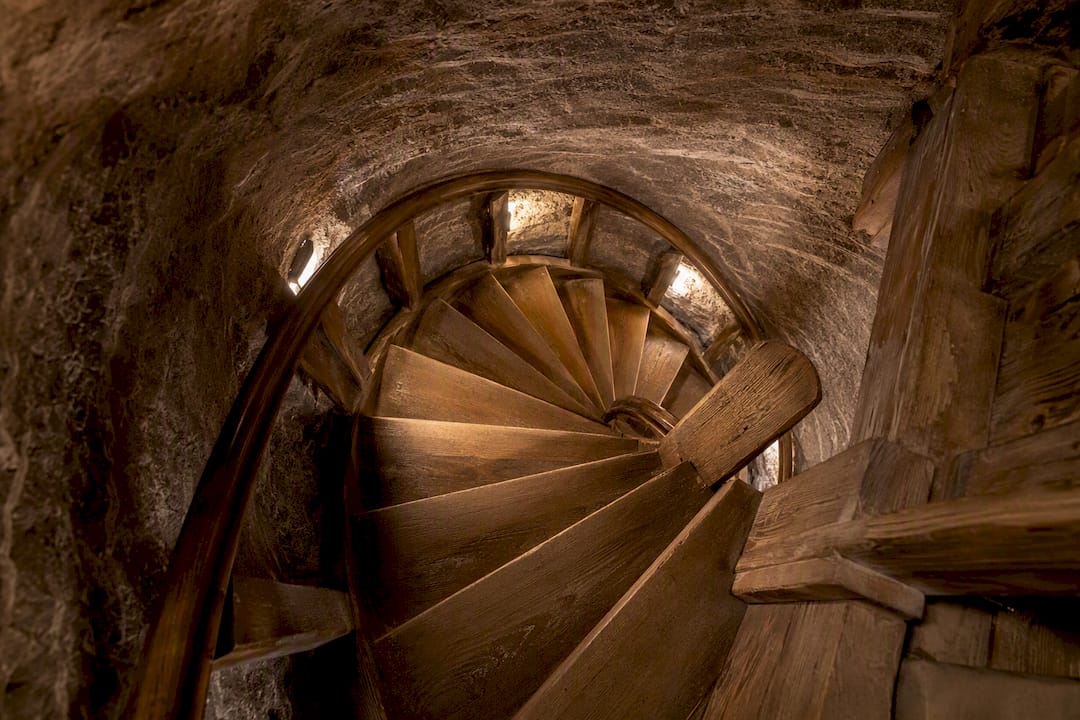
These are not ladders and they are not a scramble. The initial descent is a wooden spiral staircase built in short flights with landings between each turn, and the individual steps are close to the dimensions of a normal UK staircase at home, not the steep, narrow risers you sometimes find in castle towers or church spires. Once you’re past that opening shaft, the stairs you meet between chambers are shorter, less continuous, and easier underfoot.
A few things worth knowing before you go down:
- The spiral shape means you’re always turning, which some visitors find more disorientating than the steps themselves.
- Handrails run the length of the wooden staircase and are worth using properly, not just resting a hand on.
- Queues form at the top of the shaft in busy periods, since groups descend in sequence rather than all at once.
- The internal connecting stairs later in the tour are shorter runs, often just a dozen or so steps at a time.
- Landings between flights give a natural excuse to pause, even if nobody around you looks like they need one.
Visitor accounts consistently mention that the descent creates a steady, repetitive motion rather than one dramatic push, which is exactly why pacing matters more than raw fitness.
Who should think twice before tackling the Wieliczka stairs?
The physical demand here is almost entirely in the knees, not the lungs. Because the return trip is by lift, you never climb back up those 380 steps. What you do get is a long, continuous downhill stretch, and repeated downward stepping puts real strain on the quadriceps and knee joints through a process called eccentric loading, where the muscle lengthens under tension with every step. That’s a different kind of tiring to climbing stairs, and it catches people out who assumed the descent would be the easy half.
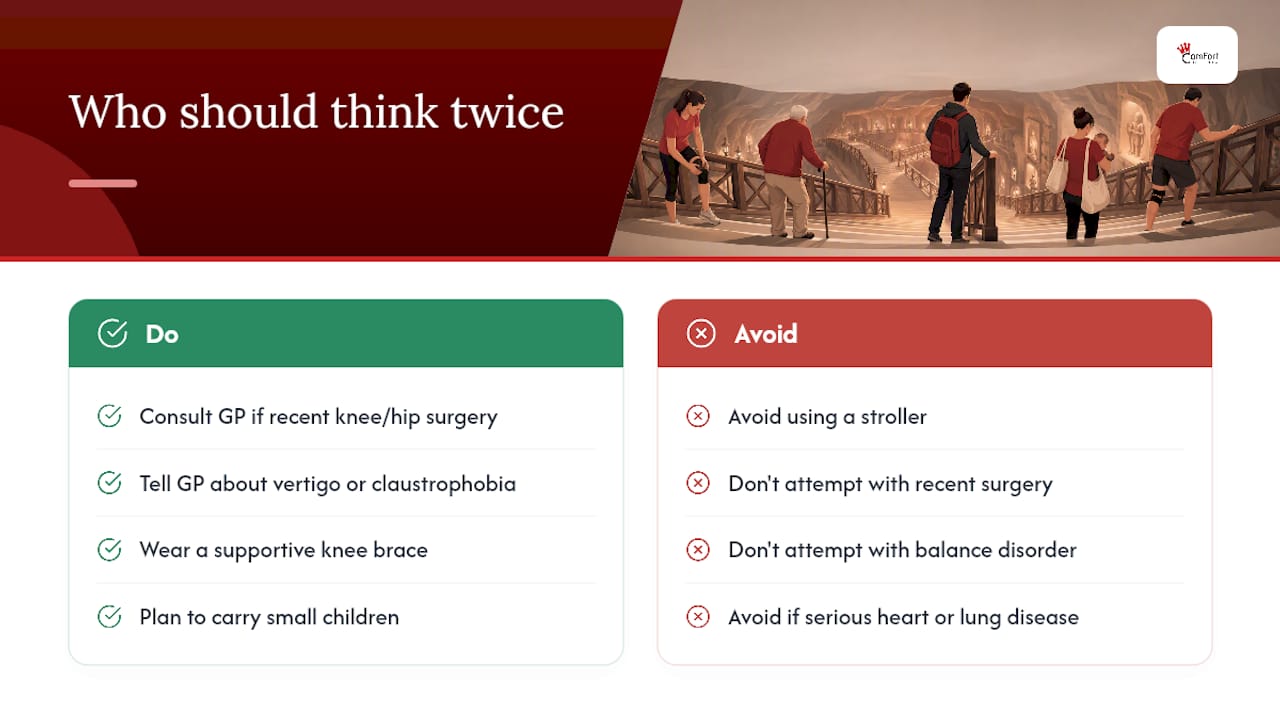
If you’ve had recent knee or hip surgery, a serious cardiorespiratory condition, or any kind of balance disorder, it’s worth a quick chat with your GP before booking. Vertigo and claustrophobia are worth mentioning too. The shaft is enclosed and the spiral staircase is narrow, and while most people adjust within a few minutes, it’s not the place to discover a problem for the first time.
Strollers are firmly discouraged, given the sheer number of stairs involved, so parents need to plan on carrying small children for the descent and much of the route.
Pro Tip: If you’re managing an old knee injury, wear a supportive brace on the day rather than packing it “just in case”. The strain builds gradually over the 380 steps, and by the time you notice discomfort, you’re already committed to finishing the descent.
Can you skip the stairs? Accessibility and mobility options
There’s no way around the honest answer: the Tourist Route is built on historic mine infrastructure, not designed from scratch for modern accessibility standards, and the descent is stair only. The lift brings everyone back to the surface, but there is currently no lift alternative for going down, and options on the standard route for visitors who cannot manage stairs at all are limited.
That doesn’t mean you’re stuck guessing. A few practical routes worth exploring:
- Contact the mine directly before your visit if you have a mobility limitation, so staff can talk through what’s realistic for your situation.
- Ask about a private or small-group booking, which allows a guide to set a slower pace without holding up a large tour party.
- Arrange a companion to walk alongside you on the stairs, particularly through the initial shaft where handrail use matters most.
- Build extra time into your day so you’re not rushing the descent to keep pace with a scheduled group.
None of this changes the stair count, but it changes how much control you have over your own pace on the day.
How to prepare your body and your kit for the descent
Footwear matters more here than almost anything else you pack. Choose comfortable, closed-toe shoes with a decent grip on the sole. Wooden stairs polished smooth by decades of foot traffic can be slightly slick, and flip-flops or heeled sandals are a genuinely bad idea.
Clothing is simple: a light layer works for the constant 17 to 18°C underground, whatever the weather is doing outside. Leave the heavy coat in your hotel room or car.
- Pack light. A small daypack is fine, but a large rucksack throws off your balance on the spiral stairs and gets in other visitors’ way.
- Keep both hands free for the handrail during the initial descent rather than juggling a phone or water bottle.
- Bring any prescribed medication with you rather than leaving it at your accommodation, particularly anything for joint pain or dizziness.
- If you’ve been advised to wear a knee brace for stairs, put it on before you arrive, not once you’re already at the shaft entrance.
- A short daily walk in the weeks before your trip helps far more than a single gym session the night before.
Statistic Callout: With roughly 380 steps concentrated in one continuous descent, most of the day’s physical effort happens in the first fifteen minutes underground, not spread evenly across the two-hour tour.
What actually happens on a guided visit
Every tour starts at the Daniłowicz Shaft, where groups gather before descending together under a guide’s instruction. Visits are guided throughout. You cannot leave the route partway through and find your own way back, since the underground layout is far too extensive and unmarked for independent navigation.
A few logistics worth locking in before you travel:
- Groups move at a set pace decided by the guide, with the underground portion lasting close to two hours across 3 to 3.5 kilometres.
- The route’s best-known highlight, the underground Chapel of St Kinga, comes after the initial stair descent, so the hardest physical section is behind you by the time you reach it.
- Working out how long a full day trip actually takes from Krakow, including transport, is worth doing before you commit to a departure time.
- If you’re arranging your own transport, check routes between Krakow and Wieliczka in advance, since journey time affects how tight your tour slot will feel.
- English-language tours are popular enough that reserving early in the season isn’t just cautious planning, it’s often the only way to get the time slot you actually want.
What our guides notice about the Wieliczka stairs
Small groups change the experience on those stairs more than most visitors expect. Local guides report that keeping numbers down means fewer bottlenecks on the landings and far more room to slow the pace for anyone who needs it, rather than everyone being locked into the speed of the slowest or fastest member of a large tour party.
The pinch points are predictable once you’ve watched enough groups go through them: the first few landings on the spiral descent, and the narrow connectors between some of the deeper chambers. A guide who knows to pause there, rather than push on, makes a genuine difference to how the visit feels afterwards. That’s the thinking behind offering smaller group sizes and private transport for visitors who want the mine’s history without feeling herded through it.
Guided groups everywhere in tourism face this same trade off between numbers and pace, and it’s worth asking any operator directly how they handle it before you book, not just for Wieliczka.
— Damian Fort
Book a Wieliczka visit that matches your pace, not a bus schedule
Some tour operators run small-group and private Wieliczka Salt Mine tours built around concerns such as fewer people on the stairs, a guide who can slow down for anyone who needs it, and private transport arrangements. If knee pain, a balance concern, or simply a preference for breathing room on those 380 steps is on your mind, mention it at the time of booking so realistic arrangements can be discussed.

You can raise mobility questions before you pay a deposit, not after, and we’ll suggest a pace, group size, or private arrangement that fits. Browse our full range of tours to see current Wieliczka departures and get in touch about a private or small-group booking today.
Where to check the official details before you go
For booking rules and the latest practical information straight from the source, check the mine’s own Tourist Route practical information page. For historical context on why the site is protected as it is, see the UNESCO World Heritage listing. For general guidance on how tour guides manage logistics and accessibility on-site, a tour guide services overview is worth a read.
Sources
- Tourist Route – practical information
- Wieliczka and Bochnia Royal Salt Mines – UNESCO World Heritage Centre
- Wieliczka Salt Mine: Stairs, Booking, What to Bring | ViewPoland
FAQ
How many steps are there at Wieliczka Salt Mine?
The Tourist Route has roughly 800 stairs in total, with about 380 of them concentrated in the initial descent down the Daniłowicz Shaft.
Is the Wieliczka staircase the longest in the UK or Europe?
No. The 380-step descent is significant for a visitor attraction but it isn’t a record-holding staircase; it’s simply an unusually long, continuous run built for a working mine, not a monument.
How steep are the Wieliczka stairs compared to normal UK stairs?
The individual steps are close to standard UK domestic dimensions rather than steep or ladder-like, though the wooden spiral design and sheer number of steps in one continuous descent make it feel more demanding than a typical staircase at home.
Can you visit Wieliczka Salt Mine without a guide?
No, the Tourist Route requires a guide throughout, and you cannot leave the route independently partway through. Booking a small-group or private tour, such as those run by ComFort Tours Cracow, is one way to get a guide who paces the descent to suit your group.
Are the Wieliczka stairs safe for someone with knee problems?
Many people with mild knee issues manage the descent using the handrails and a steady pace, but the continuous downhill stepping puts real strain on the knees, so anyone with significant joint problems should speak to a GP and consider contacting the mine directly beforehand.