Several key sites anchor any serious visit to wartime Krakow: Oskar Schindler’s Enamel Factory and the Memory Trail, the KL Płaszów memorial, a day trip to Auschwitz-Birkenau, the Galicia Jewish Museum, and the Kazimierz cluster of the Old Synagogue, Tempel Synagogue, Remah Synagogue and Eagle Pharmacy. Budget a full day for the city sites and a separate day for Auschwitz-Birkenau. Book ahead where you can, since several venues cap daily numbers and sell out.
TL;DR:
- The Auschwitz-Birkenau visit requires booking weeks in advance due to peak season ticket limits and takes at least three to four hours for a thorough experience.
- The KL Płaszów outdoor route, with 14 information points, takes about one hour to walk and is free, making it ideal for tighter schedules.
- Guided tours and private arrangements significantly improve the experience at sites like Schindler’s Factory and Auschwitz, especially with early booking for timed entries.
- Visiting the former German security headquarters on Pomorska Street offers insight into the occupation’s machinery, but it is less personal and best combined with other sites on the Memory Trail.
- The Jewish heritage sites in Kazimierz and the ghetto boundary near Podgórze provide a compact, walkable narrative, but combining them with Auschwitz-Birkenau requires careful timing and separate days.
Table of Contents
- Must-see Krakow WWII sites and why each one matters
- How much time should you allow, and when should you book?
- Walking the Memory Trail through Kazimierz and the ghetto
- Visiting places of memory respectfully
- The Warsaw Ghetto’s connection to Kraków’s own history
- Gestapo headquarters and their place in occupied Kraków
- Krakow’s resistance movements and where to see their traces
- Where to find deeper WWII exhibitions beyond the Memory Trail
- Krakow under occupation: the historical context worth knowing before you go
- Why guided interpretation changes what you take from these sites
- Book your Krakow WWII sites tour with local guides who know the history
- Sources
- FAQ
Must-see Krakow WWII sites and why each one matters
Each site tells a different part of the same story, and together they explain how Kraków survived occupation while so much of Poland did not.
- Oskar Schindler’s Enamel Factory anchors the Memory Trail with its permanent exhibition, Kraków under Nazi Occupation 1939–1945, built around theatrical reconstructions, multimedia kiosks and Schindler’s preserved office, presented as a theatrical, multimedia “factory of memory” rather than a static museum.
- KL Płaszów holds far less physical structure than Auschwitz, which is precisely why it matters: this was a working concentration camp built on Kraków’s own doorstep, and the outdoor memorial now marks that ground with information points and archaeological windows rather than reconstructed buildings.
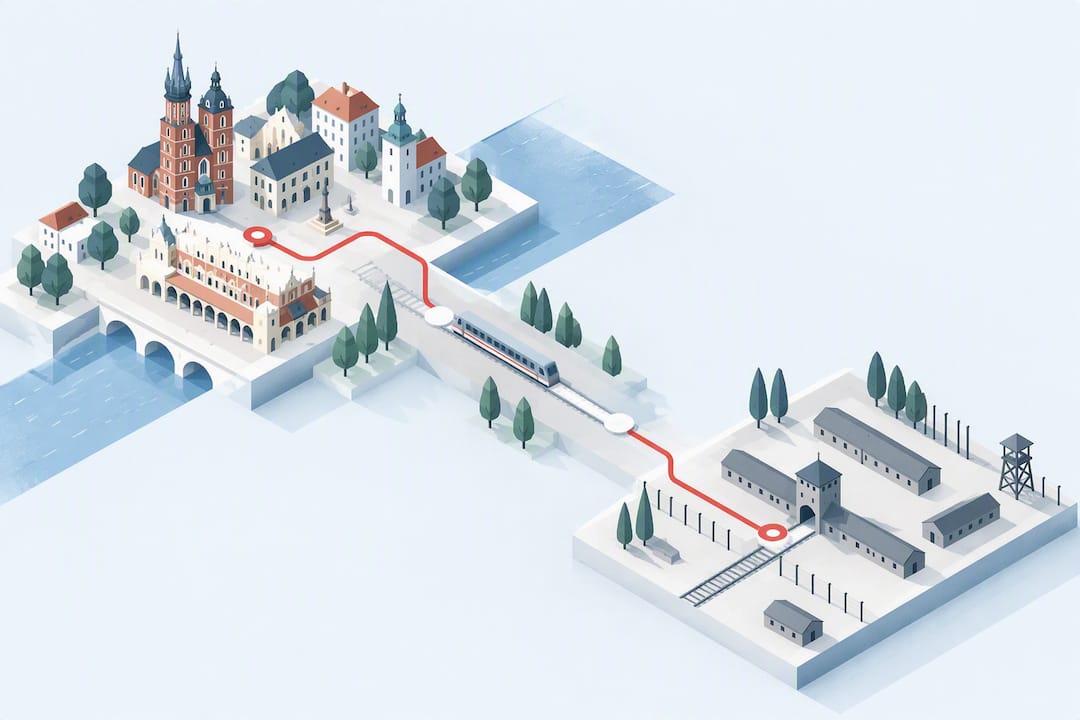
- Auschwitz-Birkenau, roughly 90 minutes from Kraków, sits outside the city but belongs on every itinerary. It requires its own logistics: timed entry, a longer day, and usually transport booked in advance.
- Galicia Jewish Museum takes a different approach entirely. Its photographic documentation of destroyed synagogues shows what was lost architecturally and culturally, not just numerically, across the wider Galicia region.
- Kazimierz’s synagogues and the Eagle Pharmacy form a compact, walkable cluster where Jewish religious life, ghetto history and wartime resistance sit within a few streets of each other.
Many UK travellers also fold in Wieliczka Salt Mine on a separate, unrelated day. It has no wartime connection but pairs naturally with a Kraków city break and gives some emotional breathing room after the heavier sites.
How much time should you allow, and when should you book?
Opening hours shift with the seasons, and summer months (June to August) bring the heaviest crowds and the tightest ticket windows. Several venues also cap how many people can enter per slot, which catches out travellers who assume they can simply turn up.
- Schindler Factory and Memory Trail branches: online ticket sales close six hours before your visit slot, though the box office can sell a limited number of tickets on the day itself.
- Galicia Jewish Museum: keeps regular public opening hours; check ahead during Polish public holidays.
- Old Synagogue and Eagle Pharmacy: occasionally run free-entry days, but those slots fill quickly and reservation is still recommended.
- Auschwitz-Birkenau: needs the earliest booking of all, ideally weeks ahead in peak season.
Statistic to plan around: the KL Płaszów outdoor route covers 14 information points and takes about 60 minutes to walk in full, and it costs nothing to visit. That makes it one of the easiest sites to slot into a tight schedule, since there’s no ticket queue to manage.
Indoor museums like Schindler’s Factory allow roughly 90 to 150 minutes given multimedia displays and seating areas, while outdoor memorials such as Płaszów demand different preparation: sturdy footwear, weather awareness and a self-paced reading of the terrain, since there’s no shelter or seating built in. Poland uses the zloty (PLN); contactless cards are accepted almost everywhere in Kraków, though carrying some cash helps at smaller kiosks.
Walking the Memory Trail through Kazimierz and the ghetto
The Memory Trail links three branches, Pomorska Street, the Eagle Pharmacy and Schindler’s Factory, into a single narrative arc covering 1939 to 1956. Following it in sequence rather than visiting the sites at random gives a far more coherent picture, because the route is deliberately curated to build chronologically and thematically as you move through it.
A sensible walking day looks something like this:
- Morning: Old Synagogue, then Remah Synagogue and its adjoining cemetery, both a short walk apart in Kazimierz.
- Late morning: Tempel Synagogue, then cross towards the former ghetto boundary near Podgórze.
- Early afternoon: Eagle Pharmacy, a small but pointed stop on the Memory Trail.
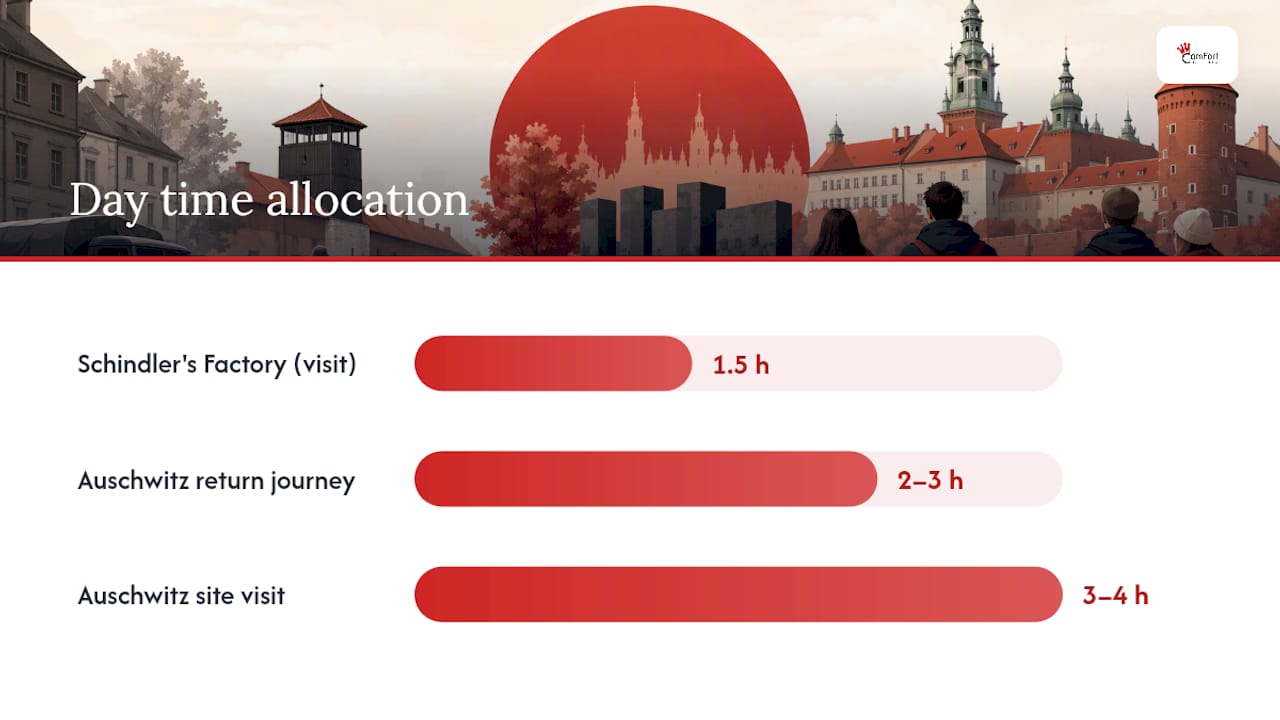
- Mid-afternoon: Oskar Schindler’s Enamel Factory, allowing at least 90 minutes for the full exhibition.
Detailed walkable Schindler’s List clusters can help you sequence this more precisely if you’re planning it yourself, and a dedicated guide to visit length at the Factory is worth checking before you fix your timings.
Combining this city route with Auschwitz-Birkenau on the same trip needs care. Most visitors do Kazimierz and the Memory Trail on one day and Auschwitz-Birkenau on another, since the return journey alone eats two to three hours and the site itself deserves an unhurried three to four hours of its own.
Pro Tip: Book Schindler’s Factory for late afternoon and Płaszów for the morning. The Factory’s multimedia rooms feel more atmospheric with fewer visitors around, and Płaszów’s outdoor route is far more comfortable to walk before the midday heat builds.
If queues worry you, timed-entry tickets solve most of the problem on their own. A guided tour or a private transport arrangement earns its cost mainly on the Auschwitz-Birkenau day, where logistics (parking, security screening, timed groups) are genuinely fiddly for a first-time visitor.
Visiting places of memory respectfully
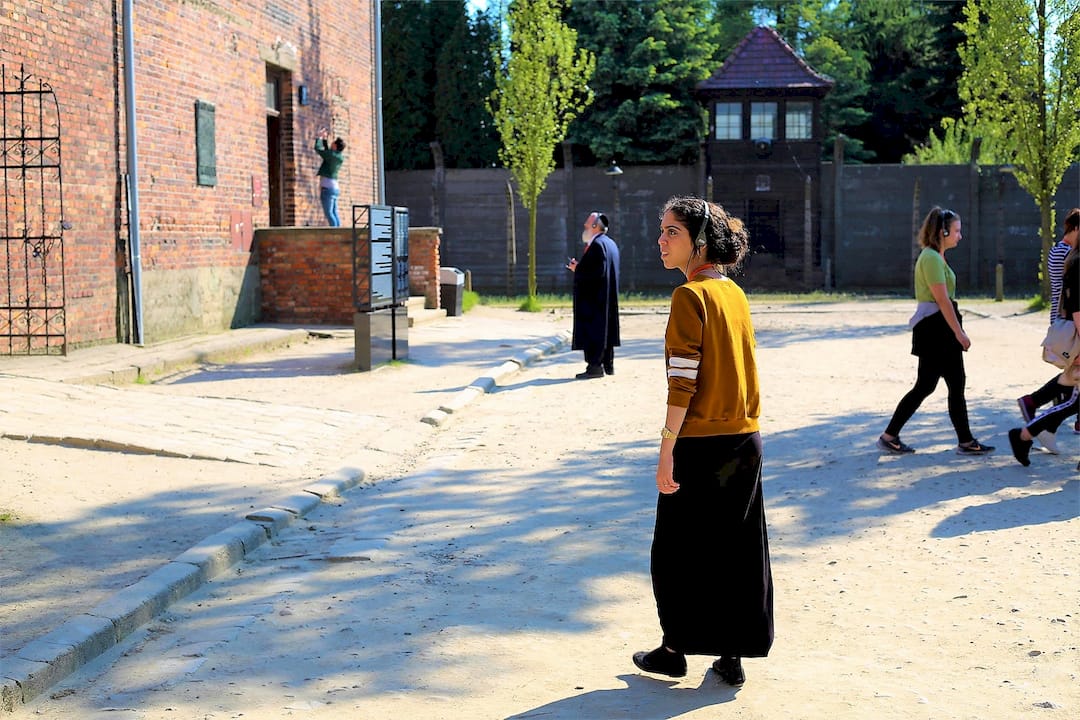
Places of memory differ from ordinary tourist attractions. They mark where real people suffered and died, and the way you behave on-site is part of how these places are preserved.
- Keep voices low and phones on silent; treat photography at Auschwitz-Birkenau and Płaszów with restraint, avoiding posed or celebratory images.
- Dress and act as you would at a cemetery, since that’s functionally what these grounds are.
- Read a short overview beforehand. The USHMM’s summary of the Kraków ghetto gives useful context in ten minutes.
- Give yourself recovery time afterwards; Auschwitz-Birkenau in particular affects most visitors more than they expect, and rushing straight into another activity rarely helps.
The Warsaw Ghetto’s connection to Kraków’s own history
Krakow had its own ghetto, established in the Podgórze district in March 1941, and it’s easy to conflate this with the much larger Warsaw Ghetto when reading general histories. The USHMM’s overview sets out how the Kraków ghetto functioned within the wider German occupation machinery, and the two ghettos shared a grim administrative logic even though they operated hundreds of kilometres apart.
Some Kraków Jews were transferred through networks connected to Warsaw during the occupation, part of the broader pattern of ghettoisation and deportation that the Nazi administration ran across occupied Poland. Survivors from both cities often crossed paths later, whether in postwar displaced-persons camps or through resettlement abroad, and Kraków’s Jewish community today includes descendants with family ties stretching back to Warsaw’s prewar Jewish population.
For visitors, the practical takeaway is this: Kraków’s WWII sites tell a self-contained story, but they sit inside a much larger occupation system. The Eagle Pharmacy and the former ghetto boundary near Podgórze give you the Kraków-specific version of that story, while Warsaw’s own museums (outside the scope of a Kraków trip) cover the larger ghetto directly. Understanding that Kraków was one node in a nationwide system, not an isolated case, changes how the local sites read once you’re standing in them.
Gestapo headquarters and their place in occupied Kraków
During the occupation, the German security apparatus based significant operations out of Pomorska Street, which now forms one of the three branches on the Museum of Krakow’s Memory Trail. This building housed Gestapo and SS administrative functions and, in the basement, cells used to detain and interrogate Polish resistance members, intellectuals and anyone the occupying authorities considered a threat.
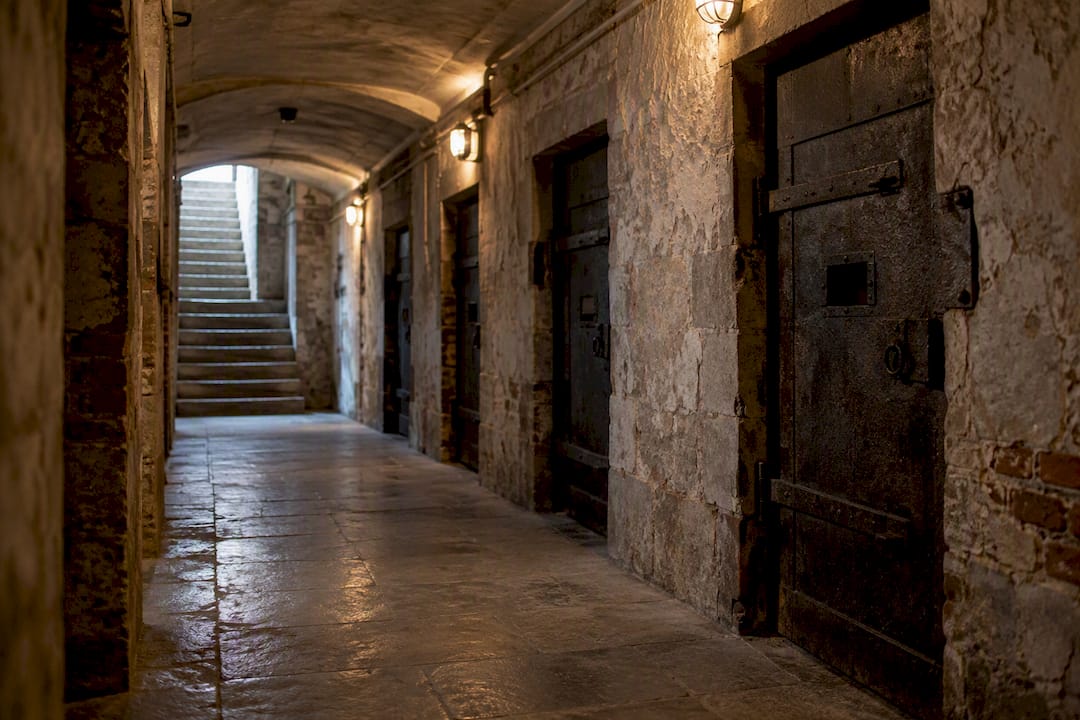
The exhibition at Pomorska Street focuses on the machinery of occupation itself: surveillance, denunciation networks, forced registration and the bureaucratic infrastructure that made mass arrests possible. It’s a colder, more procedural experience than the personal storytelling at Schindler’s Factory, and that contrast is deliberate. Where the Factory humanises individual stories, Pomorska Street shows the administrative system that made those individual tragedies possible at scale.
Visiting Pomorska Street works best as part of the full Memory Trail sequence rather than as a standalone stop, since the building makes more sense once you’ve seen how it connects to the Factory’s civilian narrative and the Eagle Pharmacy’s smaller, community-level view of occupation. Allow around 45 minutes here, less than you’d need at the Factory, since the exhibition is more compact and text-heavy.
Krakow’s resistance movements and where to see their traces
Kraków’s underground resistance operated under constant risk, coordinating with the wider Polish Home Army network while facing brutal reprisals whenever cells were uncovered. Unlike Warsaw, Kraków never staged an uprising on the scale of the 1944 Warsaw Uprising, and that absence is itself historically significant: German administrative and military concentration in Kraków, which the occupiers used as the capital of the General Government, made large-scale armed insurrection there far riskier and less viable.
That doesn’t mean resistance was absent. Underground printing operations, intelligence gathering, and support networks for those in hiding operated throughout the occupation, often coordinated through ordinary-looking premises across the city. Some of this activity intersected directly with the story told at Schindler’s Factory, where accounts of civilian resistance and quiet acts of protection against German administration form part of the permanent exhibition’s documentary and eyewitness material.
Pomorska Street’s exhibition also documents the German response to resistance activity, since many of those detained and interrogated there were suspected members of underground networks. Visiting the two sites together, Pomorska Street for the crackdown and Schindler’s Factory for the civilian response, gives a more complete picture than either site offers alone. There’s no single dedicated “uprising museum” in Kraków the way there is in Warsaw, which reflects the different character of resistance here: dispersed, cautious, and woven into daily life rather than concentrated in one dramatic event.
Where to find deeper WWII exhibitions beyond the Memory Trail
The Museum of Krakow runs several branches that go beyond the headline Memory Trail sites, and they reward a second day in the city if your schedule allows it. The core permanent exhibition, Kraków under Nazi Occupation 1939–1945, sits at Schindler’s Factory and uses documentary photographs, eyewitness accounts and multimedia staging to walk visitors through the full arc of occupation, from the September 1939 invasion to the postwar Stalinist period.
Smaller branches fill in specific gaps. The Eagle Pharmacy branch focuses tightly on how ordinary Kraków residents, including the pharmacy’s Polish owner, quietly assisted Jewish neighbours confined to the nearby ghetto. Pomorska Street, covered above, handles the machinery of German control. None of these branches duplicates another; each was designed to cover a distinct angle of the same five or six wartime years.
If your interest runs specifically to Jewish heritage rather than the broader occupation story, the Galicia Jewish Museum sits slightly apart from the Museum of Krakow network but complements it well, focusing on prewar Jewish life and its destruction through an extensive photographic archive rather than occupation-era artefacts. Treat the two museum groups as complementary rather than overlapping: Museum of Krakow tells you what happened to the city, Galicia tells you what was lost from it.
Krakow under occupation: the historical context worth knowing before you go
German forces entered Kraków on September 6, 1939, less than a week after the invasion of Poland began, and the city quickly became the administrative capital of the General Government, the Nazi-controlled zone covering much of central Poland. That decision shaped everything that followed: Kraków saw heavier German administrative presence than most Polish cities, which meant tighter control, more surveillance infrastructure, and a ghetto established specifically to isolate the city’s Jewish population from March 1941 onward, as the USHMM’s history of the Kraków ghetto documents.
Kraków’s Jewish population, once one of the largest and most established in Poland, was confined, exploited for forced labour and ultimately deported to camps including Płaszów and Auschwitz-Birkenau. Oskar Schindler’s factory, which employed Jewish workers under conditions that ultimately saved many from deportation, sits at the centre of this story precisely because it shows an exception to an otherwise devastating pattern.
One detail surprises many British visitors: Kraków’s old town survived the war almost entirely intact, unlike Warsaw. That wasn’t chance. The city’s historic core avoided the large-scale bombing and deliberate destruction inflicted elsewhere in Poland, which is why medieval Kraków still stands today while so much of Warsaw had to be rebuilt from rubble after 1945.
Why guided interpretation changes what you take from these sites
Curators built Schindler’s Factory as theatrical, layered storytelling on purpose, and that design rewards guided interpretation: a good local guide connects the multimedia rooms to the wider Memory Trail and to Kraków’s own resistance history in ways a solo visit often misses. ComFort Tours Cracow runs small-group visits precisely for this reason, using local guides who help travellers read these sites in sequence rather than in isolation. Solo visits still work well for readers who prefer their own pace; guided visits simply add context that’s easy to walk past otherwise.
— Damian Fort
Book your Krakow WWII sites tour with local guides who know the history
These routes often run with small groups, so you’re never trying to hear a guide over forty other people at Schindler’s Factory. That’s the practical difference: smaller groups mean more time with each guide, easier questions, and less standing around waiting for a crowd to move on.
Guided options include an Auschwitz-Birkenau memorial visit with transport and hotel pickup, a private Schindler’s Factory tour, and a private walking tour through Jewish Kazimierz and the former ghetto. Guides handle timed-entry bookings in advance, which matters most at Auschwitz-Birkenau, where entry slots sell out weeks ahead in peak season. Travellers combining a city stay with a Płaszów and Factory day can also add an airport transfer, priced from 100 to 150 PLN one-off, to bookend the trip without arranging separate taxis.
Check current availability and see the full range of WWII and heritage tours to book the dates that fit your visit.
Sources
- Oskar Schindler’s Enamel Factory – Museum of Krakow
- Memory Trail – Museum of Krakow
- Muzeum KL Plaszow
- Galicia Jewish Museum
FAQ
What are the top WWII attractions in Kraków?
The top sites are Oskar Schindler’s Enamel Factory and the wider Memory Trail, the KL Płaszów memorial, the Galicia Jewish Museum, and the Kazimierz cluster of synagogues and the Eagle Pharmacy. Most visitors add Auschwitz-Birkenau as a separate day trip, since it sits roughly 90 minutes outside the city.
Why wasn’t Kraków bombed during WWII?
Kraków’s medieval old town survived largely because it avoided the large-scale destruction inflicted on cities like Warsaw, escaping the deliberate levelling that followed the 1944 Warsaw Uprising. The city became the administrative capital of the German-run General Government, which brought heavy occupation and a ghetto but spared the historic architecture from bombing.
Did Britain help Poland during WWII?
Britain declared war on Germany on September 3, 1939, directly in response to the invasion of Poland, and hosted the Polish government-in-exile throughout the occupation. Polish forces, including airmen who fought in the Battle of Britain, served alongside British forces for the remainder of the war.
What was the most beautiful city destroyed in WWII?
Warsaw is usually cited as the clearest example, heavily damaged following the 1944 uprising and subsequent German reprisals, according to the USHMM’s account of the Kraków ghetto’s wider wartime context. Kraków, by contrast, is often noted precisely because its historic core survived almost untouched.
How long should I spend at Schindler’s Factory?
Allow 90 to 150 minutes for the full exhibition, since the multimedia rooms and preserved office reward a slower pace than a typical museum walk-through. Book online in advance, as sales close six hours before your slot, though limited box-office tickets are sometimes available on the day.