
Modern English favours Krakow (or Kraków, keeping the Polish diacritic) in almost every context, from travel writing to news reporting. Cracow was once the standard English form but now reads as dated, surviving mostly in older texts and archived headlines. The name itself comes from Polish, and knowing why helps explain both the spelling and how to say it properly.
TL;DR:
- The spelling “Krakow” is now the standard English form in travel guides, airline systems, and online booking platforms due to ease of typing and modern usage.
- “Cracow” was common in the past and still appears in historical documents or older titles, but it is considered outdated for current writing.
- The Polish pronunciation of Krakow is roughly “KRAH.koof,” with the final sound closer to “v” or “f,” and English pronunciations often differ significantly from the native form.
- Using “Kraków” with the diacritic is most accurate in formal or academic contexts, but “Krakow” often avoids input issues in travel booking or online forms.
- Variations in spelling reflect historical translation practices, but the choice depends on the context, with “Krakow” preferred for modern travel and informal writing.
Table of Contents
- Krakow: the modern English spelling
- Cracow: where the older spelling came from
- Kraków: the Polish original and what it means
- How do you actually say Krakow?
- Why did English end up with two spellings?
- Which form should you actually use?
- What years of guiding in Krakow actually teach you
- Sources
- FAQ
Krakow: the modern English spelling
Pick up any current guidebook, and you will see Krakow rather than Cracow. It is the anglicised version of the Polish Kraków, simply stripped of the accent mark English keyboards and older print systems could not easily reproduce. Wikipedia treats Krakow and Cracow as redirects to the same entry, but notes that usage has shifted firmly towards the K spelling. Britannica follows the same convention, which tells you where the reference-book consensus sits.
You will encounter “Krakow” in:
- Airline booking systems and airport codes referencing the city
- Contemporary newspaper travel sections and guidebooks
- Wikipedia and Britannica entries, plus most tourism boards
- Booking platforms for hotels, tours, and transport around the city
If you are writing an email to a Polish contact, drafting a blog post, or filling in a travel form, Krakow is the safe, current choice. It is recognisable, searchable, and matches what nearly every modern publication already uses.
Cracow: where the older spelling came from
Cracow is not wrong, exactly. It is simply out of step with how English handles the name today. The spelling has genuine history behind it, rooted in older transliteration habits that favoured a C where Polish uses K, following patterns borrowed from Latin and French renderings of Slavic place names.
Newspaper archives show the shift plainly. A 1993 New York Times travel piece used “Cracow” throughout, reflecting standard practice at the time. Within a couple of decades, most major outlets had moved on.
Cracow still appears, and legitimately so, in a few places:
- Historical documents, treaties, and pre-1990s scholarship
- Direct quotations from older sources, where changing the spelling would misrepresent the original text
- Some formal or academic titles that predate the shift, such as older university names
If you are quoting a historical text verbatim, keep Cracow as written. Rewriting someone else’s words to match current fashion is a bigger error than using an old spelling.
Kraków: the Polish original and what it means
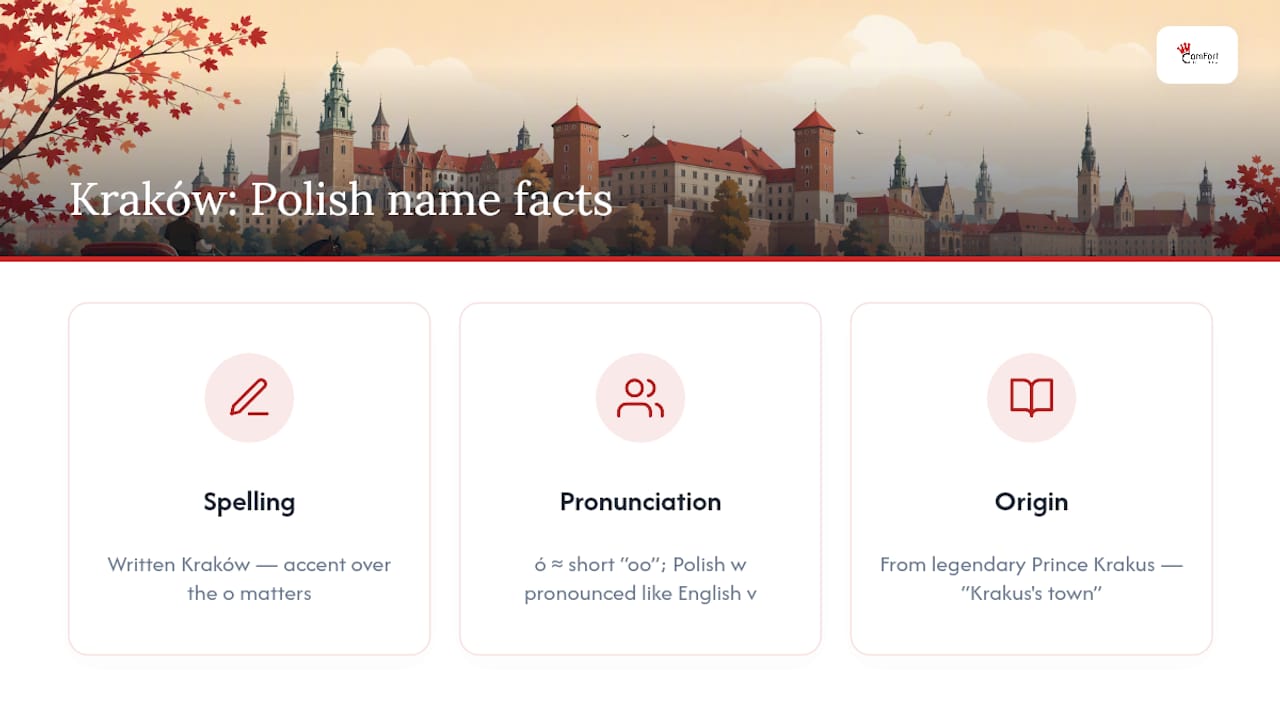
The Polish spelling is Kraków, and that little accent over the “o” is not decorative. It marks a vowel sound closer to a short “oo” than a plain “o”, which is part of why English speakers tend to drop it rather than mangle it. Polish “w” is also pronounced like an English “v”, a detail that trips up almost everyone on a first visit.
The city’s full formal name in Polish is simply Kraków, with no longer official form attached in everyday use. Its origin traces back to the legendary Prince Krakus, the semi-mythical founder credited with establishing a settlement on the hill now occupied by Wawel Castle. Wikipedia’s entry explains that the name essentially means “Krakus’s town”, an old possessive form that has survived over a thousand years of language change largely intact.
How do you actually say Krakow?
Here is the part that catches most visitors out: the English pronunciations of “Krakow” and “Cracow” differ from each other and from the Polish original, sometimes quite a lot.
According to Cambridge Dictionary, British English says “Krakow” as /kræk/, while American English favours /krɑː.kaʊ/. The Cracow entry records a near-identical pattern, UK /ˈkræk.of/ and US /Akron.kaʊ/, confirming that the spelling swap does not change how anglophones actually voice the word.
The Polish pronunciation is different again, roughly “KRAH.koof”, with that final consonant landing closer to a “v” or soft “f” than the “ow” sound English speakers default to. HowToPronounce offers audio examples if you want to hear it directly rather than decode phonetic symbols.
Practical tips for getting close enough:
- Say “rah” rather than “ray” for the first syllable
- End with a soft “v” or “f” sound, not a drawn-out “ow”
- Do not worry about nailing it perfectly. Locals hear mangled Polish from tourists daily and rarely take offence
Why did English end up with two spellings?
Multiple European languages have handled Polish place names differently for centuries, and Kraków’s name passed through several filters before settling into English. Latin chronicles, German administrative documents, and French diplomatic correspondence all rendered Slavic names using their own orthographic habits, and English inherited a patchwork rather than a single clean transliteration.
The C spelling likely gained traction through these secondary channels rather than direct transcription from Polish. Once “Cracow” was established in English print during the 19th and early 20th centuries, it stuck through inertia rather than accuracy.
The real turning point came later, as international travel expanded and publishers began prioritising fidelity to the original Polish over inherited European convention. Removing the diacritic while keeping the K, producing “Krakow”, offered a middle ground: closer to Kraków than Cracow ever was, but still typeable on a standard English keyboard. Wikipedia’s overview traces this drift, and it mirrors what happened to other Central European city names anglicised over the same period.
Which form should you actually use?
The honest answer depends on context, not personal preference. A few rules of thumb make the decision automatic:
- Writing formally or academically? Use Kraków if your publication supports diacritics; it is the most accurate and increasingly the professional default.
- Writing everyday English prose, emails, or travel content? Use Krakow. It is understood everywhere, easy to type, and matches current press convention.
- Quoting historical material? Leave Cracow exactly as the original source wrote it.
- Speaking aloud? Either English pronunciation works. Nobody will misunderstand you, and locals appreciate any attempt at the Polish version even more.
- Booking travel or filling in forms? Check the platform. Some booking systems and itinerary tools still expect Krakow without the accent to avoid input errors.
Pro Tip: If you are drafting an itinerary or booking confirmation, type “Krakow” without the accent. Diacritics occasionally break search fields on booking platforms and payment forms, so the plain K spelling avoids unnecessary friction.
What years of guiding in Krakow actually teach you
Spend enough time meeting visitors at the airport or outside Wawel Castle, and you notice something dictionaries cannot capture: nobody arrives already knowing which spelling is “right”, and almost nobody needs to. What they need is confidence saying the name out loud, because that is where the actual hesitation lives, not on the page.
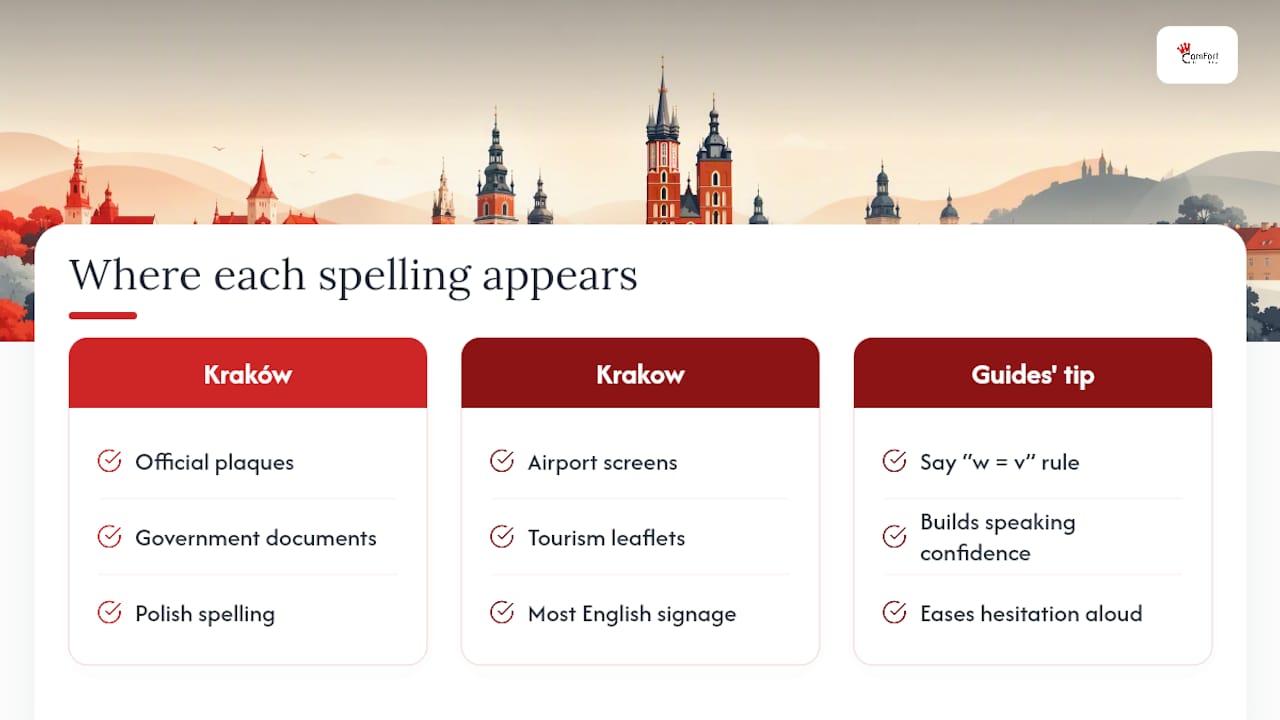
Signage across the city already reflects this split. Official plaques and government documents use Kraków, while airport screens, tourism leaflets, and most English signage default to Krakow. Both are correct in their own lane, and treating them as a strict either/or misses how the city itself operates day to day. Small-group guiding has taught me that visitors relax the moment someone tells them the “w equals v” rule rather than handing them a phonetic chart. That one detail does more for confidence than any spelling debate.
Readers planning an actual trip rather than a spelling decision will get more out of a practical three-day Krakow itinerary or a closer look at the city’s historic landmarks than further linguistic analysis. The spelling matters less once you are standing in the Main Square.
— Damian Fort
If the history and pronunciation have you itching to see the place in person, ComFort Tours Cracow runs small-group and private guided tours across the city and its surroundings, including Auschwitz-Birkenau, the Wieliczka Salt Mine, and the Tatra Mountains near Zakopane. Guides work in multiple languages and tailor itineraries around what you actually want to see rather than a fixed script. Browse the full range of guided tours in Krakow to find one that fits, whether that is a heritage walk through the old town or a private day trip further afield.
Sources
FAQ
How do locals pronounce Kraków?
Poles say it roughly as “KRAH.koof”, with the final “w” sounding like an English “v” or soft “f” rather than the “ow” English speakers default to.
Is Cracow worth visiting?
Whether you spell it Cracow or Krakow, the city holds one of Europe’s best-preserved medieval old towns, a UNESCO-listed historic centre, and easy access to the Wieliczka Salt Mine and Auschwitz-Birkenau memorial, so yes, it consistently rewards a visit.
What is a Cracow?
“Cracow” is simply the older English spelling of the Polish city Kraków, common in English print through most of the 20th century before publishers shifted towards “Krakow”.
Where should visitors be cautious in Kraków?
Standard city-centre caution applies: watch for overpriced restaurants directly on the Main Square, be wary of unofficial taxi touts outside the train station, and book Auschwitz-Birkenau or salt mine visits through a reputable operator rather than turning up unannounced, since both sites manage strict daily capacity.
Should I use Krakow or Kraków in formal writing?
Use Kraków if your publishing format supports the diacritic, since it is the accurate Polish form; use Krakow when writing in plain English text or where the accent risks causing input errors on forms and booking platforms.