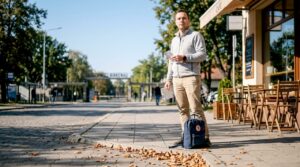
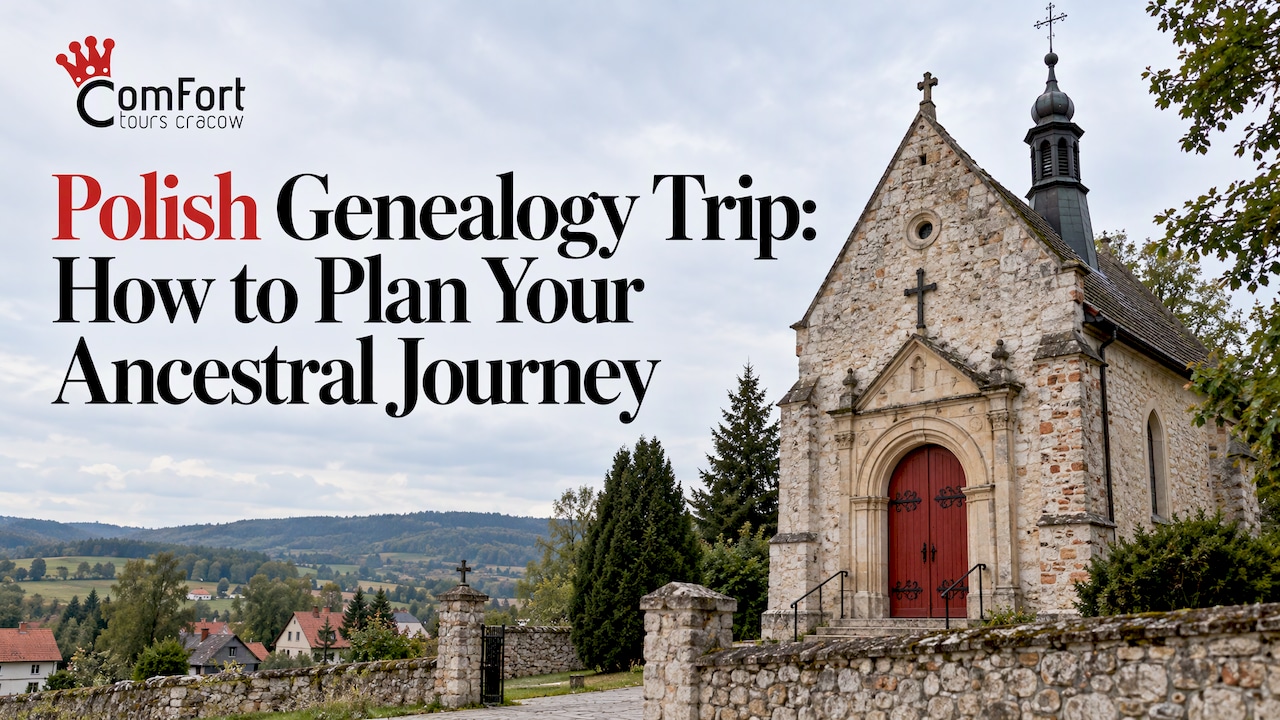
A Polish genealogy trip is a journey that combines archive work with visits to the places your family came from: the village, the parish church, the cemetery, sometimes a living relative. The trip works best when the paperwork is done first. Know the exact locality and the parish before you book flights, check how each archive handles visitors, and arrange a driver or guide for the rural stretch, because that is where most of the emotion and most of the difficulty sit.
We are a family-run team in Kraków, and many of the guests who come to us want something more personal than the usual sights. This guide is how we would walk a friend through it.
Key Takeaways
- Find the place first. Without the village and the parish (and the religion or denomination), no archive can help you.
- Do most of the record work online before you travel, using Poland’s national digital archive and regional archive portals.
- Expect the landscape to have changed: churches demolished, cemeteries overgrown, borders and place names shifted.
- Plan archive days around opening rules and holidays, and leave several months to prepare.
- Rural Poland is easiest with a private driver and, if your Polish is limited, a guide who can speak to people for you.
Table of Contents
- What a Polish genealogy trip actually is
- Step 1: Gather what your family already has
- Step 2: Identify the village when you only have a hint
- Step 3: Do the record work from your sofa
- Step 4: Plan the archive days
- Step 5: What to expect at the village itself
- Step 6: Transport, safety and getting around
- A sample week from the UK
- Add the flavour of the place
- Let us handle the journey
- FAQ
- Sources
What a Polish genealogy trip actually is
People picture two different trips under this name. The first is a research trip: you spend your days in a state archive, reading registers of births, marriages and deaths. The second is a roots trip: you stand in the place where your great-grandparents lived, walk the lanes, find the church where they were baptised, and perhaps meet someone who remembers the family name.
The best trips are both. The records tell you who and when. The place tells you what it felt like. First-hand accounts from travellers describe exactly this mix: visits to ancestral homes, villages, churches, cemeteries and former estates, often alongside archive work. One traveller combined genealogy and sightseeing over 23 days, locating his grandfather’s birthplace, meeting cousins and consulting church records along the way.
You do not need 23 days. If you have done the preparation, a well-planned trip of a week can reach a village, an archive and a cemetery. We have written up a realistic version in 5 to 7 days to visit your ancestral Polish village from the UK, and a broader primer in how to discover your Polish roots.
Step 1: Gather what your family already has
Before anything else, empty the drawers. Poland’s own archival guidance for people planning genealogical research says to collect all available information and documents, including every certificate, register-entry copy and photocopy, even if damaged, hard to read or incomprehensible. That last part matters. The smudged photocopy you cannot read may contain the one spelling of a village that unlocks everything.
Look for:
- Birth, marriage and death certificates, and baptism or naturalisation papers
- Passenger lists, ship manifests and immigration cards
- Military papers, passports and old identity documents
- Letters and postcards, especially anything with a return address
- Photographs with a photographer’s stamp from a town on the back
- Family stories, even vague ones: “near Tarnów”, “the village with the wooden church”
Write down names with every spelling variant you know. Surnames were recorded by priests and clerks in Polish, Latin, German or Russian depending on the period, so the version in your family may not match the one in the register.
The three facts you must have
The same guide is blunt: research cannot properly start without the place where the family lived and knowledge of where births, marriages and deaths were registered. You also need the religion or denomination, because that determines which parish or community kept the books. So before you plan a route, aim to have:
- The name of the village or town
- The religion or denomination of the family
- The parish (or civil registry district) where events were recorded
These three are not background detail. They decide which parish, civil office or archive can hold the record you want.
Step 2: Identify the village when you only have a hint
Many British families hold a name that is half remembered. Here is how people usually narrow it down.
Start with immigration-era paperwork. One researcher’s account shows how Social Security applications led to a village near Sandomierz, which was then checked at the archive in Sandomierz. Naturalisation papers, passenger lists and military records often name a place of birth that the family never spoke about.
Use historical gazetteers. Poland’s archival guide recommends historical gazetteers to establish a locality’s former administrative, religious and denominational affiliations. It names the 1880 to 1902 Geographical Dictionary and the 1933 to 1934 Gazetteer of towns and villages. These tell you which parish a hamlet belonged to, which is often not the church nearest to it today.
Expect borders and names to have moved. Depending on the era, your ancestors’ village may have sat in a different state, and records may be held in an archive far from where you would guess. Check the former affiliation before choosing which archive to visit.

Step 3: Do the record work from your sofa
You can now get a long way without leaving home. Poland’s National Digital Archives runs Szukajwarchiwach.gov.pl, which provides descriptions and scans from Polish archives, including parish and civil-registration material from the PRADZIAD programme. The archive says it can be used from home with just a browser, and that digital copies can generally be downloaded and copied unless a description says otherwise.
The practical workflow is simple, and the Lublin State Archive describes it well: search the archive and collection, choose the register series and year, then open the scans. Civil-register books commonly include an index that leads you to the act number, so look for the index at the back of each year’s book before you read page by page.
The goal before you fly is to arrive with:
- A shortlist of acts you have already found online (so you can verify or request fuller copies)
- Notes on which records are not online and where they are held
- The exact name and address of every archive or registry office you plan to visit
It is worth knowing that records move. A diary of research in Nowy Żmigród describes ordering civil-register copies at the local registry office and then visiting the archive after older records had been transferred. Always confirm where a register is held today, not where it was held when a blog was written.
Step 4: Plan the archive days
Archives are not like museums. Access rules differ, and they are strict. One 2014 research trip to Poznań reported that the State Archive limited how many records could be pulled and when, and allowed photographs but not scans or ordered copies. Rules change, so treat that as a reminder to ask, not as the current policy.
Some habits that save heartache:
- Start at least three months ahead. The same traveller recommends this for overseas research trips, and we agree.
- Check opening hours and Polish public holidays before fixing dates. Archives often have shorter hours than you expect.
- Email the archive first to confirm what you can order, how many items per day and whether you need to register.
- Bring printed family trees and research sheets. Paper still beats a phone when you are showing a clerk who you are looking for.
- Consider a guide if your Polish is limited. Reading Latin or Russian-era registers is a skill of its own, but even simply asking the right question at a counter makes a difference.
Keep your archive days away from the long drives. One day at the archive, one day in the village, is a calmer rhythm than trying to do both in a morning.
Step 5: What to expect at the village itself
This is the part nobody can fully prepare you for, and it is why we love this kind of trip.
Visits can bring emotion and context: seeing the church where a baptism was recorded, the fields that shaped a family’s life, a cemetery with your surname on several stones. But do not expect a film set. One family account from the Vistula valley shows that abandoned or demolished churches and overgrown cemeteries may leave little visible evidence, even when the location is correct.
Another traveller’s story shows how things really go. Joseph Faska found that a local contact’s landmarks, a taxi and an archive visit helped him reach a small ancestral town, but finding the right grave was hard when markers were missing or the wrong cemetery was visited. That is the voice of experience: the village is rarely the problem, the cemetery often is.
Plan for change, not for a photograph
- Ask the parish office (or the nearest town hall) whether there is a cemetery register or a person who looks after the graves.
- Expect older Jewish cemeteries and former Protestant or Orthodox burial grounds to be small, fenced off or hard to spot. A local guide helps here.
- Talk to older residents. A few kind words in Polish, or a guide who can translate, often lead to the story that no register holds.
- Photograph the church, the road signs, the landscape. The building you came for may be gone, but the setting is still yours to record.
Step 6: Transport, safety and getting around
Rural Poland is lovely, and not always easy by public transport. Many family villages lie several kilometres from the nearest station, and bus timetables are thin at weekends.
If you drive yourself, the UK government’s travel advice says UK photocard licence holders can drive in Poland for up to six months, should carry their licence, ID, vehicle registration and insurance papers, and may meet narrow or poorly surfaced minor roads and frequent roadworks. Allow extra time, especially on the back roads that lead to villages.
On trains and in busy stations, the same FCDO page advises you to keep valuables out of sight, avoid walking alone in isolated areas at night, and validate public-transport tickets. Sensible, simple advice, and worth following with a bag of precious family papers. Our own note on feeling safe in Poland covers more of the everyday detail.
A private driver takes the stress out of the route and gives you the one thing you will want in the village: time. You can stop when a church appears, wait while you search a cemetery, and go home the same evening. Our private driver and transport service is built for that kind of flexible day, and our airport transfer between Kraków and the airport is listed at 100 to 150 PLN one way.

A sample week from the UK
This is a framework, not a fixed schedule. Adjust it to where your family came from.
| Day | Focus | Notes |
|---|---|---|
| 1 | Arrive in Kraków, settle in | Keep it light after the flight |
| 2 | Kraków orientation and family papers review | Check printouts, plan routes |
| 3 | Archive or registry office | Pre-order or pre-register where required |
| 4 | Ancestral village, parish and cemetery | Private driver, local guide if needed |
| 5 | Second village, relatives or follow-up archive visit | Keep flexible for leads from day 4 |
| 6 | Kraków history day | Time to reflect on what you found |
| 7 | Departure | Allow time for the airport transfer |
The village day is the one you cannot rush, which is why we suggest leaving day 5 open. A name you hear on day 4 will often change your plan.
Add the flavour of the place
A genealogy trip is not only documents. Sitting down in a village inn for a bowl of something warm, or tasting the regional dishes your grandmother may have cooked, brings the records to life. Food travel writers explain the role of local cuisine in tourism, and on a roots trip the same idea works at a personal level: a plate of pierogi in the right region can tell you as much as a register entry about how your family lived. Ask your guide or host what people in that area traditionally eat.
Many visitors also pair the personal journey with the wider history of the region. If that appeals, our two-day Memory Trail through Kraków’s WWII sites gives useful context for what your family lived through.
Our view: the records tell you who, the place tells you why
We are a family-run team, and we see this again and again: guests arrive with a folder of certificates and leave with a story. The folder matters, and we urge everyone to do the paperwork first, but it is the moment in front of the church or the field that stays with people.
That is why we keep groups small and itineraries flexible. A genealogy day cannot follow a rigid timetable. You might need an extra hour in a cemetery, or a detour because an elderly neighbour remembers your surname. With a private driver, a knowledgeable local guide and multi-language support, we can bend the day around what you find.
Our advice is simple. Bring your questions, bring your documents, and let us take care of the roads, the translation and the timing, so you can be fully present when you reach the place your family came from.
Damian Fort
Let us handle the journey
We design heritage and genealogy tours around Kraków and beyond, with customised itineraries, private transport and guides who speak your language. Whether you need a driver to reach a village, an escort for an archive day or a calm start with an airport pick-up, we will shape the plan around your family’s story.
Browse our options on the ComFort Tours Cracow booking page, or read about our Polish roots explorer experience to see how a tailored day can work.
FAQ
How early should I start planning a Polish genealogy trip?
Aim for at least three months. One research-trip account recommends this as a minimum for overseas travel, to allow time to check repository rules and holidays. If your village is still unknown, start earlier, because identifying it can take longer than the trip itself.
Can I find records online before I travel?
Yes, many of them. Poland’s National Digital Archives offers Szukajwarchiwach.gov.pl, with scans from Polish archives and parish and civil-registration material. Not everything is digitised, so use the site to build a shortlist and confirm what you still need to see in person.
What if I only know the name of a region, not the village?
Go back to your family papers and immigration records, which often name a place of birth. Then use historical gazetteers to check the locality’s former parish and affiliation, as Poland’s archival guidance recommends. Once you have a candidate village, confirm it in a register before you build the trip around it.
Do I need a guide or driver?
Not always, but they help a lot in rural areas where public transport is limited and few people speak English. A driver gives you flexibility on the day, and a guide can translate at the parish office, the archive counter or the cemetery gate. You can see our transport options or get in touch to talk through your route.
Will the village look the way my family described it?
Probably not exactly. Churches may have been demolished and cemeteries overgrown, as one family account of the Vistula region shows. Go with an open mind, ask locals for help and treat the landscape, not just the buildings, as part of the story.
Sources
- Practical advice for people planning genealogical research in Poland (CAHR guide)
- Szukajwarchiwach.gov.pl, Search the Archives (National Digital Archives)
- Zbiory online, Archiwum Państwowe w Lublinie
- Safety and security, Poland travel advice (GOV.UK)
- 2004 Trip to Poland and My Mother’s Parents’ Villages
- 12 May 98 (Peter Gwozdz’s account)
- Upstream Vistula, Duninow and Karolewo
- My Two Visits to Sokolow Malopolski
- Your Cousin Caron: 2014 Road Trip to Poland
- Zmigrod, a Shtetl in Galicia
- The role of local cuisine in tourism