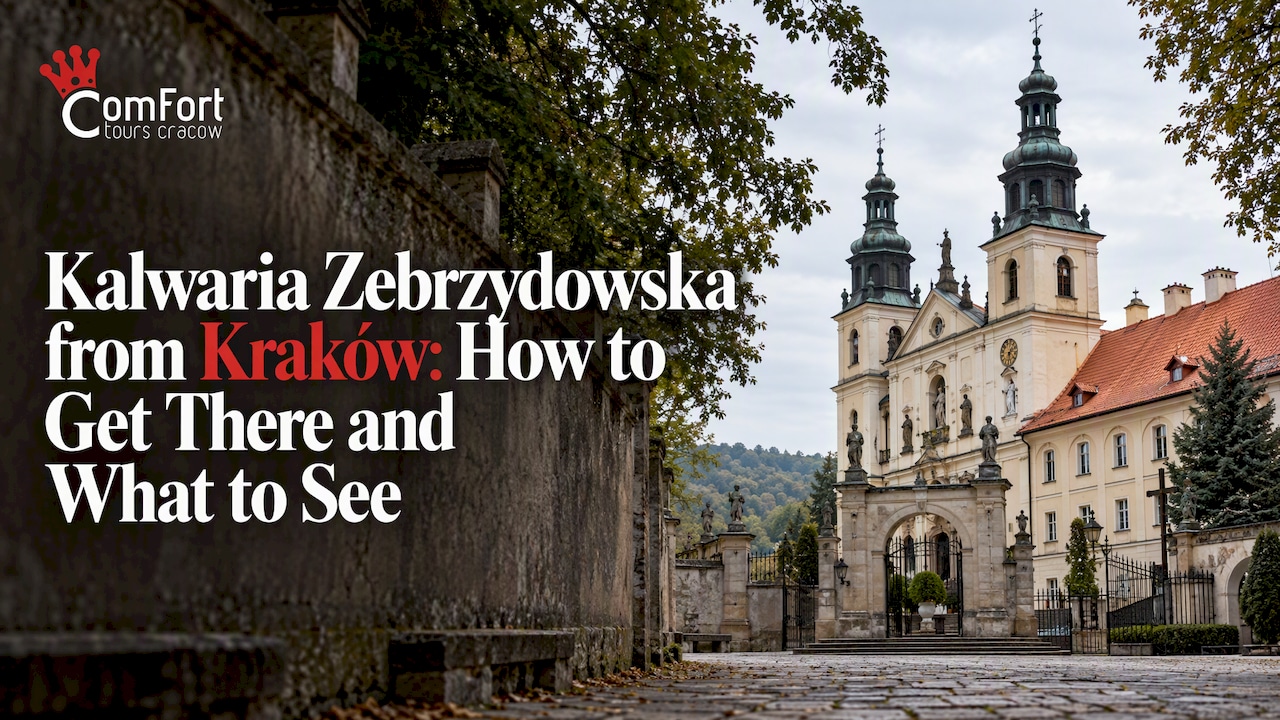
Kalwaria Zebrzydowska is an easy half-day or full-day trip from Kraków. It is roughly 35 to 40 km away. The train is the quickest public option at about 32 to 38 minutes, the bus takes around an hour, and a private car or driver takes about 40 minutes door to door. It is one of those places most UK visitors never hear about, which is exactly why we love taking people there: a hillside of chapels, forest paths and a living pilgrim tradition, with very few tour coaches.
Below, I’ll walk you through each way of getting there, what to check before you leave, how to find the sanctuary from the station, and how to shape the day so it feels relaxed rather than rushed.
Key Takeaways
- The train from Kraków Główny to Kalwaria Zebrzydowska Lanckorona is the fastest public transport, at roughly 32 to 38 minutes.
- The bus takes about an hour and leaves from Kraków’s bus station area, so check the return times, especially in the late afternoon.
- Allow a half-day at the sanctuary: about two hours for the basilica and monastery, and two to five hours if you want to walk the full Kalwaria Paths.
- The sanctuary is a UNESCO World Heritage Site with 42 chapels and churches, so a local guide makes a real difference.
- If you want no timetable stress, a private transfer or a guided day trip combined with Wadowice is the simplest option.
Table of Contents
- What Kalwaria Zebrzydowska actually is
- How to get from Kraków to Kalwaria Zebrzydowska
- Check these things before you go
- From the station to the sanctuary
- What to see once you are there
- Combining Kalwaria with Wadowice
- Our perspective
- Let us arrange it for you
- FAQ
- Sources
What Kalwaria Zebrzydowska actually is
People sometimes call it the “Polish Jerusalem”, and once you are walking among the chapels you understand why. The sanctuary’s own English page explains that it began in 1601, when Mikołaj Zebrzydowski built a chapel on Mount Żarek. Further chapels, built between 1605 and 1617, depict the stations of Christ’s Passion, and Passion and Marian chapels were added later.
UNESCO recognises the site as an exceptional cultural landscape, in which the natural setting became a symbolic representation of the Passion. It also stresses the unbroken tradition of the mysteries still enacted here. That living tradition is what separates Kalwaria from a museum: you will meet pilgrims, hear singing drifting out of a chapel and see people walking the paths in quiet reflection.
It is inscribed on the World Heritage list (in 1999) and, according to the Polish encyclopaedic entry, it holds a basilica, a monastery and 42 chapels and churches scattered along its paths.

How to get from Kraków to Kalwaria Zebrzydowska
There are three realistic options: train, bus or a private car. Each suits a different kind of traveller.
| Option | Typical journey time | Best for |
|---|---|---|
| Train | About 32 to 38 minutes | Speed and predictability |
| Bus | About 45 minutes to 1 hour 4 minutes | Flexible budget travel |
| Car or private driver | About 37 to 45 minutes | Groups, families, no timetable worries |
The times above come from two travel-planning sources: a 2026 comparison of train, bus and car and Rome2Rio’s route page. Road distances vary slightly depending on the starting point, from about 34 km to 40 km.
By train
The station you want is Kalwaria Zebrzydowska Lanckorona. Regional trains on the Kraków Główny to Zakopane line serve it, and Koleje Małopolskie’s timetable page lists it on that corridor. The same 2026 comparison says tickets start from 19 PLN, although fares depend on the day and the train, so treat that as a guide rather than a promise.

The train’s great advantage is that it avoids road traffic when leaving Kraków. The Baltic Cluster writer calls it the best choice for travellers who value speed and predictability, and I agree: on a busy weekday morning that matters.
Timetables change with the season. Polish Railway Lines say their network tables are updated weekly, so check the exact departures for your travel date rather than relying on a blog post, including this one.
By bus
Buses heading towards Wadowice, Andrychów and Bielsko-Biała leave from Kraków’s bus station, according to the sanctuary’s FAQ. One local listing says buses run hourly, and up to three times an hour at peak times. Rome2Rio’s June 2026 bus page gives an average of 51 minutes, though other pages quote closer to an hour.
The bus drops you in the town rather than at the railway station, which is useful to know when you work out your walk. The bus fare is lower than most UK intercity fares, usually just a few euros according to Rome2Rio.
By car or private driver
Driving takes around 40 to 45 minutes. A car lets you stop along the way, for example at Lanckorona, a small wooden-house town nearby, and it removes the return-bus puzzle completely. If you would rather not drive on Polish roads or hunt for parking near the monastery, we can arrange a private driver who waits while you explore. Families and groups often find the cost per person is far lower than expected once you split it.
Check these things before you go
A few small details decide whether the day feels easy or stressful:
- Station or town? Confirm whether you are heading to Kalwaria Zebrzydowska Lanckorona station or the town bus stop. They are not the same place, and the 2026 travel comparison specifically warns readers to verify this.
- Return times. Look up the last sensible return, particularly if you plan to come back in the late afternoon. Buses thin out later in the day.
- Weather and shoes. The paths run through woodland and over hills. Comfortable shoes matter more than a camera.
- Respect for worship. This is an active sanctuary. Dress modestly in the basilica and keep voices low in the chapels.
- Guides. Organised groups of 15 or more can request a sanctuary guide through the Kalwaryjskie Centrum Informacji. English, Italian and German guides need to be booked four days ahead.
From the station to the sanctuary
From the station you walk into the town centre, reach the Market, then take 3 Maja Street, which leads uphill towards the Bernardine Monastery. A route description from a Polish hiking site follows the same line. The sanctuary’s address is Bernardyńska 46, as given on the official English page, which is handy for a taxi or a satnav.
Allow time for the climb. It is not extreme, but if you have older relatives or small children, a taxi or private transfer to the top saves energy for the paths themselves.
What to see once you are there
The heart of the complex is the basilica and the Bernardine monastery. From there the Kalwaria Paths branch out through the hills, linking the chapels. Together they recreate Jerusalem’s sacred geography in a Polish landscape, which is the big idea behind the whole place.
If religious travel is new to you, this guide to religious travel gives a helpful grounding in how to approach sacred sites respectfully and what to expect from them. Think of Kalwaria as a gentle introduction: beautiful, calm and understandable even if you do not share the faith.
A local guide is worth having. One Polish travel site recommends one for the monastery so visitors see all the interesting places rather than just the obvious ones. In my experience that is true: the stories behind the chapels, the founder’s family and the pilgrim customs are what bring the landscape to life.
How long to allow
The same Polish travel guide suggests a half-day for a visit. Exploring the basilica and monastery takes about two hours, while walking the full Kalwaria Paths can take anywhere from two to five hours depending on the route and your pace. Most UK visitors on a short Kraków break choose one of two plans:
- The quick visit: basilica, monastery and a few chapels, about 2 to 3 hours on site.
- The slow visit: the basilica plus one of the longer path loops, with a picnic or a coffee in town, about 5 hours on site.
Combining Kalwaria with Wadowice
The most popular way to use the day is to pair Kalwaria with Wadowice, the birthplace of Pope John Paul II, which is close by. It makes a satisfying loop: spiritual landscape in the morning, town centre and famous cream cake in the afternoon. We have written a separate Wadowice and Kalwaria day trip plan with the order we recommend.
If you are building a longer stay, our guide to the best day trips from Krakow shows how Kalwaria fits alongside Auschwitz-Birkenau, the Wieliczka Salt Mine and the mountains. Our three-day Kraków itinerary helps you slot a day trip around the city sights.
Our perspective
We are a small, family-run team, and we have learned that Kalwaria Zebrzydowska is a place people underestimate. Visitors expect a quick photo stop and leave saying it was the quietest, most moving morning of their trip.
The transport is the part that puts people off, and it does not need to. If you enjoy independent travel, the train is a perfectly good way to go. Just check the timetable the day before and know your return. But if you are travelling with children, with parents, with a group, or you simply want to arrive relaxed, small-group and private arrangements are where we shine. A private vehicle with a driver who knows the roads, and a guide who can explain the chapels as you go, turns a logistical puzzle into a gentle day out.
Our advice: do not rush it. Pick one route, linger in one or two chapels, and let the landscape do the work. Save the second plan for another visit.
— Damian Fort
Let us arrange it for you
We organise small-group and private tours from Kraków, with hotel pickup, private transport, multi-language guides and itineraries adapted to your pace. For a day like this, a private driver is often the easiest way to combine Kalwaria with Wadowice without watching the clock.
See our tours and online booking to browse what we offer, or look at our private driver and transport service if you simply need a reliable ride. Tell us your dates, group size and interests and we will shape the day around you.
FAQ
Is Kalwaria Zebrzydowska worth visiting from Kraków?
Yes, if you enjoy history, architecture, landscapes or quiet places. It is a UNESCO-listed pilgrimage site with 42 chapels and churches, and it is far less crowded than Kraków’s headline attractions. It works especially well combined with Wadowice.
How long does it take to get from Kraków to Kalwaria Zebrzydowska?
The train takes about 32 to 38 minutes, the bus around 45 minutes to an hour, and a car about 40 minutes. Add time for the walk uphill from the station to the monastery. Always check the current timetable for your date.
Can I visit Kalwaria Zebrzydowska without a car?
Yes. Regional trains stop at Kalwaria Zebrzydowska Lanckorona, and buses run from Kraków’s bus station. The main thing to plan is the return journey, particularly in the late afternoon, when services are less frequent.
Do I need a guide?
Not required, but recommended. A guide explains the history and the meaning of the chapels, and shows you places you might miss. Groups of 15 or more can request a sanctuary guide in advance, while smaller parties can book a private guide with us.
How much time should I allow at the sanctuary?
Plan on a half-day. The basilica and monastery take about two hours, and the longer path walks can take between two and five hours depending on your pace.
Sources
- Sanctuary in Kalwaria Zebrzydowska, official English page
- Sanctuary FAQ, Kalwaria Zebrzydowska
- UNESCO World Heritage Centre: Kalwaria Zebrzydowska
- Sanktuarium pasyjno-maryjne w Kalwarii Zebrzydowskiej, encyclopaedic entry
- Kraków – Kalwaria Zebrzydowska: train, bus or car
- Rome2Rio: Kraków Główny to Kalwaria Zebrzydowska
- Rome2Rio: bus Kraków to Kalwaria Zebrzydowska
- Koleje Małopolskie: Kraków Główny to Zakopane timetable
- PKP PLK Portal Pasażera: network timetable
- Sanktuarium Pasyjno-Maryjne w Kalwarii Zebrzydowskiej, bus information
- Góra Żar, Bugaj settlement and Barwałd Castle route
- Kalwaria Zebrzydowska: sightseeing and information
- A Beginner’s Guide to Religious Travel