
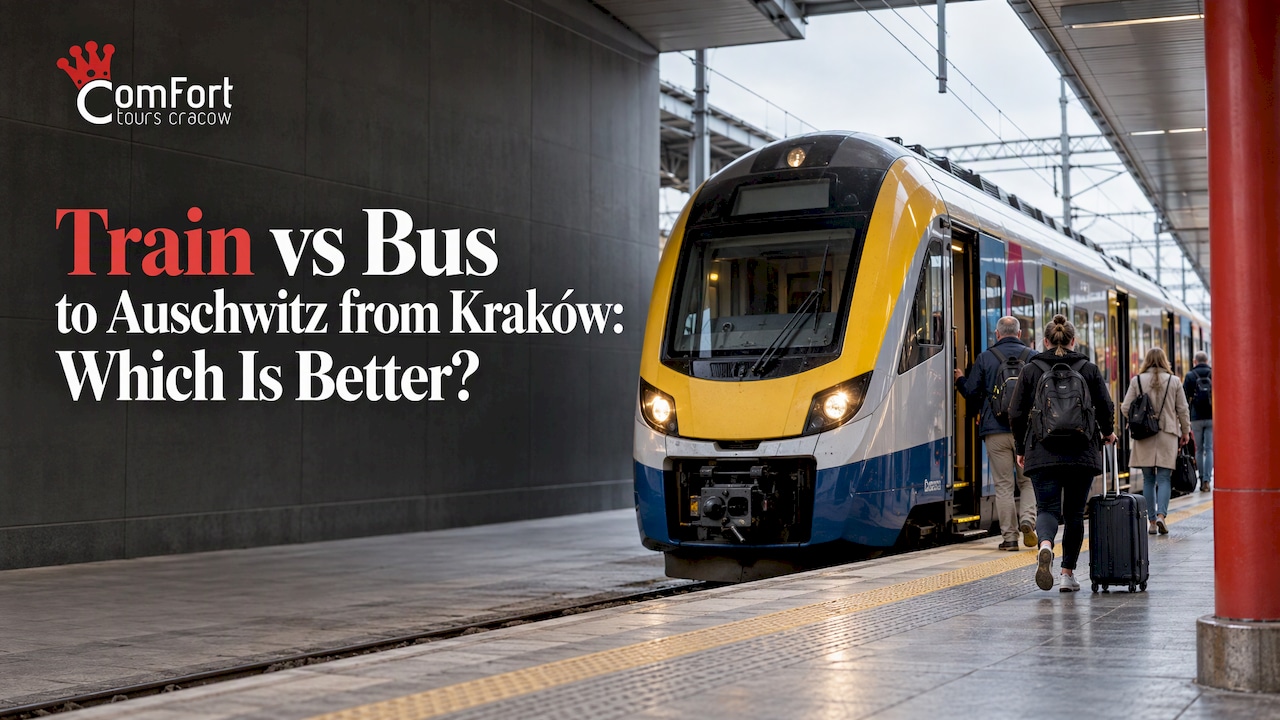
The train is usually quicker on paper, but the bus drops you closer to the gate. The train can take as little as 39 minutes and costs around PLN 18 on the regional line. The direct bus takes longer but stops at the Museum car park. If you want neither the walk nor the timetable puzzle, a private transfer or a guided tour with hotel pickup takes you from your door to the entrance. We are a small family-run team in Kraków, and we have watched hundreds of UK visitors work this out on the morning itself. Here is how it really goes.
Key Takeaways
- The fastest non-stop train takes 39 minutes, but it arrives at Oświęcim station, about 1,500 metres from the Museum.
- The direct Lajkonik bus goes to the Museum car park, so there is no walk or taxi at the far end. It is slower than the train.
- Entry cards are online only since 1 March 2026. Reserve your visit first, then fit the transport around your time slot.
- Public transport suits flexible, independent visitors. A private transfer or guided tour suits families, anyone with mobility needs, and anyone who wants a stress-free return.
Table of Contents
- The short comparison
- Going by train
- Going by bus
- So which is better: train or bus?
- Book the Museum first, then the transport
- Getting around once you are there
- The door-to-door option
- Our perspective
- Plan your Auschwitz day with us
- A simple plan for your day
- FAQ
- Sources
The short comparison
No single option wins on every count. This table shows what matters when you plan the day. The fares are the ones published as of April 2026, so check the operators before you travel.
| Train | Direct bus | Private transfer or guided tour | |
|---|---|---|---|
| Journey time | From 39 minutes on the fastest non-stop service, with other services also listed | Usually longer than the train | Door to door by road, with the time depending on traffic |
| Fare | 18 PLN on the regional line | 27 PLN to the Museum, 20 PLN to Oświęcim station | Quoted per booking |
| Where it drops you | Oświęcim station, then about 1,500 m to the Museum | Museum grounds | The Museum entrance or your hotel |
| Starts from | Kraków Główny | Kraków bus station | Your hotel |
| Best for | Early starters, budget travellers, confident walkers | Independent visitors who want a simple direct ride | Families, groups, mobility needs, first-timers |
Going by train
Trains are the fastest public option. Koleje Małopolskie services run from Kraków Główny to Oświęcim, with two routes known as SKA2 (via Skawina) and SKA3 (via Trzebinia). Faster categories exist too: the quickest non-stop DANUBIUS service takes 39 minutes, and other listed journeys include a 45-minute service.
On cost, the regional fare is 18 PLN. Standard tickets on this route typically range from about PLN 20 to PLN 50, with the faster categories costing more. Discounts exist for children, teenagers, students and seniors.
What happens when you arrive
This is the part that surprises people. The Museum is approximately 1,500 metres from the railway station. That is a walk of roughly 20 minutes for most people, or a short taxi or local bus ride. Many visitors do not budget for it, and then arrive at their entry time flustered rather than composed.
A visit to Auschwitz is heavy emotionally, and it is nicer to arrive calm. I always tell friends to treat the station-to-gate stretch as part of the journey and to leave a generous buffer.
Train timetable notes
The first direct train from Kraków Główny leaves at 05:47 and the last at 19:34. That is a wide window, but your return matters more than your outward trip. Guided visits last several hours, so work out when you will realistically finish, then look at the trains after that. One planning guide points out that a projected arrival back at the station can fall between trains, which means a wait rather than a smooth connection. Build in slack and don’t book the tightest return you can find.
Going by bus
The bus is the simple option. Lajkonik coaches run from Kraków and, according to one local guide, depart from the stop at 55 Więźniów Oświęcimia Street on the return. The nearest stop is the Auschwitz Museum bus stop on the grounds themselves. You step off, and you are there.
Fares as of April 2026 were 20 PLN to Oświęcim Dworzec PKP or 27 PLN to the Auschwitz Museum. Online purchases may receive a discount. A comparison table from one travel guide also lists the 27 PLN fare as paid to the driver, arriving at the car park.
The bus costs a little more than the train and takes longer. In exchange you skip the 1,500 metre transfer and arrive at the Visitor Services Center area with no further planning. That trade suits many visitors very well, especially in cold or wet weather, which Kraków’s autumns and winters bring in plenty.

So which is better: train or bus?
Here is how we would think about it.
- Choose the train if you are an early riser, you like a quick ride, and you are happy to walk or grab a taxi at the other end.
- Choose the bus if you want the shortest path from vehicle to entrance, and you don’t mind a slightly longer ride.
- Choose a private option if you are travelling with children, older relatives, a wheelchair user, or a group, or if you want your day to run to someone else’s timetable rather than yours.
Neither public option is wrong. They are two honest ways to do an independent visit, and the right one depends on how you like to travel.
Book the Museum first, then the transport
The most important change for UK visitors is not about transport at all. Individual visitors must reserve entry cards online at visit.auschwitz.org, and cards are no longer available at the Museum entrance since 1 March 2026. Free entry cards can be booked up to seven days in advance, while guided-tour cards remain available until sold out.
The Museum has said that its own website is the only official system for reserving entry cards and that it does not cooperate with outside entities for reservations. If you want to understand the options, our guide to Auschwitz ticket types walks through which one to book and when.
Once you have your time slot, choose the train or bus that gets you there with room to spare. Do it in that order, not the other way round. One travel guide recommends reserving the English-language visit before committing to transport, and we agree. It stops you buying a train ticket for a slot that is already gone.

Timing for the free unguided slots
If you plan to visit on your own with a free pass, note that those slots tend to sit late in the day. According to one ticketing guide, free unguided slots start in the late afternoon, with the start varying by month: 17:00 from April to September, 16:00 in October and March, 15:00 in February, 14:00 in January and November, and 13:00 in December. Because the exact rules can change, check the official site before you plan around them.
That has a knock-on effect for transport. A late-afternoon visit means a late return, and the final direct train leaves at 19:34. Think about that before you commit.
Closed days
The Memorial is closed on 1 January, 25 December and Easter Sunday. Neither the train nor the bus will help you on those days, so plan around them.
Getting around once you are there
Auschwitz I and Auschwitz II-Birkenau are 3.5 km apart. A Museum shuttle moves visitors between the two sites, and it has a platform that allows wheelchair users to enter and exit. Taxis wait at the rank in front of the Museum entrance, and the official page lists HALO TAXI on +48 32 19 194.
Individual guided visitors also get a free shuttle between the sites, including a return to Auschwitz I after the visit. Use the arranged transfer rather than planning to walk between them. Our Birkenau visit guide explains what to expect at the second site.
Mobility and accessibility
The distances on site are considerable. At Auschwitz I, around 1,300 metres must be covered, including a nearly 600 metre passage with a 300 metre tunnel section. At Birkenau, more than 2,000 metres must be covered, and the historic surfaces make navigation difficult for people with mobility impairments.
The Museum offers free wheelchair and walker rentals. You can request them by email in advance or at the ENTRY PASSES desk on the day. The Visitors’ Service Centre has ramps, an accessible indoor platform and floor paths for the visually impaired.
If anyone in your group needs step-free travel, plan the transport first. A 1,500 metre transfer from the station is a big ask, and a direct drop is far more comfortable. Our page on Auschwitz wheelchair access for UK visitors covers what we arrange.
The door-to-door option
Public transport is perfectly workable, but it asks you to manage several things: a timetable, a station, a walk or a taxi, an entry slot, and a return. Many UK visitors would rather spend that energy on the visit itself.
That is why we run live-guided Auschwitz-Birkenau tours with transportation and hotel pickup as well as private-transport visits to the Museum. We keep groups small, so you are not following a flag through a crowd. Our guides cover the history and the human stories, and the transport is simply part of the day. There is no walk from a station, no wait on a platform, and no worry about the last train home.
If you want to see how the tour works, our Auschwitz tour from Krakow page sets it out. For a guide with a guaranteed transfer, see our page for UK travellers booking a licensed guide. If you want the distances and road times, we have a page on the distance from Kraków to Auschwitz.
Arriving by air
Many UK visitors fly into Kraków and head to Auschwitz in the same trip. Our guide to getting from Kraków airport to Auschwitz shows how to link the two. Our standard airport transfer between Kraków and the airport is 100-150 PLN one-off.
Our perspective
We have taken guests to Auschwitz-Birkenau for years, and the question we hear most often is whether to take the train or the bus. Our honest answer is that both work, and that the better question is how you want to feel when you walk through the gate.
This is not a place you want to arrive at in a rush. We built our approach around small groups and a calm, unhurried day: hotel pickup, a knowledgeable guide, and transport arranged so you never have to think about connections. Our guides tell the history with care, and we think that is easier when you are not watching the clock for a train.
If you prefer to travel independently, do it well. Book your entry card first, leave a generous buffer, and plan your return before you set out. If you would rather leave the logistics to us, we are a family-run team and we will look after you from start to finish.
Damian Fort
Plan your Auschwitz day with us
If you want the easy version, we will collect you from your Kraków hotel, take you to Auschwitz-Birkenau with a live guide, and bring you back. We also arrange private-transport visits and tailored itineraries, and our guides work in several languages. You can see everything on our tours page.
If you are combining Auschwitz with another day out, we also run a half-day Wieliczka Salt Mine tour. Our guide to Auschwitz and Wieliczka in one day sets out your options. For groups and business travellers, we offer a private driver and conference transport.
A simple plan for your day
Whichever route you pick, the same sequence keeps the day smooth.
- Reserve your entry card or guided visit on the official Museum site.
- Pick your transport to arrive at least 30 to 45 minutes before your slot.
- Look up the return options and note the last departure you could catch.
- Pack for the weather, since a lot of the visit is outdoors. Comfortable shoes matter most.
- Keep the morning free of other plans. The visit deserves your full attention.
If you want a wider checklist, our guide to planning your visit covers the details.
FAQ
Can I get a train from Kraków to Auschwitz?
Yes. Trains run from Kraków Główny to Oświęcim, and the fastest non-stop service takes 39 minutes. The station is about 1,500 metres from the Museum, so you will need to walk or take a taxi or local bus for the last stretch.
Is the bus or the train cheaper?
The regional train fare was 18 PLN as of April 2026, while the Lajkonik bus was 27 PLN to the Museum. Fares change, so check the operators before you go. Faster train categories cost more than the regional fare.
Can I buy Auschwitz tickets at the gate?
No. Since 1 March 2026, individual visitors must reserve entry cards online and nothing is available at the entrance. Use the official Museum site and be wary of anyone else selling entry.
Is public transport suitable for wheelchair users?
It depends on the person, and the station-to-Museum stretch is the difficult part. The Museum provides free wheelchair and walker rentals, and a direct road transfer avoids the 1,500 metre transfer altogether. Contact the Museum in advance and talk to us about transport.
Sources
- Getting to the Museum, Auschwitz-Birkenau
- Entry cards available only online from 1 March, Auschwitz-Birkenau
- Additional information for persons with mobility difficulties, Auschwitz-Birkenau
- Train Krakow Main to Oswiecim, PolishTrains
- How to get to Oswiecim (Auschwitz) from Krakow
- Krakow to Auschwitz: Trains, Coaches and Entry Tickets
- Kraków Auschwitz and Wieliczka tickets guide
- Auschwitz from Kraków: tickets, tours, how to get there