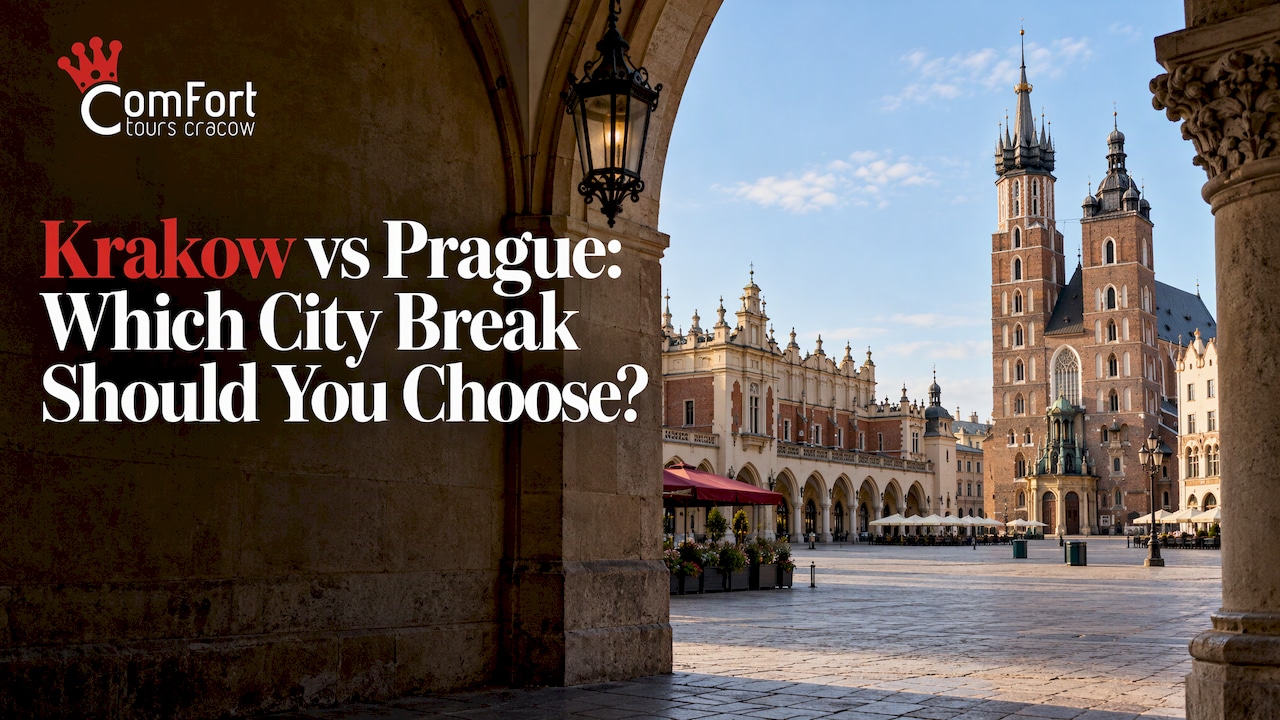
Choose Krakow if you want a compact, walkable old town, a deep and moving history, and day trips to Auschwitz-Birkenau and the Wieliczka Salt Mine. Choose Prague if you want a dense, polished capital with fairy-tale skylines and castle towns on its doorstep. Both are wonderful, and honestly you can’t go badly wrong. We live and work in Krakow, so we’re biased, but we’ll be fair about where Prague wins.
Key Takeaways
- Krakow is small, intimate and easy on foot. Prague is a bigger, grander capital spread over several districts.
- Krakow’s history leans towards royal Poland, Jewish heritage and the Second World War. Prague’s leans towards Bohemian kings and imperial grandeur.
- Both cities have official visitor passes with published prices, so you can budget before you fly.
- UK visitors can travel to both under Schengen rules without a visa for up to 90 days in any 180-day period.
- Doing both is possible by direct train, but expect most of a day on the rails.
Table of Contents
- Krakow vs Prague at a glance
- Atmosphere and architecture: small and soulful, or grand and layered
- The sights: what you’ll actually see
- What each city costs
- Day trips: Auschwitz and salt versus castle towns
- Travelling between the two
- Practical points for UK visitors
- Which city for which traveller?
- Our perspective: why Krakow wins with a local beside you
- See Krakow with ComFort Tours Cracow
- FAQ
- Sources
Krakow vs Prague at a glance
| Krakow | Prague | |
|---|---|---|
| Feel | Intimate, student-led, slower | Grand, layered, full capital |
| Centre | One compact old town around the Main Market Square | Several districts with landmarks close together |
| Signature sights | Wawel Castle, St Mary’s Basilica, Kazimierz | Charles Bridge, Prague Castle, St Vitus Cathedral, Josefov |
| Big day trips | Auschwitz-Birkenau, Wieliczka Salt Mine, Zakopane and the Tatras | Kutná Hora, Karlštejn, Český Krumlov |
| Visitor pass | Krakow Tourist Card, from €30 for 1 day | Prague Visitor Pass, from 2,700 CZK for 48 hours |
| Best for | History, heritage, great value, mountain escapes | Architecture, photography, a classic capital break |
Atmosphere and architecture: small and soulful, or grand and layered
I’ll start with the feeling, because that’s what people remember long after the museum tickets are forgotten.
Krakow’s old town revolves around Rynek Główny, one of the largest medieval market squares in Europe. You can cross the whole historic centre on foot in about twenty minutes, which means you spend your trip wandering, not commuting. The mood is a little slower and a little more student-ish, with cellar bars, courtyards and cafés tucked behind heavy wooden doors. Most of that character is described by travel writers as compact and relaxed, and we’d agree.
Prague feels like a capital because it is one. Gothic and Baroque landmarks sit in several districts, joined by trams, bridges and steep climbs towards the castle. Some visitors describe the experience as dense and layered, with one postcard view after another. If your idea of a city break is to point a camera at a skyline every ten minutes, Prague delivers.
The honest difference is this. Krakow feels more intimate and more authentically Polish. Prague has the more polished infrastructure and a bigger, more international tourism industry. Neither is better, they simply suit different moods.

The sights: what you’ll actually see
In Krakow the big names are Wawel Castle and Cathedral, St Mary’s Basilica with its trumpet call from the tower, and the Main Market Square itself. According to a 2025 report from the Krakow Tourism Organisation, the Main Market Square was the most visited place in the city in 2024, accounting for 27.7% of visits. Then there’s Kazimierz, the old Jewish quarter, where history, street food and independent galleries share the same cobbles. Beyond the postcards, our guide to Krakow’s hidden gems shows where locals actually go.
Prague’s headline acts are Charles Bridge, Prague Castle, St Vitus Cathedral and Josefov, the Jewish Quarter. The castle is the star: official Czech figures show it was the most visited tourist site in the Czech Republic in 2025, with over 2.7 million visitors. Go early. One traveller’s tip we like is to cross Charles Bridge at around 6am, when the crowds haven’t arrived and the light is beautiful.
On history, the two cities tell different stories. Prague was the seat of the Holy Roman Empire, and it shows in the scale of its buildings. Krakow was a Polish royal capital, and it sits close to some of the most important Holocaust sites in Europe. If you want a trip that makes you think as well as admire, Krakow has the edge.
What each city costs
Krakow is generally the more budget-friendly of the two, particularly for mid-range dining and accommodation, while Prague charges more in the tourist-heavy central districts. Both have cheap, effective public transport. Rather than guess at menu prices, here are the official numbers you can check yourself.
Krakow. The Krakow Tourist Card covers around 40 attractions, including the Cloth Hall galleries, Rynek Underground, St Mary’s Church and Schindler’s Factory. It costs €30 for 1 day with unlimited public transport, €45 for 2 days and €52 for 3 days. A 3-day Museum & Attraction Pass without transport is €30, and students pay €23. It doesn’t include Wawel or the Wieliczka Salt Mine, so budget separately for those. For getting around, the city’s trams and buses use the same tickets across the whole city zone, from single and 20-minute tickets up to 7-day passes. Validate your ticket when you board.
Prague. The official Prague Visitor Pass includes more than 70 experiences, a Vltava cruise and unlimited public transport including the airport. Adults pay 2,700 CZK for 48 hours, 3,300 CZK for 72 hours and 3,900 CZK for 120 hours. Single sights are priced separately: the basic Prague Castle ticket is 450 CZK (300 CZK reduced, 950 CZK family), valid for two days with one entry to each building. The New Town Hall Tower is 100 CZK, and the Petřín Mirror Maze is 150 CZK.
A sensible way to use these: add up the sights you genuinely want, then compare that total with the pass. In Krakow, many people find a pass worthwhile mainly if they plan on lots of museums and trams. If you’d rather have a local fill your day, our low-cost walking tours guide explains how to see a lot without spending a lot, and our Krakow food tour breakdown helps you decide where your zloty are best spent. Prices are published figures that change, so check the official pages before you book.
Day trips: Auschwitz and salt versus castle towns
This is where the two cities really split.
From Krakow, the two classic day trips are Auschwitz-Birkenau and the Wieliczka Salt Mine. Auschwitz is a sombre, important visit, and it deserves proper preparation. Our guides to the Auschwitz Memorial and Birkenau explain what to expect. Wieliczka is a very different day out: chambers carved from salt, underground chapels and a long staircase, covered in our Wieliczka tour routes guide. If you’re heading south, the Tatra Mountains and Zakopane are an easy day, and families who want some fresh air love the Dunajec river rafting.
From Prague, the favourites are medieval castle towns: Kutná Hora, Karlštejn and Český Krumlov. Prague itself has family attractions such as a zoo, a funicular and river boat trips, which make it easy with children. Krakow has parks and playful corners too, but the strongest family experiences tend to be the day trips out of town.
One practical warning from experience: popular Auschwitz-Birkenau tours fill up. Travellers often suggest booking four to six weeks ahead, and in busy seasons we’d say the earlier the better.
Travelling between the two
Can you do both? Yes, and many people do. A direct train links Krakow Central and Prague. Trainline lists an average journey of 6 hours 33 minutes, with the fastest services taking 5 hours 55 minutes, and advance fares starting from £9.84. The ride runs through Polish and Czech countryside and is generally considered scenic, so pack a book and a flask.
It’s a long day, though, so don’t try to squeeze it into a weekend. If you’re doing both cities, give each at least three nights and treat the train as a quiet half-day of its own.
Practical points for UK visitors
A few things worth sorting before you go:
- Entry. Czechia follows Schengen rules, and UK travellers can visit for up to 90 days in any 180-day period without a visa, according to GOV.UK’s Czechia entry requirements. Poland is also in Schengen.
- Passport and EES. Poland requires valid travel documents, and UK travellers entering the Schengen area may need to register biometric details under the Entry/Exit System. Check the GOV.UK Poland travel advice before you travel, as procedures can change.
- Health cover. A GHIC or EHIC covers medically necessary state healthcare in Poland, but it isn’t a replacement for travel insurance, which can pay for costs the card doesn’t. The same GOV.UK page explains the difference.
- Driving. UK citizens can use a UK photocard driving licence in Poland for up to 6 months. If you’d rather not drive at all, that’s where a local driver earns their keep.
Which city for which traveller?
A long weekend, first time in Central Europe. Both work. Krakow is easier for a two- or three-night trip because everything is close. Prague rewards a slightly longer stay because it’s more spread out.
History lovers. Krakow, mainly for the Jewish heritage, the wartime story and proximity to Auschwitz-Birkenau. Prague is the pick if medieval and imperial history is your thing.
Families. Prague for ready-made attractions in the city. Krakow for countryside days, rafting and the salt mine.
Couples and photographers. Prague for skyline drama, Krakow for atmosphere and evenings.
Solo travellers. Krakow’s compact centre makes it comfortable and sociable. A small-group tour is a friendly way to meet people.

Groups and business travellers. Whichever city you choose, plan transport early. If you’re weighing up destinations for a shorter stay, this piece on small group travel in Europe is a helpful read on how group size changes a trip.
Our perspective: why Krakow wins with a local beside you
We’ll say it plainly: we think Krakow is the better city to experience with a guide. Its stories are tucked away in courtyards, in Kazimierz’s side streets and in the places beyond the city, and they come alive when someone who lives here tells them.
That’s why we keep our groups small. When you’re not part of a crowd of fifty, you can ask questions, linger where something catches your eye and hear the story behind the building rather than just its date. We’re a family-run team, and we plan every trip around the people on it: private transport, tailored itineraries and guides who speak your language.
Prague is gorgeous and we’d happily go. But if you want a trip that feels personal, with history you can feel and a day out to Auschwitz-Birkenau or Wieliczka arranged without stress, Krakow is where we’d send a friend.
Damian Fort
See Krakow with ComFort Tours Cracow
If Krakow wins your vote, we’ll take care of the details. We run small-group and private guided tours, including Auschwitz-Birkenau with transport and hotel pickup, the Wieliczka Salt Mine, Jewish Kazimierz and the Ghetto, Nowa Huta, Schindler’s Factory, and day trips to Zakopane and the Tatras. You can browse everything on our tours page.
Landing at the airport? Our airport transfer between Krakow and the airport is listed at 100-150 PLN one-off, and our guide to Krakow airport transfer costs explains what to expect. For couples wanting something special there’s ComFort Premium, and if you’re bringing a team, take a look at our group tours and private driver and conference transport. Not sure what to see in the city itself? Start with our Cracow city tours.
FAQ
Is Krakow or Prague better for a short city break?
For two or three nights, Krakow is easier because the old town, Wawel and Kazimierz are all within walking distance. Prague suits a slightly longer stay, as its landmarks are spread across several districts. Both are good choices for a first Central European trip.
Is Krakow cheaper than Prague?
Krakow is generally the more budget-friendly city, especially for mid-range meals and accommodation. Prague tends to cost more in its busy central districts. Check the official visitor pass prices for Krakow and Prague to compare your own itinerary.
How long is the train from Krakow to Prague?
On average it takes about 6 hours 33 minutes, and the fastest services take 5 hours 55 minutes, according to Trainline. Direct trains run, and advance fares can start from £9.84. It’s a scenic journey, but plan it as a half-day.
Do UK citizens need a visa for Krakow or Prague?
No, not for short stays. Under Schengen rules UK travellers can stay in Czechia for up to 90 days in any 180-day period without a visa. Check GOV.UK for the latest guidance on passports and the Entry/Exit System before you travel.
Sources
- Krakow vs Prague comparison, PolandWander
- Krakow Tourism Organisation report on tourist traffic in 2024
- Tourdata, Czech tourism statistics
- Krakow Tourist Card, Kraków Travel
- Municipal transport, Kraków Travel
- Prague Visitor Pass, Prague City Tourism
- Prague Castle, Prague City Tourism
- New Town Hall, Prague City Tourism
- Krakow Central to Prague by train, Trainline
- Czechia entry requirements, GOV.UK
- Poland travel advice, GOV.UK
- Small group travels to Europe, Elite Travel