
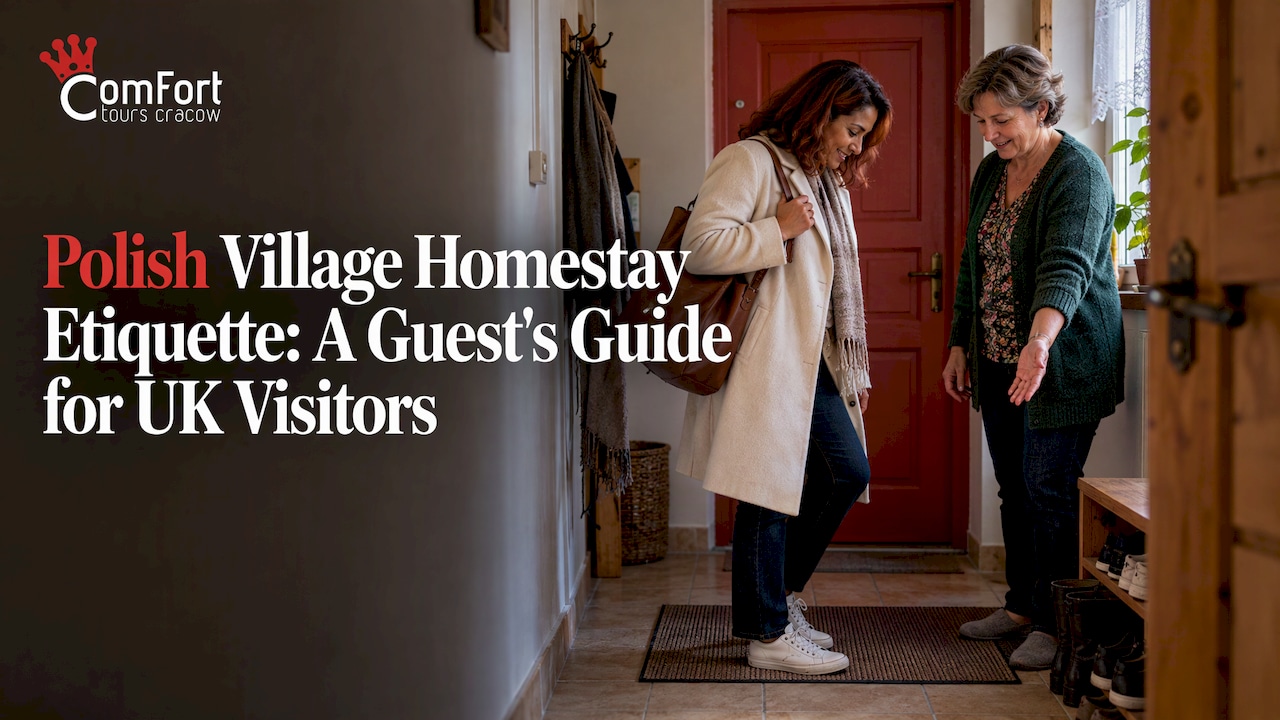
Staying in a Polish village home is one of the warmest ways to see the country, and the etiquette is gentler than most visitors fear. Greet formally, take your shoes off, arrive at the table on time, eat what you are offered with real appreciation, bring something small to share and follow the rhythm of the house. At ComFort Tours Cracow we are a family-run team in Kraków, and we like our guests to arrive in a village already knowing the few phrases and habits that make a host smile. Here is what we would tell a friend before the trip.
Key Takeaways
- Start formally: a handshake and “Dzień dobry”, with Pan or Pani until your hosts invite you to use first names.
- Shoes come off at the door unless your hosts say otherwise, and a small, modest gift to share is always welcome.
- Expect generous, long meals. Say “Smacznego”, accept seconds if you can, and decline warmly if you cannot.
- Fit in with the household’s routines, including mealtimes, and ask before smoking indoors or wandering around the house.
- Customs differ between families, regions and generations, so treat every rule here as a sensible starting point rather than a script.
Table of Contents
- Why village etiquette feels different from a hotel stay
- Greetings and forms of address
- Arriving, shoes and the house itself
- Mealtimes: the heart of the stay
- Gifts: small, thoughtful, shared
- Living by the household’s rhythm
- Language: bridging the gap
- When customs differ
- Where we come in
- Our view: etiquette is really about attention
- FAQ
- Sources
Why village etiquette feels different from a hotel stay
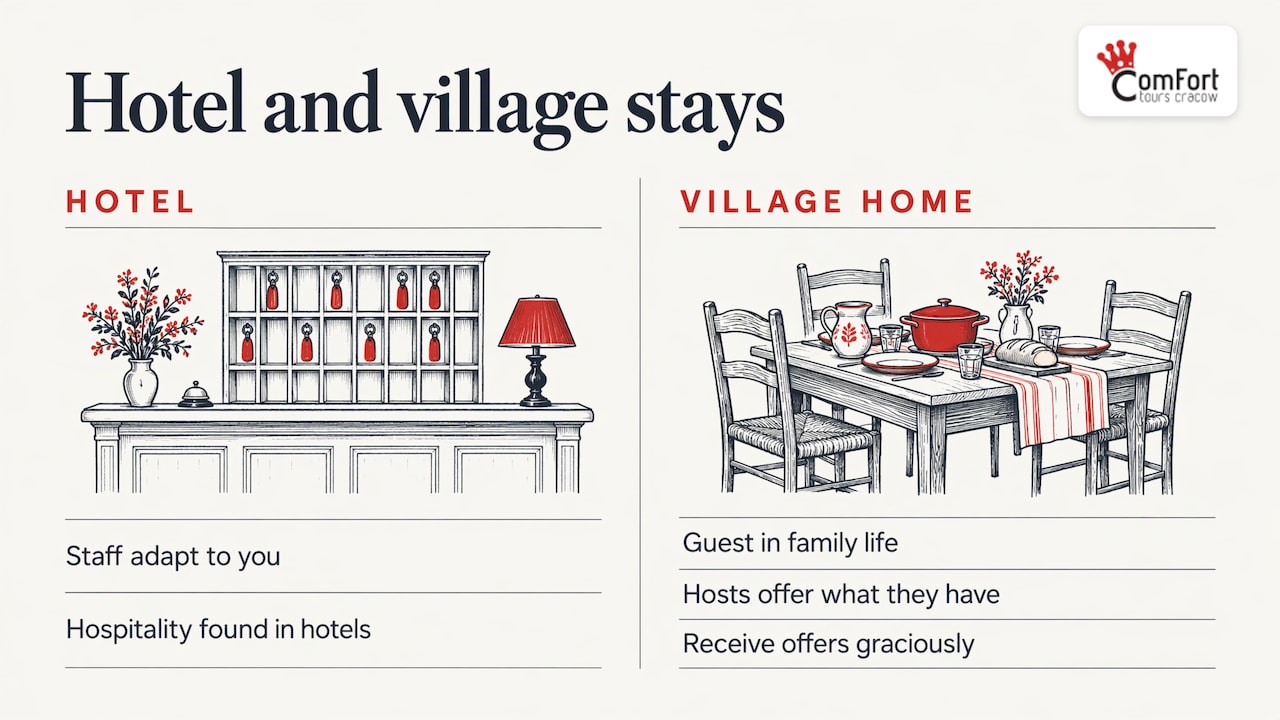
In a hotel, the staff adapt to you. In a village home, you are a guest in someone’s family life, and that changes the unwritten rules. Poland’s official tourism guidance describes hospitality as something visitors can meet everywhere, from hotels and manor houses to farms. In a family home, hosts tend to offer generously whatever they have, which is lovely, but it also means you are expected to receive it graciously.
A 2024 peer-reviewed study by Kamil Łuczaj, based on interviews with 15 Polish hosts in and around Rzeszów, found that household routines and expectations can be a source of difficulty in longer home stays. The same study argues that hospitality is shaped by language, gender and social class. So the useful approach is simple: learn the common courtesies below, then watch your hosts and follow their lead.
Greetings and forms of address
First impressions matter, and formality is the safe default.
- Handshake first. A university savoir-vivre guide for students says a handshake is the safest first-meeting greeting, and that hand-kissing is old-fashioned to younger generations. Do not attempt it yourself.
- Formal hello. Zakopane’s tourism site lists “Dzień dobry” (good day) and “Dobry wieczór” (good evening) as the standard phrases for a first meeting, rather than the casual “Cześć”.
- Pan and Pani. Poland’s official tourism board notes that people who do not know each other well generally avoid informal address. Pan means Mr or Sir, Pani means Mrs or Madam. Polska App’s etiquette guide adds that you should switch to first names only when invited.
In practice, you might say “Dzień dobry, Pani Krystyno” to your hostess and wait. If she says “mów mi po imieniu” (call me by my name), the ice is broken. Our five-day Polish phrase kit with phonetic lines gives you these basics in a form that is easy to say out loud on the plane.
Arriving, shoes and the house itself
The moment you cross the threshold, look at the hallway. If there is a row of shoes and slippers, you have your answer. The WSEI guide says guests should take off their shoes unless the hosts explicitly say they may leave them on. Many hosts will hand you a pair of tapczki (house slippers), and it is nice to accept them with a smile. Pack a pair of clean, thick socks, because village floors can be cool in autumn and winter.
A few other points on the house:
- Smoking. The US Defense Language Institute’s Polish country guide says to ask permission before smoking indoors. Most hosts will point you to the garden.
- The grand tour. The same guide notes that a tour of the home should not be assumed or requested as a matter of course. Stay in the rooms you are invited into and let your hosts offer to show you more.
- Bedroom and bathroom. Ask where things are and when the bathroom is free in the morning. In a family home, one bathroom may serve everyone.
Mealtimes: the heart of the stay
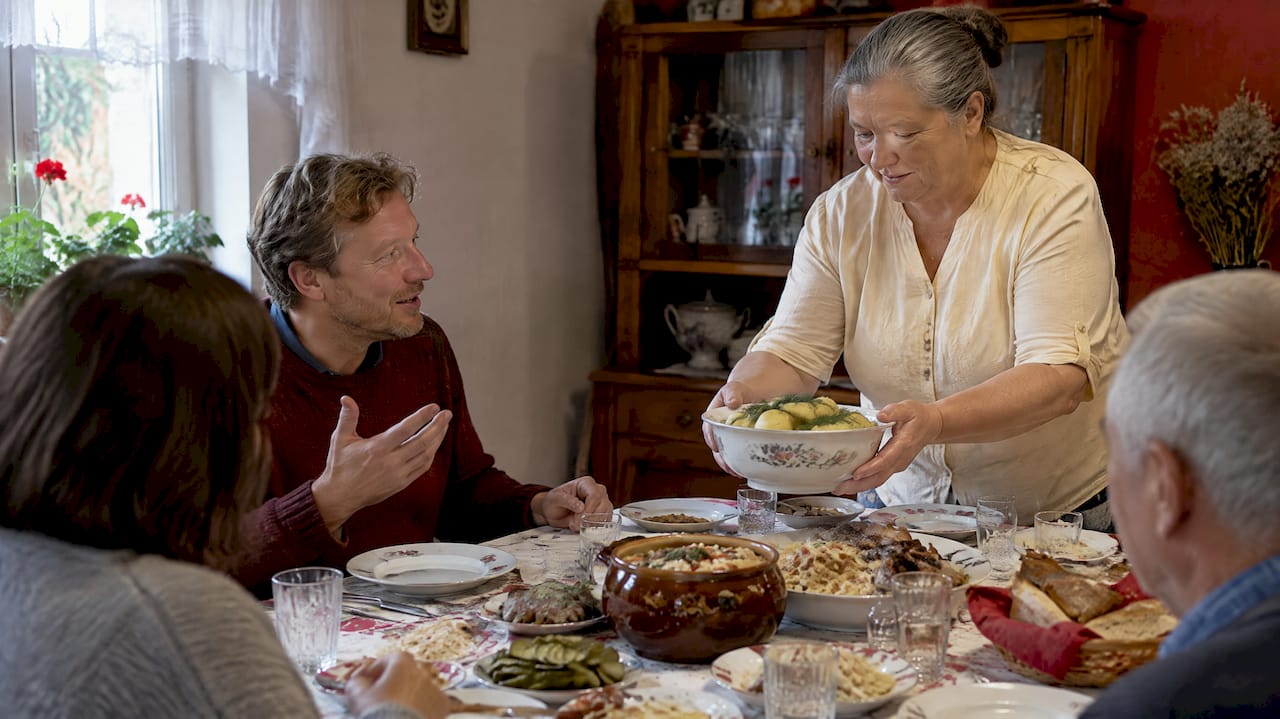
Food is where hospitality becomes visible. Poland’s tourism board says that Poles enjoy long meals with conversation and show hospitality through abundant servings. Plan to linger.
What you might be served
A typical family dinner follows a clear sequence. A Polish-language course guide describes soup, then a main such as pork chop with potatoes and salad, then dessert like cheesecake or apple pie. Poland’s official tourism guidance mentions a similar dinner of soup, a pork cutlet with cabbage and potatoes, cheesecake and homemade liqueur. If you have allergies or follow a vegetarian diet, tell your hosts before you arrive, not at the table, so they can plan without feeling caught out.
Table manners that win hearts
- Be on time. Meals are an event. A historical account from Poland’s National Institute of Rural Culture and Heritage describes guests on longer stays being expected to follow the household’s routines and arrive punctually for meals.
- Wait for the signal. The Defense Language Institute guide says the meal may begin once everyone is seated and the host says “Smacznego”, which means roughly “enjoy your meal”. Traveller Poland also suggests wishing others “smacznego” before eating and thanking the host afterwards.
- Accept seconds, or refuse kindly. The Defense Language Institute guide treats conversation during the meal and accepting seconds as welcome gestures. If you are truly full, the course guide suggests thanking the host and saying the meal was delicious rather than a blunt “no”. Try: “Dziękuję, było pyszne, ale już nie dam rady.” (Thank you, it was delicious, but I really cannot manage more.)
- Talk. Polish hosts may seem reserved at first, but Poland’s tourism board says they soon break the ice and enjoy talking about family. Ask about the village, the garden, the recipes. Curiosity is the best compliment.
A worked example: your host brings a third helping of pierogi. You say “Dziękuję, pyszne!”, take a small half portion, and ask how she makes the filling. You have honoured the food and the cook without overeating.
Gifts: small, thoughtful, shared
Arriving empty-handed is the one slip that is easy to avoid. The WSEI guide advises that when you are invited to a home you bring a gift, with something to share being the best option. Good UK-friendly ideas include:
- A box of good biscuits or chocolates, or shortbread from home.
- A quality tea, which many hosts enjoy trying.
- Flowers for the hostess. Polska App recommends an odd number of flowers and avoiding chrysanthemums, which are associated with funerals.
- Small treats or a picture book about your own region for children in the house.
Keep it modest. The Cultural Atlas notes that appropriateness matters more than expense, and that gifts may not be opened in front of the giver, so do not wait for a big unwrapping.
Living by the household’s rhythm
The Rural Culture Institute’s history of Polish hospitality describes a two-way arrangement: hosts provide comfort, and guests on longer stays fit in with household schedules, including rising at a time convenient to residents. That still works as a modern rule of thumb.
- Ask at the start what time breakfast is and when the family usually goes to bed.
- Tell your hosts your plans for the day, so lunch is not cooked for people who are out.
- Offer to help clear the table. They may refuse, but the offer is noticed.
- Keep noise down early and late, especially in an old wooden house where sound carries.
- Dress modestly if the family goes to church, and see our church dress code guide if you plan to visit one.
Tipping and paying
If you are staying with a family, a cash payment for the room is one thing and a tip is another: hosts are not service staff. For the wider picture of when tipping is expected in Poland, read our guide to tipping in Poland. A heartfelt thank-you note, a photograph sent later or a gift left on departure goes down far better than money pressed into a hand.
Language: bridging the gap
Many UK visitors worry that they will not understand anyone. Łuczaj’s research reports that hosts use a variety of communication strategies, including English among younger people, and that language ability affects how deep and comfortable the relationship becomes. Older villagers may speak little English, so a few phrases and a patient smile go a long way.
Learn these before you go:
- Dzień dobry: good day
- Dziękuję: thank you
- Smacznego: enjoy your meal
- Przepraszam: excuse me, sorry
- Poproszę: could I have, please
A translation app helps when you need to explain an allergy or a change of plan. Speak slowly, point, smile and laugh at your own mistakes. Hosts nearly always take effort as respect.
When customs differ
No etiquette list covers every family. The Łuczaj study stresses that hospitality varies with language, gender and social class, so advice should not be read as a rigid script. Poland’s tourism board notes that the bread-and-salt welcome persists mainly in rural settings, so you may meet it in a village and not in a city. Older hosts may be more formal, younger ones more relaxed about first names and shoes. If you are unsure, ask a friendly question: “Czy mam zdjąć buty?” (Shall I take my shoes off?) always works.
Where we come in
Most of our guests do not need us to run their homestay. They need a smooth journey around it. A homestay in a village often means a long drive from the airport, unfamiliar roads and a first meal waiting at a set time. That is where a comfortable arrival helps you walk in on time, relaxed and smiling.
Our airport transfer between Kraków and the airport is published at 100-150 PLN one-off, and our private driver service covers longer journeys. If you are visiting a family village as part of tracing your roots, our guides can help you plan the trip, and our articles on visiting an ancestral Polish village from the UK and on planning a Polish genealogy trip set out the steps. Our small-group and private tours include multi-language guides, so you can pair your village stay with Kraków, Auschwitz-Birkenau or the Tatras without worrying about logistics. For a taste of village craft and warmth, read about Felicja Curyło’s homestead in Zalipie.
We are ready to plan your private transfers and tours at comforttours.pl.
Our view: etiquette is really about attention
We have welcomed travellers from the UK for years, and the pattern is always the same. The guests who are most loved by their hosts are rarely the ones who memorised every rule. They are the ones who arrive on time, greet people properly, take an interest and say thank you with feeling.
That is why we put so much into the small things. We run small groups so that guests can actually talk with a guide, ask questions and hear the stories behind a place. We arrange flexible transport and tailored itineraries so that your day fits around real life, including a family dinner you do not want to be late for. And our guides speak several languages, because a warm word in the right language opens doors.
If you are heading to a Polish village, think of etiquette as a way of saying “I am glad to be here”. Learn the greeting, carry a small gift, and let us take care of the road.
Damian Fort
FAQ
Do I need to speak Polish to stay with a Polish family?
No, but a few phrases make a big difference. Younger hosts may speak some English, while older ones may rely on gestures and patience. Learning greetings, thank you and “smacznego” shows respect, and our phrase kit is a good place to begin.
Should I take my shoes off in a Polish home?
Yes, unless your hosts say otherwise. A university savoir-vivre guide advises taking shoes off unless hosts explicitly say you may keep them on. Watch the hallway for shoes and slippers, and ask if you are unsure.
What gift should I bring to my hosts?
Bring something modest that can be shared, such as biscuits, chocolates, good tea or flowers in an odd number, avoiding chrysanthemums. Expense is less important than thoughtfulness. Do not expect the gift to be opened in front of you.
Can I call my host by their first name?
Wait to be invited. Begin with Pan or Pani plus the name, or just the formal title, and switch only when your host suggests it. It usually happens quickly once they warm to you.
Sources
- Costumbres polacas, Polonia Travel
- Bräuche und Sitten, Polen Travel
- Savoir-vivre practical tips, WSEI University (2024)
- Etiquette in Poland: greetings, tipping, customs, Polska App
- Basic Polish Phrases for Tourists Visiting Zakopane
- Polish country guide, Defense Language Institute (2020)
- Family in Polish: practical conversations, VARIA (2025)
- Polish Etiquette for Travellers, Traveller Poland
- Polish Etiquette, Cultural Atlas
- Gość w dom, Bóg w dom, National Institute of Rural Culture and Heritage (2022)
- Multifaceted Hospitality, Kamil Łuczaj (2024)