Yes, you can visit Auschwitz in winter, and for many travellers it is the more powerful time to go. Snow, silence and thin crowds change the atmosphere of the site completely. The trade off is logistics: you need to book entry cards in advance, expect shorter daylight opening hours, and dress properly for conditions that sit between -5°C and 5°C, colder still with wind chill across the open fields of Birkenau.
Before anything else, do this:
- Reserve entry cards at Auschwitz as early as possible.
- Book a guided tour, since guide-educators are mandatory across much of the October to March window.
- Pack for genuinely cold, exposed conditions, not a mild British December.
Allow around 3.5 to 4 hours on site. Admission to the grounds is free, but guided tours (which include a headset and transfer between Auschwitz I and Birkenau) carry a fee.
Pro Tip: Book a winter tour with hotel pickup. It removes the coldest, most stressful part of the day, standing at a bus stop before dawn, and gets you straight into the warm queue for entry cards.
Key Takeaways
Visiting Auschwitz in winter rewards advance booking, proper cold-weather clothing, and a guided tour that includes transport, since these three factors determine whether the day runs smoothly or badly.
| Point | Details |
|---|---|
| Book entry cards early | Reserve on visit.auschwitz.org 6 to 8 weeks ahead, since no entry cards are sold at the gate. |
| Expect shorter winter hours | December entrance runs 7:30 to 14:00, so early guided slots matter for finishing in daylight. |
| Dress in proper layers | Temperatures sit between -5°C and 5°C, colder with wind chill across Birkenau’s exposed fields. |
| Guides are effectively mandatory | Individual entry without a guide-educator is very limited between October and March. |
| Choose door-to-door transport | ComFort Tours Cracow’s small-group winter tours include hotel pickup and guaranteed entry slots. |
Table of Contents
- Auschwitz winter visit: booking rules and entry cards
- When is Auschwitz open in winter and when is it closed?
- Do you need a guide in winter, and how long does a visit take?
- How do you get from Kraków to Auschwitz in winter?
- What should you wear for an Auschwitz winter visit?
- What are the on-site facilities and accessibility like in winter?
- A UK traveller’s pre-trip checklist for winter
- Photographing Auschwitz in winter light
- Where to stay near Auschwitz during winter
- Are audio guides available for winter visits?
- Covid-19 and health measures for winter visits
- Book a small-group Auschwitz winter tour with ComFort Tours Cracow
- Sources
- FAQ
Auschwitz winter visit: booking rules and entry cards
The single biggest mistake UK travellers make is assuming they can turn up and buy a ticket. They cannot. Every visitor needs a personalised entry card reserved in advance, and the museum does not sell these at the gate.
Admission to the memorial grounds themselves is free, but the official Auschwitz-Birkenau booking page explains that a guide-educator is recommended, and for large parts of the year, required. During winter months, entrance for individual visitors without a guide is heavily restricted, so most UK travellers end up booking a guided slot regardless of preference.
Book early. December fills fastest of all, partly because of Christmas and New Year travel from the UK, and partly because there are fewer daily slots than in summer.
- Aim to book 6 to 8 weeks ahead for preferred English-language guided slots.
- Confirm whether your chosen tour includes both Auschwitz I and Auschwitz II-Birkenau, or just one site.
- Check whether headset rental and museum transfer are included in the price, since some cheaper listings exclude one or the other.
A standard 3.5 hour guided tour covering both sites, with headset and transfer included, is the version most UK visitors should book. Full official pricing sits on the museum’s own booking page rather than third-party listings, so check there before paying a markup elsewhere.
Pro Tip: If your dates are flexible, avoid the last week of December entirely. It is the single busiest winter period, and slots for English-language guides go first.
When is Auschwitz open in winter and when is it closed?
Winter hours are considerably shorter than summer ones, and this catches people out more than almost anything else.
- December: entrance 7:30 to 14:00
- January: entrance 7:30 to 15:00
- February: entrance 7:30 to 16:00
The museum closes only three days a year: 1 January, 25 December, and Easter Sunday, according to its official opening hours page. Outside those dates, it is open right through winter.
You may remain on site for up to 90 minutes after the final entrance time, which matters in December when daylight is already scarce by mid-afternoon. Given that a full guided visit runs 3.5 hours, an early morning slot is not optional in December and January. It is the only way to finish comfortably in daylight, especially once you account for the roughly 90-minute drive from Kraków.
Do you need a guide in winter, and how long does a visit take?
For most of the year between October and March, entrance without a guide-educator is either unavailable or extremely limited. The museum’s individual-visitor guidance confirms that guided access is the practical route for the vast majority of winter visitors, first-timers especially.
Three tour lengths dominate the winter calendar:
- 2.5 hours: a shorter overview, typically covering less ground.
- 3.5 hours: the standard format, covering Auschwitz I and Auschwitz II-Birkenau, with headset and museum transfer included.
- 6 hours: a study tour for visitors wanting deeper historical context, less common among first-time UK travellers.
English-language slots are available but limited compared with Polish or German, so book your specific language early rather than assuming availability. As a rough time breakdown: expect 1.5 to 2 hours at Auschwitz I, 1 to 1.5 hours at Birkenau, plus shuttle and queuing time either side, bringing the realistic total to 3.5 to 4 hours door to door.
How do you get from Kraków to Auschwitz in winter?
Kraków sits roughly 1 to 1.5 hours from the memorial by road, and how you cover that distance matters more in winter than any other season.
- Organised tours with hotel pickup: the least stressful option in cold weather. You are collected from your accommodation, driven in a heated vehicle, and dropped directly at the entrance. A tour from Kraków with hotel pickup avoids standing outdoors waiting for connections in the dark.
- Direct bus: cheap and reasonably frequent, but you still need to walk to a bus station and manage transfers in freezing temperatures.
- Train plus taxi: trains run to Oświęcim, but you then need a short taxi or local transfer, adding friction on icy mornings.
- Private car or self-drive: flexible, but Polish winter roads can ice over, and parking near the site fills early during peak periods.
Taxi fares from Kraków run to a rough local ballpark rather than a fixed rate, so budget loosely rather than expecting a precise figure. A detailed guide to December visits makes the same point: winter roads add unpredictability, so building in extra travel time is worth doing regardless of which option you choose.
Pro Tip: If your guided tour starts before 8am, hotel pickup is worth the extra cost on its own. Standing at a cold bus stop at 6:30am in January is a miserable way to start a visit that deserves your full attention.
What should you wear for an Auschwitz winter visit?
Birkenau in particular is almost entirely outdoors, flat, and exposed. There is very little shelter from wind across its open fields, and that wind chill makes the actual temperature feel several degrees colder than the number on your weather app.
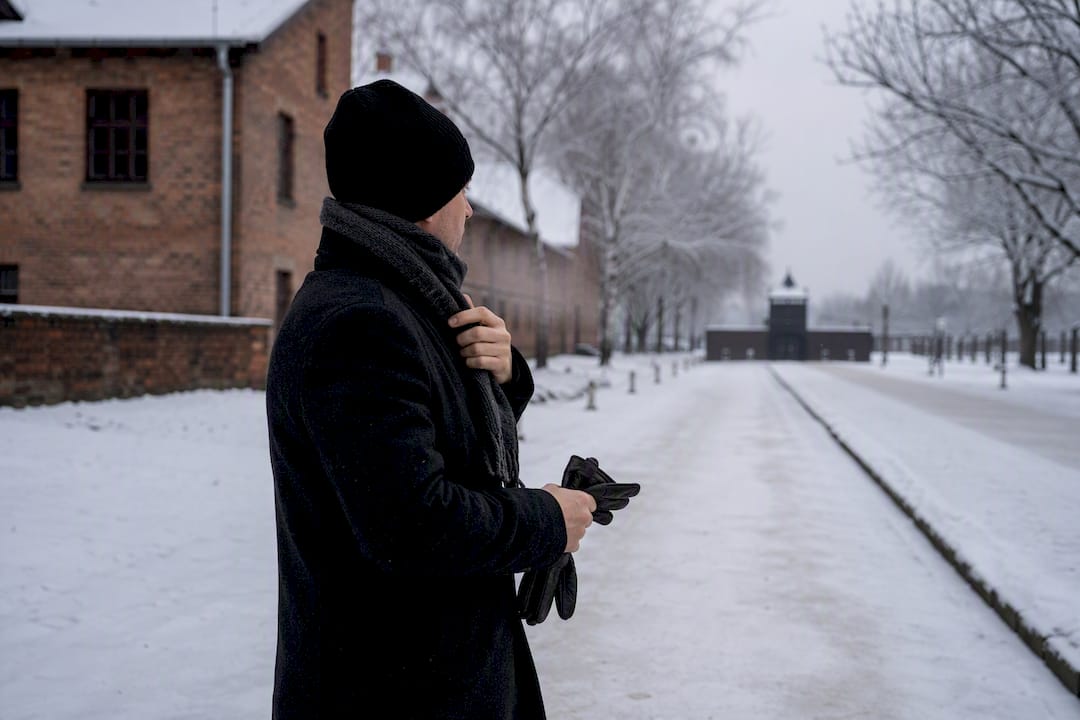
Temperatures typically sit between -5°C and 5°C through December and January, according to the museum’s own seasonal guidance. That is colder than most UK winters, and the flat, unbroken exposure at Birkenau makes it feel worse than the number suggests.
Pack layers rather than one heavy coat:
- A windproof, waterproof outer coat, ideally insulated.
- Thermal base layers underneath, not jeans.
- Insulated, waterproof boots with proper tread; ice forms on paths and gravel.
- Hat, scarf, gloves, and spare socks.
- Hand warmers, genuinely useful for the outdoor stretches at Birkenau.
Layering beats a single bulky garment because you can shed a layer indoors and add it back outside, and it copes better with variable wind than one thick coat. Walk slowly, and use indoor exhibition spaces or your coach as scheduled warm breaks rather than pushing through the cold for the sake of pace. Our Auschwitz dress code guide covers this in more depth if you want a fuller packing list.
What are the on-site facilities and accessibility like in winter?
A free shuttle runs between Auschwitz I and Auschwitz II-Birkenau for guided visitors, which is worth knowing since the sites sit roughly 3.5 kilometres apart. Walking that distance in snow or ice is possible but adds real time and effort to an already long day.
Toilets and cloakroom facilities exist at both sites, parking is available near Auschwitz I, and headset rental comes bundled into most guided tours. Admission to the grounds themselves stays free regardless of whether you join a paid guided tour.
Birkenau’s flat, exposed layout, combined with snow or ice underfoot, can make movement genuinely difficult for visitors with mobility restrictions. If that applies to you or someone travelling with you, contact the museum directly ahead of your visit to check current path conditions and arrange support.
This is a memorial site, not a tourist attraction in the conventional sense, and conduct expectations reflect that.
Visitors are expected to maintain respectful, quiet behaviour throughout, with particular restraint inside exhibition buildings, and photography is restricted in certain indoor spaces out of respect for those the museum commemorates.
Read the code of conduct before you go so nothing catches you off guard on the day.
A UK traveller’s pre-trip checklist for winter
A short list to run through before you fly:
- Documents: valid passport, printed or mobile confirmation of your entry cards and guided tour booking, plus contact details for your tour provider if you have booked one.
- Insurance: travel insurance that covers winter weather disruption and emergency repatriation; a GHIC is worth carrying for Poland, though check exactly what it covers before relying on it.
- Money and communication: some local currency in złoty for incidental costs, plus a working roaming plan or local SIM.
- Timing: build in extra motorway time for icy roads, and screenshot your booking confirmations in case of a weak signal on the day.
Pro Tip: Keep a screenshot of your entry card, not just an email link. Mobile signal near the memorial can be patchy, and staff need to see the confirmation, not just hear you describe it.
Photographing Auschwitz in winter light
Low winter sun changes how the site photographs, often for the better. The sun sits lower in the sky through December and January, throwing long shadows across the railway tracks at Birkenau and giving the watchtowers a starker outline than summer’s flatter light produces.
Snow cover, when it falls, adds contrast against the dark wood of the barracks, but it also means slower shutter speeds struggle in the flat grey light of an overcast morning. Bring a camera that copes reasonably well in low light, or accept that some indoor shots will need a higher ISO.
Photography rules matter here more than technique. Certain indoor spaces, including areas inside specific exhibition buildings, restrict photography entirely out of respect for the material on display and the people it commemorates. Check current signage on arrival rather than assuming last year’s rules still apply.
Practical points worth knowing before you go:
- Cold drains camera batteries faster than usual; carry a spare, kept in an inside pocket for warmth.
- Condensation forms on lenses moving between a heated coach and freezing air, so give equipment a minute to adjust before shooting.
- Gloves with removable fingertips make operating a camera in sub-zero temperatures far less painful.
- Golden hour arrives late morning in December, not at dawn, given how late sunrise falls.
Treat photography as secondary to the visit itself. Guides generally allow time for it at natural pauses, but this is not a site where rushing for a shot sits comfortably with the tone of the place.
Where to stay near Auschwitz during winter
Most UK visitors base themselves in Kraków rather than Oświęcim itself, and that remains the sensible choice in winter. Kraków has far more accommodation choice, better transport links, and a livelier evening scene for the rest of your trip, all within that 1 to 1.5 hour drive of the memorial.
Staying in central Kraków, near the Old Town or Kazimierz district, puts you within easy reach of organised tour pickup points, which matters when your tour departs before sunrise in December. Hotels in these areas are used to early winter pickups and can usually arrange a packed breakfast or early check-out if your tour starts unusually early.
A smaller number of guesthouses exist in and around Oświęcim itself, useful if you want to visit very early without a long drive, or if you are combining the memorial with other sites in the region over several days. They tend to be simpler and quieter than anything in Kraków, which suits some travellers fine.
Whichever base you choose, book accommodation with reliable heating and confirm check-in times against your tour schedule. Winter in this part of Poland is genuinely cold indoors as well as out if a building is under-heated, and a badly heated room the night before an early, physically demanding day will not help you.
Are audio guides available for winter visits?
Yes. Headset rental is included as standard within the price of most guided tours booked through the official museum booking system, so you rarely need to arrange it separately in winter or any other season.
The headset system lets your guide speak at a normal volume while the group spreads out slightly, useful in winter when everyone is bundled in coats and naturally drifts apart to stay warm while walking. Reserve your guided tour through the museum’s own booking page, and the headset comes bundled automatically rather than requiring a separate step.
Self-guided audio options exist for the limited slots where individual entry without a guide-educator is possible, though these slots are scarce during the October to March period when guided access is effectively the standard route. If you are booking independently rather than through a tour operator, confirm at the time of booking exactly what your ticket includes, since listings vary in how clearly this is stated.
Covid-19 and health measures for winter visits
Health and safety measures at the memorial have eased considerably since the height of the pandemic, and current visits operate under standard museum conduct rather than pandemic-specific restrictions. That said, winter itself brings its own health considerations worth taking seriously.
Indoor exhibition spaces can get crowded during peak tour times, and cold, dry winter air combined with close indoor groups is a reasonable setting to catch a seasonal cold, quite apart from any pandemic-specific concern. Basic precautions, hand sanitiser, dressing so you are not alternating between overheating indoors and freezing outdoors, help more than people expect.
Check current guidance on the official museum site close to your travel dates, since any site-specific health measures would be published there first rather than through third-party tour listings.
Why ComFort Tours recommends winter, small-group visits
Winter strips away the crowds and leaves something quieter and harder to shake off. We favour small-group visits for exactly this reason: a good local guide sets the pace, handles the cold logistics, and gives you space to actually sit with what you are seeing, rather than rushing between stops.
Book a small-group Auschwitz winter tour with ComFort Tours Cracow
ComFort Tours Cracow runs a genuine alternative to booking the museum slot yourself and arranging transport separately: one booking covers hotel pickup, a warm vehicle, guaranteed entry, and a knowledgeable local guide, all in a small group rather than a coachload of forty.

That matters most in winter, when the difference between a well-organised day and a miserable one often comes down to logistics rather than the visit itself. Our Auschwitz tour from Kraków includes door-to-door hotel pickup, so you are not standing at a bus stop in the dark before a 3.5 hour walk through freezing conditions. Guides keep groups small deliberately, which means more room to ask questions and a pace that suits the site rather than a schedule. If you would rather travel with others on a set date, our group tours run through winter with the same attention to warm transport and guaranteed entry.
Check availability and book your preferred winter date through our tours page before the busiest December slots fill.
Sources
Check official hours close to your travel dates and keep booking confirmations to hand.
FAQ
How much does it cost to visit Auschwitz from the UK?
Admission to the memorial grounds is free, but guided tours carry a separate fee, and flights, accommodation and transport from Kraków add to the total; a small-group tour with hotel pickup typically bundles the guided tour fee, headset and transfer into one price.
Where do you fly into for Auschwitz?
Most UK travellers fly into Kraków John Paul II International Airport, roughly 1 to 1.5 hours by road from the memorial, making Kraków the natural base for a winter visit.
Can you go to Auschwitz in January?
Yes, the museum is open throughout January with entrance hours running 7:30 to 15:00, though most winter slots require a guided visit and cold, exposed conditions call for proper layered clothing.
Can you visit Auschwitz all year round?
Almost. The memorial closes on only three days a year, 1 January, 25 December and Easter Sunday, and is open with adjusted hours every other day, including throughout winter.