
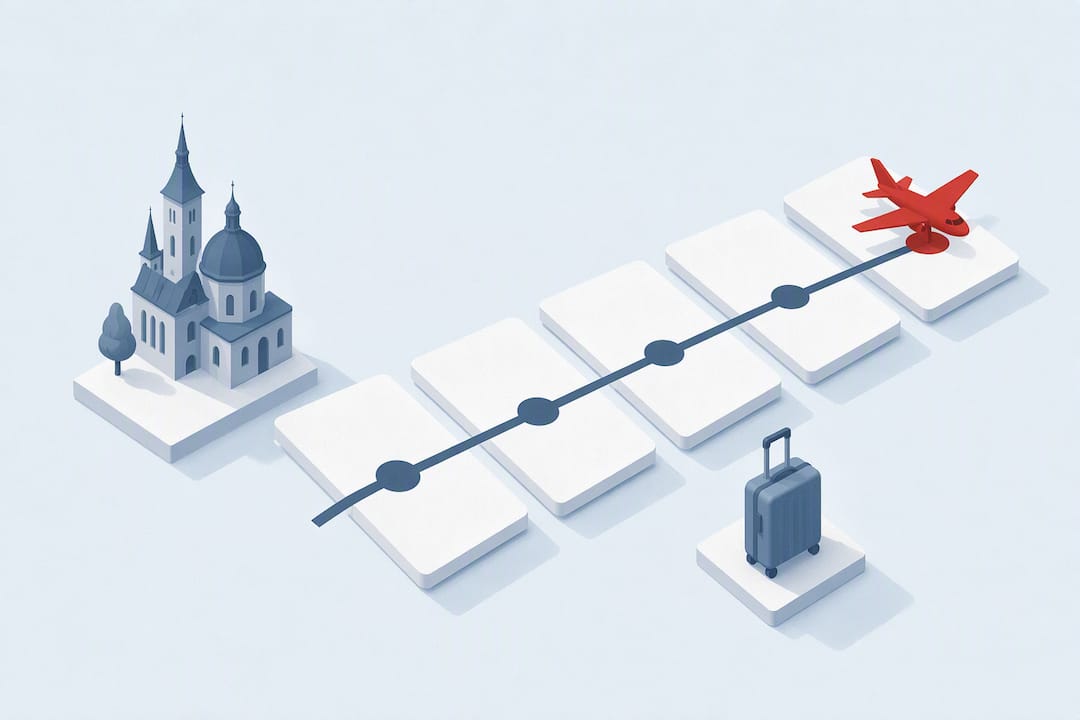
This page gives you a compact set of Polish phrases for travelers, each with a simple phonetic respelling you can say out loud within minutes. You will find the polite core, greetings, directions, dining and emergency lines you actually need in Cracow or anywhere else in Poland. A short pronunciation primer and a five day practice plan follow, so by the time you land, these words feel like yours rather than borrowed.
TL;DR:
- Knowing the evacuation of the core words allows travelers to handle most routine transactions politely in Poland.
- The formal greetings stay in use until evening, with informal “Cześć” reserved for friends or after invitation to switch to first names.
- Asking permission before switching to English with “Czy mówi Pan/Pani po angielsku?” usually results in a friendlier response from Poles.
- Practicing key phrases over five days, especially in real-world settings, significantly improves confidence and pronunciation accuracy.
- Basic Polish numbers and phrases are essential for bargaining and understanding pricing, but even imperfect effort garners warmth from locals.
Table of Contents
- The polite core: five words that cover most exchanges
- Greetings and farewells: knowing when to switch register
- Getting around: directions, tickets and transport words
- Eating and ordering: café and restaurant phrases
- Numbers, money and shopping phrases
- Asking if someone speaks English and using Pan/Pani
- Pronunciation basics: reading Polish letters with confidence
- A five day practice plan, and why guided practice sticks
- Checking in, checking out and booking a room
- Cultural tips: formality, gestures and reading the room
- Why even broken Polish opens doors
- Practising these phrases with a local guide in Cracow
- Sources
- FAQ
The polite core: five words that cover most exchanges
I always tell visitors the same thing: learn these five phrases and you can survive almost any shop, hotel or café encounter in Poland.
- Dzień dobry (jen DOH-bri): the formal hello, used from morning until early evening.
- Dziękuję (jen-KOO-yeh): thank you. Add bardzo for “thank you very much”.
- Proszę (PROH-sheh): please, you’re welcome, and “here you go” when handing something over.
- Przepraszam (psheh-PRAH-sham): excuse me and sorry, in one word.
- Do widzenia (doh vee-DZEH-nyah): formal goodbye, for shops, taxis and staff.
According to one A0 lesson on Polish basics, these four core words, Dzień dobry, Dziękuję, Proszę and Przepraszam, are enough to navigate most routine transactions politely, and the same source notes that Przepraszam doubles as both an apology and an attention-getter, which makes it arguably the single most useful word you will carry.
Greetings and farewells: knowing when to switch register
Cześć (cheshch) is the informal hello and goodbye, fine for peers, younger staff or once someone has invited you to use first names. Dzień dobry stays formal until roughly dusk, when Dobry wieczór (DOH-bri VYEH-choor), good evening, takes over.
If you are introducing yourself:
- Nazywam się… (nah-ZI-vahm shyeh): “My name is…”
- Miło mi poznać (MEE-woh mee POH-znach): “Pleased to meet you.”
- Cześć, jak się masz? (informal “hi, how are you?”), reserved for friends or people who have already dropped formality with you.
Poles rarely rush this switch. Waiting for the other person to invite informality, rather than assuming it, tends to land better than jumping straight to Cześć with a stranger.
Getting around: directions, tickets and transport words
Cracow’s old town is walkable, but trains, buses and taxis all come with their own vocabulary.
- Gdzie jest…? (gjeh yest): “Where is…?”, the phrase you will use most.
- Jak dojść do…? (yahk doyshch doh): “How do I get to…?”, useful for walking directions.
- Ile kosztuje? (EE-leh kosh-TOO-yeh): “How much does it cost?”, works for tickets, fares and taxis alike.
- Ile kosztuje taksówka do…?: the same phrase extended for a taxi fare to a specific place.
- Learn the nouns separately: dworzec (train station), lotnisko (airport), przystanek (bus or tram stop), bilet (ticket).
Keep Pomocy! (poh-MOH-tsi), “help!”, in reserve, and remember that 112 is the emergency number across the country, a detail confirmed by the Wikivoyage Polish phrasebook, which groups exactly these situational phrases the way most travellers need them.
Eating and ordering: café and restaurant phrases
Ordering in Poland runs on one small word: poproszę (poh-PROH-sheh), a softer, more polite form of “I’ll have”. Say poproszę kawę for a coffee, or poproszę menu to ask for the menu itself.
- Poproszę rachunek: “The bill, please.”
- Czy mogę płacić kartą? (chi MOH-geh PWAH-cheech KAR-toh): “Can I pay by card?”
- Co pan/pani poleca?: “What do you recommend?”, addressed to a man or woman respectively.
- Mam alergię na… (mahm ah-LER-gyeh nah): “I have an allergy to…”, followed by the ingredient.
- Smacznego (smach-NEH-goh), said before eating, and Na zdrowie (nah ZDROH-vyeh), “cheers” or “bless you” after a sneeze, both smooth out table talk instantly.
If pierogi are on the menu, and they usually are, this recipe for pierogi ruskie shows what you are actually ordering: potato and cheese dumplings finished in browned butter.
Numbers, money and shopping phrases
Counting in Polish is worth ten minutes of your time, because prices, change and bargaining all run through it.
- jeden (YEH-den), one
- dwa (dvah), two
- trzy (tshi), three
- cztery (CHTEH-ri), four
- pięć (pyench), five
- sześć (sheshch), six
- siedem (SHEH-dem), seven
- osiem (OH-shem), eight
- dziewięć (JEH-vyench), nine
- dziesięć (jeh-SHEH-nch), ten
For markets and shops, pair numbers with Ile to kosztuje? (“How much is this?”) and Poproszę zapakować (“Please wrap or pack it for me”). Carry small change where you can, and validate paper tram or bus tickets on board where machines require it.
Asking if someone speaks English and using Pan/Pani
The most useful opening line, before you launch into English, is asking permission to switch. According to TalkPolish’s guide to basic phrases, the standard formal question comes in two gendered forms: Czy mówi Pan po angielsku? (chi MOO-vee pahn poh ahn-GLEE-skoo) when addressing a man, and Czy mówi Pani po angielsku? (chi MOO-vee PAH-nee) when addressing a woman.
- Both forms use the third-person verb, literally asking “does the gentleman/lady speak English”, which is the polite convention rather than a slip of grammar.
- Pan and Pani replace “you” in formal Polish, and dropping them with strangers, shopkeepers or older people can come across as blunt.
- If the answer is tak (yes), keep your follow-up short and polite. If it is nie (no), fall back on the core phrases you already have.
Pro Tip: Say “Czy mówi Pan/Pani po angielsku?” before you say anything else in English. It signals respect and almost always gets you a warmer, more patient response.
Pronunciation basics: reading Polish letters with confidence
Polish spelling is far more consistent than English, which means a handful of rules unlock most words you will see on menus and signs.
- ł sounds like an English “w” (Łódź becomes WOODCH).
- w sounds like “v” (Warszawa starts VAR).
- j sounds like “y” (Dziękuję ends -YEH).
- sz sounds like “sh”, cz like “ch”, and rz or ż like “zh”.
- c on its own sounds like “ts”.
Take Dzień (jen), day or good, and Proszę (PROH-sheh): once you know that “dzi” reads as “j” and “sz” reads as “sh”, both stop looking intimidating. Stress almost always falls on the second-to-last syllable, so kosztuje is kosh-TOO-yeh, not kosh-too-YEH.
Some phrasebooks and lesson pages show that these simplified respellings, rather than full IPA, are what actually help short-term travellers, according to The Poland Guide’s basic phrases page, which pairs each entry with a plain-English sound guide rather than technical phonetic symbols. Try reading a street sign or menu item cold, then check it against this rule set: you will be right more often than you expect.
A five day practice plan, and why guided practice sticks
Cramming a phrasebook the night before rarely works. Spreading it over five short sessions does.
- Day one: learn the polite core (Dzień dobry, Dziękuję, Proszę, Przepraszam, Do widzenia) and say each aloud ten times.
- Day two: add greetings and the Pan/Pani question, then shadow a recording, repeating half a second behind it.
- Day three: drill numbers one to ten and the shopping phrases until they come without pausing.
- Day four: run a two-minute roleplay in your head: ordering coffee, asking for the bill, asking directions.
- Day five: combine everything in one imagined day, from checking in to ordering dinner, out loud, start to finish.
Practising phrases in real, physical context tends to beat isolated memorisation, a point echoed by Words on Repeat’s guide to Polish travel phrases, which notes that role-play and immediate use accelerate both retention and confidence. A city walk with a local guide gives you exactly that: real streets, real shopkeepers, and someone on hand to correct your sz from your cz before it becomes a habit.
Checking in, checking out and booking a room
Hotel Polish is short and predictable, which makes it one of the easiest categories to prepare.
When you arrive, Mam rezerwację (mahm reh-zer-VAH-tsyeh), “I have a reservation”, followed by your name, gets you straight to the desk. If you are booking on the spot, Czy mają Państwo wolny pokój? (chi MAH-yoh PAHN-stfoh VOHL-ni POH-kooy), “Do you have a free room?”, is the formal, plural version used with hotel staff generally.
Useful lines for the stay itself:
- Chciałbym pokój jednoosobowy/dwuosobowy (chchahw-bim POH-kooy): “I’d like a single/double room.”
- O której jest wymeldowanie? (oh KTOO-rey yest vi-mel-doh-VAH-nyeh): “What time is check-out?”
- Czy śniadanie jest wliczone? (chi shnyah-DAH-nyeh yest vlee-CHOH-neh): “Is breakfast included?”
At check-out, Chciałbym się wymeldować (chchahw-bim shyeh vi-mel-DOH-vach), “I’d like to check out”, paired with Poproszę rachunek, covers it. Staff at most Cracow hotels handle English comfortably, so these phrases work best as a warm opener rather than a full negotiation, and they tend to earn you a friendlier front desk for the rest of your stay.
Cultural tips: formality, gestures and reading the room
Formality in Polish is not just grammar, it shapes how people read you. Sticking with Pan and Pani until someone explicitly invites first names, usually with “możemy sobie mówić na ty” (we can use “ty” with each other), signals respect rather than distance.
Handshakes are the default greeting between adults meeting formally, firm but brief, and eye contact matters more than a big smile. Among friends, a light hug or cheek-to-cheek gesture is common, though as a visitor you can safely default to a handshake and let locals set the tone.

A few small habits go further than any phrase: removing your shoes when invited into a Polish home, waiting to be told where to sit, and never starting a toast, Na zdrowie, before the host does. According to Words on Repeat’s phrasebook piece, Poles are generally warm towards travellers who make a genuine attempt at the language, and that attempt, however imperfect, often does more social work than getting every word exactly right.
Why even broken Polish opens doors

I have watched a visitor mangle “Dzień dobry” into something closer to three syllables of confusion, and still get a grin and a proper answer back. Poles notice the effort long before they notice the accent. A shopkeeper who hears you try switches from transactional to genuinely helpful almost every time.
Use the five day plan, keep the pronunciation rules handy, and let the words feel clumsy for a while. That is how they become yours.
— Damian Fort
Practising these phrases with a local guide in Cracow
Reading respellings gets you started, but nothing corrects a stubborn “sz” like saying it out loud to someone who will gently fix it mid-sentence. Our Cracow city tours run in small groups, which means you get real back-and-forth with a local guide rather than a script recited at a crowd, plenty of natural chances to try Dzień dobry, Poproszę and Ile kosztuje on shopkeepers and café staff along the way.
If you are arriving straight from the airport, our transfer service offers a low-pressure place to try your first Dzień dobry before the city even starts moving, with prices that are generally affordable for travelers. It is a low-pressure place to try your first Dzień dobry before the city even starts moving. Check availability for a city tour and put the phrases to work on your first afternoon in Cracow.
Sources
- Introductions & Basic Phrases — Polish A0 Lesson
- Your Guide to Basic Polish Words and Phrases — TalkPolish
- Top Polish phrases for travelers — Words on Repeat
- Basic Polish phrases for travellers — The Poland Guide
FAQ
What does “dupa jaś” mean in Polish?
“Dupa jaś” is a playful, slightly rude Polish exclamation used the way English speakers might use “darn it” or a stronger mild oath, not a phrase you need for polite travel exchanges. It is best left alone as a tourist and is not part of any standard phrasebook for visitors.
What does “jak się masz” mean in Polish?
“Jak się masz?” means “How are you?” in informal Polish, said as YAHK shyeh MAHSH, and is used with friends or people who have already moved past formal address. With strangers or service staff, stick to Dzień dobry rather than this casual greeting.
What are some pretty-sounding phrases in Polish?
Many travellers find phrases like Miło mi poznać (“pleased to meet you”) and Smacznego (said before a meal) pleasant to say aloud, since Polish carries a soft, flowing rhythm despite its consonant clusters. Na zdrowie, used both as “cheers” and after a sneeze, is another one visitors tend to enjoy picking up.
How do you say “enjoy your trip” in Polish?
“Enjoy your trip” translates as Miłej podróży (MEE-way pod-ROO-zhi), a phrase Poles commonly say to someone setting off on a journey. It works equally well said to a fellow traveller or heard from a host as you leave.
How quickly can I realistically learn basic Polish phrases?
A focused five day plan covering the polite core, greetings, numbers and a handful of situational lines is enough to handle most everyday exchanges in Poland. Fluency is not the goal here: recognisable, polite effort is what gets you further with locals in a short trip.