There is no legally enforced age limit at Auschwitz-Birkenau Memorial and Museum. The museum does not turn children away at the gate. What it does do is recommend that children under 14 do not attend in-person visits, and it sets a minimum participant age of 15 for its online guided educational tours. These are considered recommendations, not prohibitions. Every visitor, regardless of age, must hold a personalised entry pass and carry valid ID. School groups face additional requirements: a formal group register and identified supervising adults.
Two facts matter most before you book:
- No legal ban exists, but the museum’s guidance on Auschwitz visitor age is clear: under 14s are not recommended for in-person visits.
- Every visitor needs a booked entry pass and valid ID — this applies to adults and children alike.
Key takeaways
There is no legal age limit at Auschwitz, but the museum recommends children under 14 avoid in-person visits and sets a minimum age of 15 for online guided educational tours.
| Point | Details |
|---|---|
| No legal age ban | The museum recommends against under-14s visiting in person, but enforces no legal prohibition. |
| Online tours: age 15 minimum | The museum’s online guided educational tours recommend a minimum participant age of 15. |
| Entry pass and ID required | Every visitor must hold a personalised entry pass; school groups must also submit a formal group register. |
| Preparation is decisive | Prior historical education significantly improves how young visitors cope and what they take from the visit. |
| ComFort Tours Cracow | Small-group and private guided tours with pre-visit briefings, tailored for families and UK school groups. |
Table of Contents
- Is there an official Auschwitz age limit for visitors?
- What the museum recommends on age: in-person visits versus online tours
- Where the “strict age limit” claim comes from
- A practical checklist for parents deciding whether to bring a child
- Rules and guidance for school groups and educational visits
- What families should expect on the day
- A tour operator’s perspective on child readiness
- ComFort Tours Cracow: small-group visits for UK families and schools
- Sources
- FAQ
Is there an official Auschwitz age limit for visitors?
The official booking and entry rules confirm that entry to the grounds is free, but all visitors must reserve a personalised entry pass in advance for guided or independent tours. There is no age-of-entry threshold written into Polish law or museum statute. The museum’s position is that the decision rests with parents and guardians, guided by its recommendation against visits by under-14s.
For ID, adults must present a valid document. Children travelling as part of a family group are handled differently from those in organised school parties. School groups must supply a formal register listing every participant and identifying the supervising educators responsible for the group.
Practical booking rules at a glance:
- Reserve entry passes at visit.auschwitz.org before you travel.
- Guided tours require a booked time slot; self-guided visits also need a pass outside peak hours.
- Bags larger than A4 size are not permitted inside the exhibition buildings.
- Pushchairs and prams are restricted in certain areas of the site.
- School groups must submit a group register and educator credentials when booking.
Pro Tip: Arrive at opening time (typically 7:30 AM) to avoid the longest queues and to give children the calmest possible introduction to the site. Midday slots in summer can mean significant crowds.
What the museum recommends on age: in-person visits versus online tours
The museum’s position, as summarised by Poland Wander’s visiting guide, is that children under 14 are not recommended for in-person visits. The reasoning is straightforward: the exhibition contains graphic photographic evidence, personal effects of victims, and spaces that carry an intense emotional weight that younger children are unlikely to process constructively.
Online guided educational tours carry a higher recommended minimum. The museum sets that threshold at 15, reflecting the more explicit discussion of historical events in those sessions and the interactive format, which requires participants to engage directly with difficult content.
In-person visit versus online guided tour:
| Factor | In-person visit | Online guided educational tour |
|---|---|---|
| Recommended minimum age | 14 | 15 |
| Enforced by museum? | No | No |
| Content intensity | High (physical exhibits, spaces) | High (explicit historical discussion) |
| Parental control over pacing | Yes (self-guided option) | Limited |
| School group format | Yes, with register | Yes, with educator coordination |
The distinction matters. An in-person visit allows a parent to steer a child away from the most graphic rooms. An online session does not offer that flexibility in the same way, which is partly why the museum’s online tours page sets the bar one year higher.
Where the “strict age limit” claim comes from
Search any travel forum and you will find threads insisting there is a hard cut-off of 11, or that under-14s are flatly refused entry. Neither is true. TripAdvisor threads on visiting Auschwitz with a 10-year-old and Rick Steves community posts repeat older, regionally specific guidance or misremember school-group rules as universal policy.
Common myths and where they originate:
- “Under 14s are banned” — this conflates the museum’s recommendation with a legal prohibition.
- “Strict age limit of 11” — likely derived from individual tour operators setting their own minimums, not museum policy.
- “You need special permission for children” — no such process exists for family visits; school groups have separate documentation requirements.
- “The rules changed recently” — the museum’s recommendation has been consistent; what changes is how individual tour operators interpret it.
Pro Tip: Before booking, verify the current rules directly on visit.auschwitz.org. Forum posts age quickly and often reflect one person’s experience with a specific tour operator rather than museum policy.
A practical checklist for parents deciding whether to bring a child
Lonely Planet’s expert guidance is clear: parental judgement and prior preparation are the main determinants of whether a young person benefits from the visit. Age is a proxy for maturity, not a guarantee of it.
Before you go:
- Has your child studied the Holocaust at school or through books and documentaries?
- Can they discuss death, suffering, and historical atrocity without becoming acutely distressed?
- Have you talked explicitly about what they will see, including photographs of victims and personal belongings?
- Are they asking to go, or are they being taken reluctantly?
On the day:
- Plan which blocks to enter and which to skip — rooms displaying children’s personal effects are among the most distressing.
- Choose a self-guided visit if you want full control over pacing and exits.
- Build in rest time; the site covers a large area and the emotional toll is cumulative.
- Bring water, light layers, and a small authorised bag. Leave large rucksacks at the car or cloakroom.
After the visit:
- Ask open questions: “What stayed with you?” rather than “How did that make you feel?”
- Watch for signs of sleep disruption or withdrawal in the days following.
- If a child shows lasting distress, the NHS’s Young Minds helpline (0808 802 5544) offers guidance for parents.
Pro Tip: Students who arrive with prior historical grounding derive more value and cope better emotionally, according to visiting guides. A single lesson or a documentary watched together the week before makes a measurable difference.
Rules and guidance for school groups and educational visits
Schools operate under a different set of administrative requirements. The museum treats organised educational visits separately from family visits, and the documentation burden is higher.
What schools must provide:
- A formal group register listing every student by name.
- Identified supervising adults with stated roles.
- Confirmation of the educational purpose of the visit.
- Pre-booked guided tour slots (self-guided visits are not standard for school groups).
How to book a school visit:
- Contact the museum’s education department via the official site well in advance — popular dates fill months ahead.
- Submit the group register and educator credentials as requested.
- Confirm transport and arrival logistics; the museum car park has capacity limits.
- Brief students before departure using the museum’s own educational materials, available on the official site.
- Assign a lead educator responsible for group welfare on the day.
In practice, most UK schools visiting as part of a history or citizenship curriculum bring students aged 14 and above, aligning with the museum’s recommendation. Preparation through classroom study beforehand is not just good practice; it is the single factor most consistently linked to a meaningful visit. Schools working with a specialist operator can access educational visit support and group coordination to handle logistics.
What families should expect on the day
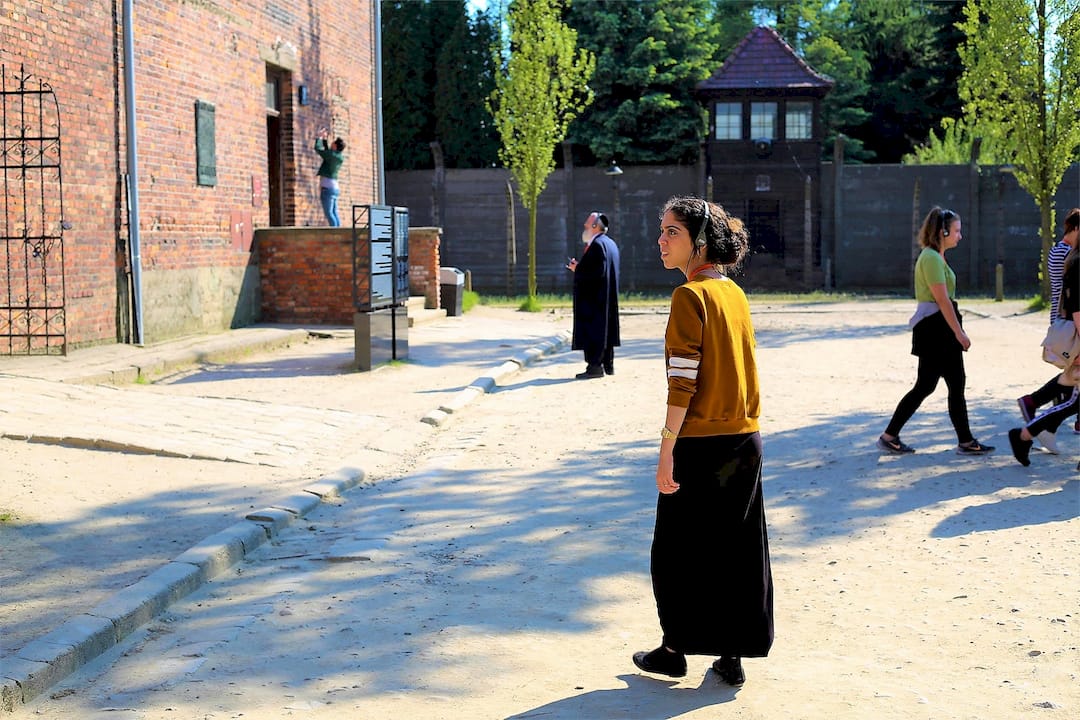
A full visit covering both Auschwitz I and Birkenau takes three to four hours at a measured pace. Birkenau alone involves considerable walking across open ground, which can be challenging in poor weather. There are limited facilities for young children: a café and toilets are available near the entrance, but amenities inside the exhibition areas are minimal.
Photography, behaviour, and dress:
- Dress modestly; there is no formal dress code, but shorts and sleeveless tops are considered disrespectful by many visitors.
- Keep voices low throughout; the site functions as both a museum and an active memorial.
- Mobile phones should be on silent.
- Photography inside the gas chamber at Auschwitz I is prohibited.
Pro Tip: Wear comfortable, flat shoes. The ground at Birkenau is uneven and the distances between structures are longer than they appear on maps. A full visit logistics guide from ComFort Tours Cracow covers pacing, distances, and what to prioritise if time is short.
A tour operator’s perspective on child readiness
The question families ask most often is not “Is my child allowed?” but “Is my child ready?” Those are different questions, and the second one is harder.
At ComFort Tours Cracow, small group sizes mean guides can read the room. When a younger visitor shows signs of distress, a guide can slow the pace, step outside a building, or simply stand quietly for a moment. That flexibility disappears in a large coach group where the schedule drives everything.
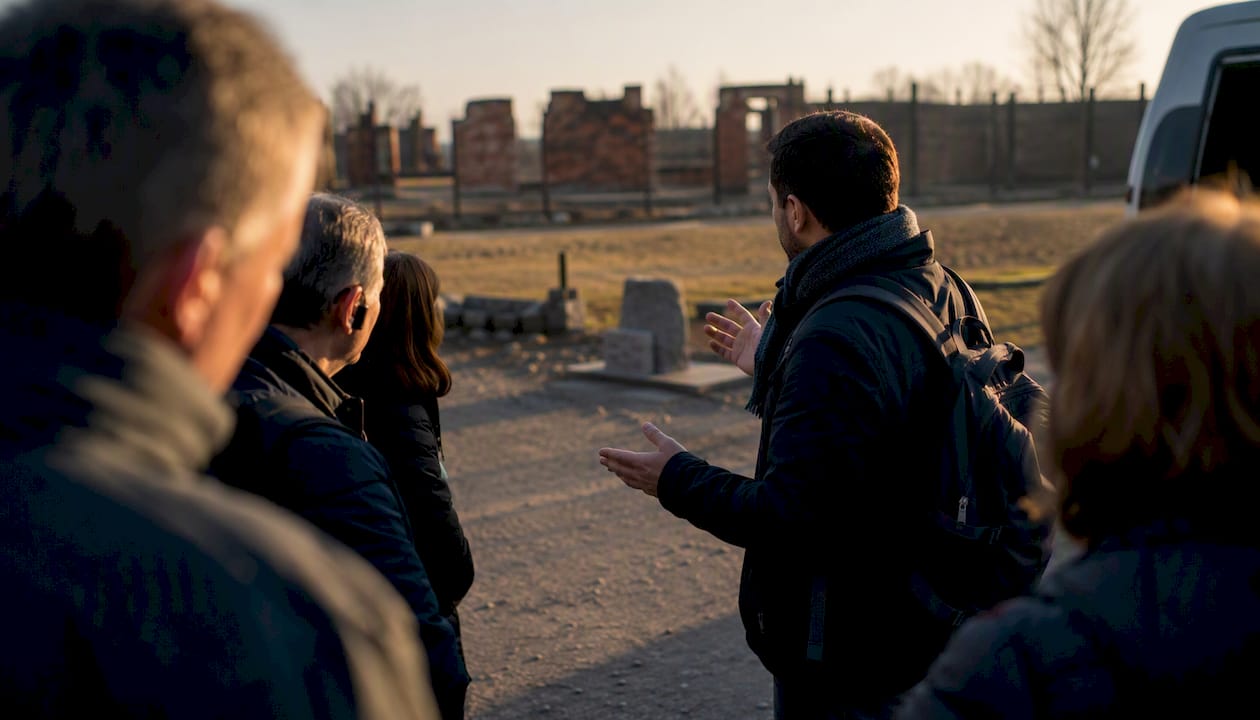
The most effective visits we see are private family tours or small school groups where an educator has done preparatory work. The guide’s role shifts from narrator to facilitator: they frame what visitors are about to see, give context before entering each block, and check in with younger participants throughout. For families with children below the recommended age, the practical answer is often to arrange an alternative activity in Kraków for the younger child while older siblings or parents visit. The shooting range Krakow activities and city walking tours work well as parallel options on the same day.
ComFort Tours Cracow: small-group visits for UK families and schools
Families and school groups from the UK planning an Auschwitz visit get something specific from ComFort Tours Cracow: a small group, a guide who has done this hundreds of times, and a pre-visit briefing that means no one arrives unprepared.

The practical difference is size. A private or small-group tour means the guide can skip a room if a child is struggling, adjust the pace, and answer questions that a large group format simply does not allow. For school groups, ComFort Tours Cracow handles the logistics — transport from Kraków, group coordination, and documentation support — so the lead teacher can focus on the students.
Check availability and book your guided Auschwitz tour directly, or browse the full range of small-group and private tours from Kraków to plan the rest of your trip alongside the memorial visit.
Sources
- For online guided educational tours, the museum recommends a minimum participant age of 15 years
- Entry rules and booking information for visitors to the Auschwitz-Birkenau Memorial and Museum
- Visiting Auschwitz-Birkenau: A Complete 2026 Guide | Poland Wander
- Is there an appropriate age to bring children to visit … | Lonely Planet
- Visiting Auschwitz with kids and teens – Wyld Family Travel
FAQ
Is there an age limit to enter Auschwitz?
No legal age limit exists. The museum recommends that children under 14 do not attend in-person visits, but this is guidance rather than an enforced rule.
Can you visit Auschwitz with children?
Yes. Parents may bring children of any age, though the museum advises against in-person visits for under-14s. Emotional maturity and prior preparation matter more than a child’s exact age.
Why do you need ID at Auschwitz?
All visitors must present valid identification to collect their personalised entry pass. School groups must also provide a formal group register and educator credentials when booking.
What is the minimum age for Auschwitz online guided tours?
The museum recommends a minimum participant age of 15 for its online guided educational tours, one year higher than the in-person recommendation, reflecting the more explicit content in those sessions.