Kraków’s Kazimierz Jewish quarter is one of Central Europe’s most significant historic districts, a place where medieval synagogues stand a few streets away from buzzing cafés and street-art murals. For most visitors, the best starting point is a focused 90–120 minute walk through the quarter’s core, or better still, a small-group guided tour with ComFort Tours Cracow to get the historical context that transforms a pleasant stroll into something genuinely moving.
On arrival, prioritise these three stops first:
- Szeroka Street — the historic heart of the Jewish community, lined with synagogues and the main venue for the annual Jewish Culture Festival
- Old Synagogue — the oldest surviving synagogue in Poland, now a museum branch of the Historical Museum of Kraków
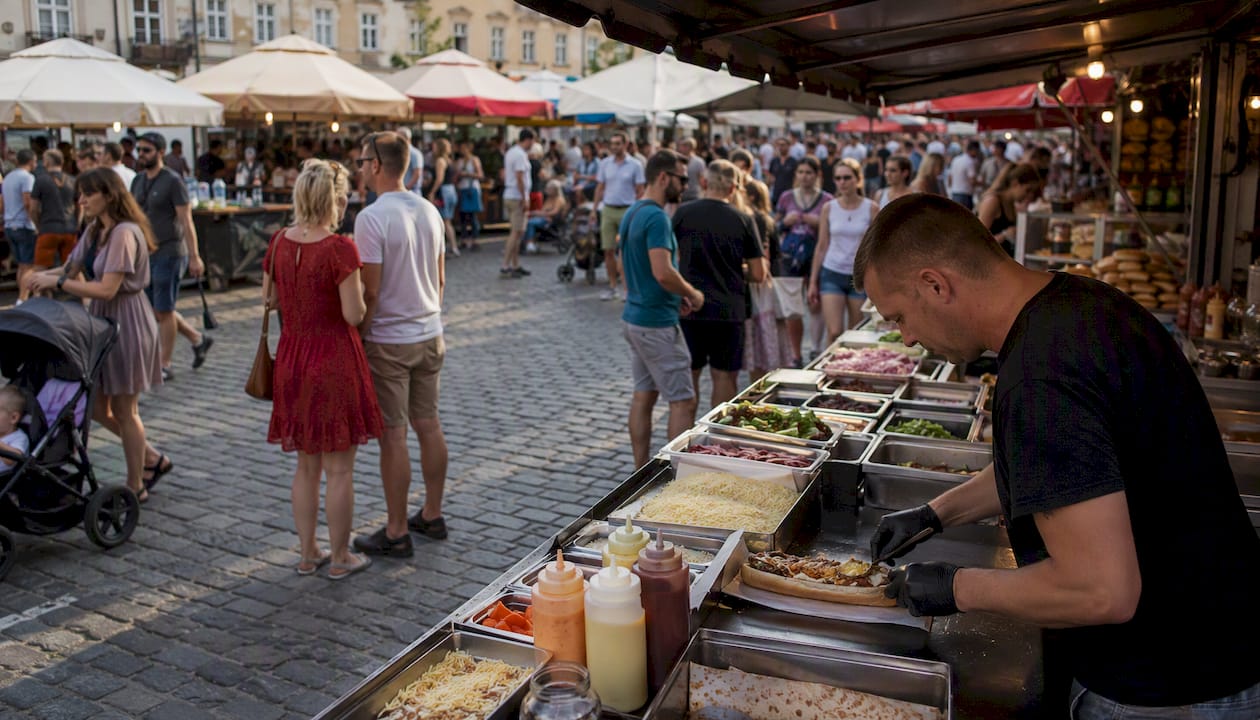
- Plac Nowy — the lively market square that captures the neighbourhood’s contemporary energy, with food stalls and klezmer music most evenings
Key takeaways
Kazimierz is one of Europe’s most layered historic districts: a place of profound memorial significance and a genuinely lively cultural neighbourhood, best understood by combining a guided historical visit with independent time to explore at your own pace.
| Point | Details |
|---|---|
| Allow enough time | A focused visit needs 90–120 minutes; a full half-day covers all major sites comfortably. |
| Top three sites | Old Synagogue, Remuh Synagogue and Cemetery, and Galicia Jewish Museum reward the most time. |
| Check before you go | Many museums close on Mondays; synagogues may be closed on Shabbat and Jewish holidays. |
| Visitor etiquette | Cover your head, dress modestly, and ask before photographing inside any synagogue. |
| Recommended guided option | ComFort Tours Cracow offers small-group, licensed-guide walks tailored to Jewish heritage in Kraków. |
Table of Contents
- What shaped the Kazimierz Jewish quarter: a brief history
- Why Kazimierz matters today: memorial and living culture
- Must-see sites in Kazimierz: what to expect at each
- A suggested 90–120 minute walking route through Kazimierz
- Practical information for UK visitors: getting there, tickets and safety
- Guided tour or self-guided visit: how to decide
- Why ComFort Tours Cracow is worth considering for this visit
- Jewish life in Kazimierz today
- Book a Kazimierz guided tour with ComFort Tours Cracow
- Sources
- FAQ
What shaped the Kazimierz Jewish quarter: a brief history
Kazimierz was founded in the 14th century as a separate royal town by King Casimir III, sitting just south of Kraków’s Old Town on the banks of the Vistula. It was not originally a Jewish settlement; the Jewish community began concentrating there from the 15th century, gradually establishing what became known as the Oppidum Judaeorum (Jewish Town) around Szeroka Street. By the 16th and 17th centuries, Kazimierz had become one of the most important Jewish cultural and spiritual centres in Europe, home to renowned rabbinical schools, printing houses, and a community that shaped Jewish intellectual life across the continent.
The 19th century brought administrative change: Kazimierz was formally incorporated into Kraków in 1800, losing its status as a separate town. Jewish residents began moving into other parts of the city, and the quarter’s character slowly shifted.
World War II was catastrophic. The German occupation in 1939 forced Kraków’s Jewish population into a ghetto established not in Kazimierz itself but across the river in the Podgórze district. From there, deportations to the Bełżec and Auschwitz-Birkenau extermination camps decimated a community that had numbered around 60,000 before the war. The sites of Kazimierz fell into decades of neglect and near-silence.
The revival came gradually from the 1990s. Steven Spielberg’s Schindler’s List, filmed partly on location in Kraków and Kazimierz, brought international attention and helped fuel preservation efforts. Cafés, galleries and cultural organisations moved in, and the annual Jewish Culture Festival became a fixture.
Key dates at a glance:
- 14th century — Kazimierz founded as a royal town under King Casimir III
- 15th–17th century — Jewish community flourishes; cultural and religious peak
- 1800 — Incorporated into Kraków
- 1939–1945 — Occupation, ghetto in Podgórze, mass deportations
- 1990s onwards — Cultural revival, Schindler’s List effect, festival growth
Why Kazimierz matters today: memorial and living culture
The district carries a genuine duality, and it is worth being prepared for it. Within a single block, you might pass a cemetery where 16th-century gravestones lean against a Renaissance wall, then turn a corner to find a terrace full of people drinking coffee in the afternoon sun. That contrast is not accidental or disrespectful; it reflects the district’s dual identity as both a place of remembrance and a lively modern cultural quarter.
For some visitors, particularly those with family connections to the community, the atmosphere can feel jarring at first. The key is sequencing. Spend the first part of your visit at the synagogues and the Remuh Cemetery, where the weight of history is tangible and the setting demands quiet reflection. Save Plac Nowy and the café streets for afterwards, when the shift in mood feels earned rather than abrupt.
Visitor etiquette at synagogues and cemeteries:
- Cover your head at active synagogues (kippot are usually available at the entrance)
- Dress modestly: covered shoulders and knees for both men and women
- Ask before photographing inside synagogues; photography is generally restricted during services
- At the Remuh Cemetery, keep voices low and do not touch or move any gravestones
- Switch your phone to silent before entering any place of worship
Pro Tip: Book a guided history tour for the morning, then give yourself a free hour or two in the afternoon to wander Plac Nowy, try a zapiekanka (a local open-faced baguette snack), and absorb the neighbourhood’s contemporary side at your own pace.
Must-see sites in Kazimierz: what to expect at each
Kazimierz’s synagogues, museums and public spaces each tell a different part of the story, and knowing what you are walking into makes the visit far richer.
Old Synagogue (Stara Synagoga)
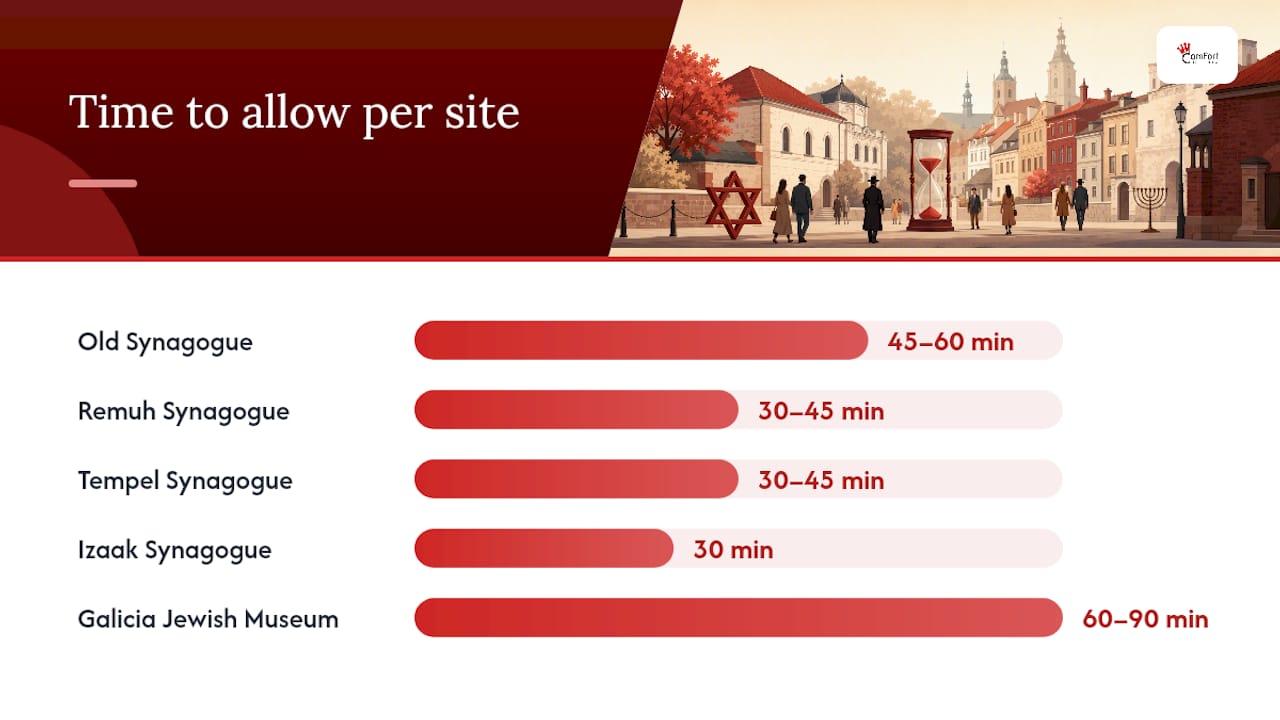
The oldest surviving synagogue in Poland, dating to the 15th century, now operates as a branch of the Historical Museum of Kraków. The permanent exhibition covers Jewish religious life, community history and the Holocaust. Admission is modest (guides typically quote around 15–20 zł, though you should verify current prices on the official museum page before visiting). Allow 45–60 minutes. Photography inside is restricted.
Remuh Synagogue and Remuh Cemetery
Still an active place of worship, the Remuh Synagogue dates to the 16th century and is one of the smallest and most atmospheric in the quarter. The adjacent cemetery is extraordinary: Renaissance-era tombstones, a wall built from fragments recovered after WWII, and the grave of Rabbi Moses Isserles (the Remuh), one of the most revered figures in Ashkenazi Jewish history. Entry is donation-based or carries a modest fee. Allow 30–45 minutes. Modest dress is required.
Tempel Synagogue
Built in the 19th century in a Moorish-Renaissance style, the Tempel is the most ornate synagogue in Kazimierz. It serves as both an active synagogue and a cultural venue, hosting concerts during the Jewish Culture Festival. The painted interior is genuinely stunning. Check opening hours in advance, as they vary seasonally.
Izaak Synagogue
One of the largest synagogues in Kraków, the Izaak was built in the 17th century and has been partially restored. Its walls are covered with fragments of original painted inscriptions uncovered during restoration work. It functions primarily as a museum and cultural space. Allow 30 minutes.
Galicia Jewish Museum
This is the most contemporary of the major sites, housed in a former factory on Dajwór Street. The permanent exhibition, Traces of Memory, is a photographic journey through the remnants of Jewish culture in the Galicia region, shot by the late British photographer Chris Schwartz. It is thoughtful, unsentimental and genuinely affecting. Admission is a paid museum entry (guides quote approximately 18–20 zł). Allow 60–90 minutes.
Szeroka Street
Less a street, more an elongated square, Szeroka is the historic core of Jewish Kazimierz. Several synagogues face onto it, and it hosts the main outdoor concerts of the Jewish Culture Festival each summer. Even outside festival season, it is the right place to begin any walk through the quarter.
Plac Nowy
The social hub of contemporary Kazimierz, Plac Nowy hosts a flea market on Saturday mornings and is lined with bars and food stalls. The circular rotunda in the centre sells zapiekanki around the clock. It is the best place to understand how the neighbourhood has evolved from a site of memory into a living district.
| Site | Why visit | Typical opening / ticket note | Time to allow |
|---|---|---|---|
| Old Synagogue | Oldest in Poland; Holocaust exhibition | Paid entry (~15–20 zł, verify officially) | 45–60 min |
| Remuh Synagogue & Cemetery | Active worship; Renaissance graves | Donation or modest fee | 30–45 min |
| Tempel Synagogue | Ornate interior; festival concerts | Seasonal hours; check in advance | 30–45 min |
| Izaak Synagogue | 17th-century scale; restored inscriptions | Paid entry; check locally | 30 min |
| Galicia Jewish Museum | Photography exhibition; modern approach | Paid entry (~18–20 zł, verify officially) | 60–90 min |
| Szeroka Street | Historic heart; festival venue | Free to walk | 15–20 min |
| Plac Nowy | Market; food; contemporary life | Free; stalls open daily | 20–30 min |
All fees are approximate figures from travel guides. Verify current prices on official museum websites before visiting.
A suggested 90–120 minute walking route through Kazimierz
This self-guided Kazimierz walking route covers the essential sites in a logical loop. It suits most fitness levels, though note that several streets are cobbled and some synagogue entrances have steps.
- Start on Szeroka Street (0 min) — Orient yourself at the northern end. The Old Synagogue is at the southern end of the street; take a moment to read the information boards before entering.
- Old Synagogue (10–50 min) — Spend 40 minutes inside the museum. This sets the historical context for everything else you will see.
- Remuh Synagogue and Cemetery (50–90 min) — Walk to the northern end of Szeroka Street. The synagogue and cemetery are side by side. Allow 30–40 minutes; the cemetery alone rewards a slow, quiet visit.
- Szeroka Street café pause (90–95 min) — Several cafés on Szeroka serve good coffee. A five-minute stop here before the final stretch is worth it.
- Tempel and Izaak Synagogues (95–115 min) — Both are a short walk west of Szeroka on Miodowa and Kupa Streets respectively. If time is tight, choose one; the Tempel’s interior is the more visually striking.
- Plac Nowy (115–120+ min) — End at Plac Nowy, roughly five minutes’ walk from the synagogues. Pick up a zapiekanka, browse the market if it is running, and decompress.
Accessibility notes: The cobbled streets in the older parts of the quarter can be challenging for wheelchair users and pushchairs. Trams serve the area well; lines 3, 9, 13 and 24 stop near Kazimierz, reducing the need to walk from the Old Town. The Galicia Jewish Museum on Dajwór Street has step-free access. For visitors with limited mobility, a private tour with a vehicle is a practical alternative to the walking route.
Where to pause for klezmer music: Several restaurants and bars on Szeroka Street and the surrounding lanes host live klezmer performances in the evenings, particularly at weekends. Check local listings on the day of your visit.
Practical information for UK visitors: getting there, tickets and safety
Kazimierz sits roughly 15–20 minutes on foot from Wawel Castle and the Main Market Square, making it an easy addition to any day in central Kraków. Walk south from Wawel along the river, or cut through the Stradom neighbourhood. Trams are the fastest public option if you prefer not to walk; lines 3, 9, 13 and 24 all stop nearby.
Key practical points:
- Opening hours: Most museums open Tuesday to Sunday; many close on Mondays. Always check official museum websites before travelling, as hours shift seasonally.
- Tickets: Carry some Polish złoty (PLN) in cash. Some smaller sites do not accept cards. Approximate fees from travel guides: Old Synagogue around 15–20 zł, Galicia Jewish Museum around 18–20 zł, Remuh donation-based or modest fee. These are guide-sourced approximations; confirm on official pages.
- Best time to visit: Weekday mornings in spring (April–May) or early autumn (September–October) offer the quietest conditions and the most pleasant weather. Summer weekends can be crowded, particularly during the Jewish Culture Festival.
- Safety: Kazimierz is a safe, central neighbourhood. Standard city precautions apply: keep an eye on bags in crowded market areas around Plac Nowy, particularly during the Saturday flea market. The area is well-lit and lively at night.
- Shabbat and Jewish holidays: Several synagogues and Jewish-run businesses close from Friday sundown through Saturday. During major Jewish holidays, opening hours across the quarter can change significantly. Check schedules in advance.
- Jewish Culture Festival: Held annually in late June or early July, the festival brings concerts, workshops and the large Shalom on Szeroka Street outdoor concert to the district. Ticketed and free events run across several days; check the official festival website for exact dates each year.
Guided tour or self-guided visit: how to decide
Both options work well, but they suit different visitors. The self-guided route above covers the main sites in 90–120 minutes and costs only the entrance fees. The trade-off is context: without a guide, it is easy to walk past a wall or a doorway that carries a story you would never know to look for.
A guided tour adds the layer of interpretation that turns a collection of old buildings into a coherent narrative. A good guide explains why the Remuh Cemetery’s wall was built from broken fragments, what the inscriptions on the Izaak Synagogue walls actually say, and how the geography of Kazimierz relates to the Podgórze ghetto across the river. That context is hard to replicate from a guidebook, particularly at sensitive Holocaust-related sites where tone and pacing matter.
What to look for when choosing a guided option:
- Small group sizes (ideally no more than 12–15 people) so you can hear the guide and ask questions
- A locally licensed guide with demonstrable knowledge of Jewish history, not just general Kraków tourism
- Languages offered: English-language tours are widely available; check if your preferred language is covered
- Sensitivity and pacing at memorial sites, particularly cemeteries and Holocaust-related stops
- Clear itinerary that covers the main synagogues, the cemetery and at least one museum
- Transparent cancellation policy and what is included in the price (entrance fees, transport)
Questions worth asking before booking:
- How many people are in the group?
- Does the price include museum entrance fees?
- What happens if a site is closed on the day?
- Is the guide a licensed local professional or a general tour operator?
A guide makes the biggest difference at the Remuh Cemetery, the Galicia Jewish Museum and any site where archival context deepens what you are looking at. For Plac Nowy and a café stop, you do not need one.
Why ComFort Tours Cracow is worth considering for this visit
For visitors who want guided context without a large coach group, ComFort Tours Cracow offers small-group and private walking tours focused on Kraków’s history and heritage. Their guides are locally licensed and history-focused, which matters in a district where the difference between a good and a mediocre explanation of the Remuh Cemetery can define the whole visit.
Key features relevant to a Kazimierz visit:
- Small-group policy: Groups are kept small to allow genuine conversation with the guide and flexibility at each site
- Licensed local guides: All guides hold local licences and specialise in Polish history and Jewish heritage
- Languages: English-language tours are available; enquire about other languages when booking
- Private and customised options: Private tours can be tailored to specific interests, including genealogy and family-history research
- Accessibility support: Mobility requirements can be discussed at the booking stage; private transport options are available for visitors who cannot manage the cobbled walking route
- Flexible itineraries: Tours can be combined with other Kraków experiences or extended to include the Podgórze ghetto area and Schindler’s Factory
Booking is straightforward via the ComFort Tours Cracow website. The Krakow walking tours page covers available options, group sizes and what each tour typically includes. For visitors tracing Polish or Jewish family roots, the Polish roots explorer tour is a separate, specialist offering worth considering.
Jewish life in Kazimierz today
The contemporary Jewish community in Kraków is small but active. Before the Second World War, the city’s Jewish population numbered around 60,000; today the community is a fraction of that size, though exact current figures are not publicly listed. The Jewish Community Centre (JCC Kraków), established in 2008 on Miodowa Street, has become a focal point for community life, running cultural programmes, language classes, and social events open to both Jewish residents and visitors.
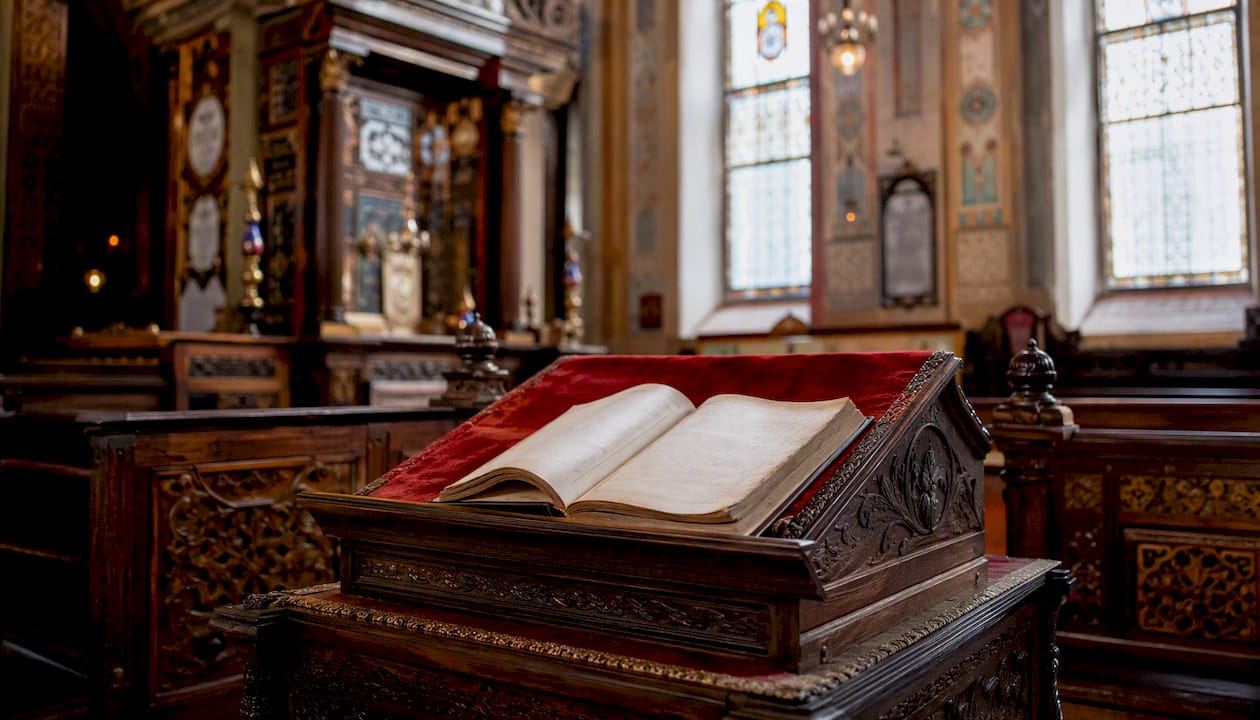
Several synagogues in the quarter remain active places of worship rather than purely museum spaces. The Remuh Synagogue holds regular Shabbat services, and the Tempel Synagogue hosts services during major festivals. This is worth knowing before you visit: you may arrive to find a service in progress, which means waiting quietly outside or returning later.
The Jewish Culture Festival, now in its fourth decade, is the most visible expression of that ongoing cultural life. It draws performers and scholars from across Europe and beyond, and the Shalom on Szeroka Street closing concert regularly attracts tens of thousands of people. The festival is not a memorial event; it is a celebration of living Jewish culture, which is precisely what makes it worth attending if your visit coincides with late June or early July.
Restaurants and cultural spaces with a Jewish or Central European heritage focus have multiplied in the quarter since the 1990s. Several serve traditional Ashkenazi dishes alongside contemporary Polish food, and a handful of bookshops and galleries specialise in Jewish history and art. The neighbourhood has a genuine cultural density that rewards slow exploration.
A note on visiting Kazimierz
There is a particular quality to the light in Kazimierz on a quiet weekday morning, before the tour groups arrive and the café terraces fill. Standing in the Remuh Cemetery, reading the names on stones that survived because someone thought to bury them during the war, the weight of what happened here is not abstract. It is specific and close.
What strikes me most, having spent time in this district, is how the revival has not softened that weight. The klezmer music drifting from a restaurant on Szeroka Street does not diminish the cemetery a hundred metres away. If anything, the contrast sharpens both. The best time to visit is early morning, when the streets are quiet and the synagogues have not yet filled with visitors. You get the history to yourself, and it lands differently.
Book a Kazimierz guided tour with ComFort Tours Cracow
A small-group guided walk through Kazimierz with a licensed local expert is the single most efficient way to get genuine depth from the district in a short visit. ComFort Tours Cracow offers exactly that: small groups, locally licensed guides with specialist knowledge of Jewish heritage, and flexible start times to suit your wider Kraków itinerary.

Tours typically include a licensed guide, a structured route covering the main synagogues and the Remuh Cemetery, and the option to extend into the Podgórze ghetto area. Private tours are available for families, solo travellers, or anyone who wants a fully tailored experience. If you have mobility requirements, note these at the booking stage and the team will arrange an appropriate option. Browse available tours and book your Kazimierz walk directly on the ComFort Tours Cracow website.
Sources
Before you travel, verify opening hours, ticket prices and festival dates directly with official sources. These change seasonally and are not always reflected in third-party guides.
- Kazimierz
- Kraków: Kazimierz and the Jewish city | Kraków travel
- Kazimierz Guide — Jewish Quarter History, Food, Art & Everything You Need to Know | Krakow Itinerary
- Your Ultimate Kazimierz Jewish Quarter Guide in Krakow | Poland Wander
- Krakow Kazimierz — the former Jewish district | inyourpocket
Always check official site pages for the most current opening hours and festival dates before your visit.
FAQ
Was Kazimierz a Jewish district in Kraków?
Yes. Kazimierz served as the centre of Jewish life in Kraków from the 15th century onwards, with the community concentrated around Szeroka Street and the area known as the Oppidum Judaeorum. It remained a major Jewish cultural and religious hub until the Second World War.
How many synagogues are there in Kazimierz?
There are several historic synagogues in the quarter, with four considered the principal heritage sites: the Old Synagogue, Remuh Synagogue, Tempel Synagogue, and Izaak Synagogue. Some function primarily as museums while others remain active places of worship.
Is Kazimierz safe to visit?
Kazimierz is a safe, central neighbourhood in Kraków. Standard city precautions apply, particularly around the busy Plac Nowy market area. The district is well-lit and lively at night, and it is popular with both tourists and local residents.
How long should I spend in Kazimierz?
A focused visit covering the main synagogues and Plac Nowy takes 90–120 minutes. To include the Galicia Jewish Museum and allow time for a café stop, allow at least half a day.
Do I need a guided tour, or can I visit independently?
Both work well. A self-guided walk covers the main sites using the route above. A guided tour with a licensed local expert, such as those offered by ComFort Tours Cracow, adds historical depth and context that is particularly valuable at the Remuh Cemetery and the synagogues.