Driving Kraków to Zakopane in winter typically takes 2.5 to 3.5 hours, longer on stormy or peak-season weekends. Self-drive suits confident winter drivers with proper tyres and a bit of patience. If you’d rather leave the mountain roads to someone who knows them, a private transfer with a local operator takes the guesswork out of the journey entirely.
TL;DR:
- The drive from Kraków to Zakopane typically takes 2 to 2.5 hours in good winter conditions, but can extend to over 3.5 hours during snowstorms or peak holidays.
- Winter hazards include black ice, slush, thaw-freeze cycles, and narrow, snow-covered roads, all requiring slower speeds and extra caution.
- Proper vehicle preparation, such as fitted winter tyres, checking the battery, and packing an emergency kit, is crucial for safety and smooth driving.
- Experienced winter drivers with confidence and appropriate tyres can manage the route, but those unfamiliar with snow and ice are advised to consider private transfers.
- Public options like trains or buses are available but may be delayed during storms, making private transfers a more reliable choice for families or less experienced drivers.
Table of Contents
- How long does the Kraków to Zakopane winter drive really take?
- What winter hazards should you expect on the Zakopianka?
- What should you check before driving a rental car in winter?
- How do you drive the mountain approaches safely?
- Where can you park once you reach Zakopane?
- Should you take the train, bus or a private transfer instead?
- Which dates and times should you avoid driving?
- What does a local guide’s winter experience actually tell you?
- How does altitude change the driving experience near Zakopane?
- What emergency numbers and roadside help should you save before you go?
- Do you need snow chains for this drive?
- What winter driving laws apply on this route?
- Why the “just drive carefully” advice misses the point
- Want the mountain views without the mountain driving?
- Sources
- FAQ
How long does the Kraków to Zakopane winter drive really take?
The distance between Kraków and Zakopane runs about 105 to 110 kilometres, depending on whether you start from the city centre or the airport at Balice. In good conditions, that’s a journey of roughly 1 hour 45 minutes to 2 hours. Winter changes that arithmetic completely.
Almost the entire route runs on two roads: the S7 expressway south from Kraków, then the DK47, better known locally as the Zakopianka, once you pass Myślenice. The S7 is wide, well-lit, and generally well maintained even in snow. The Zakopianka is a different story: narrower, busier, and prone to bottlenecking through towns like Rabka-Zdrój and Nowy Targ as it climbs towards the Tatras.
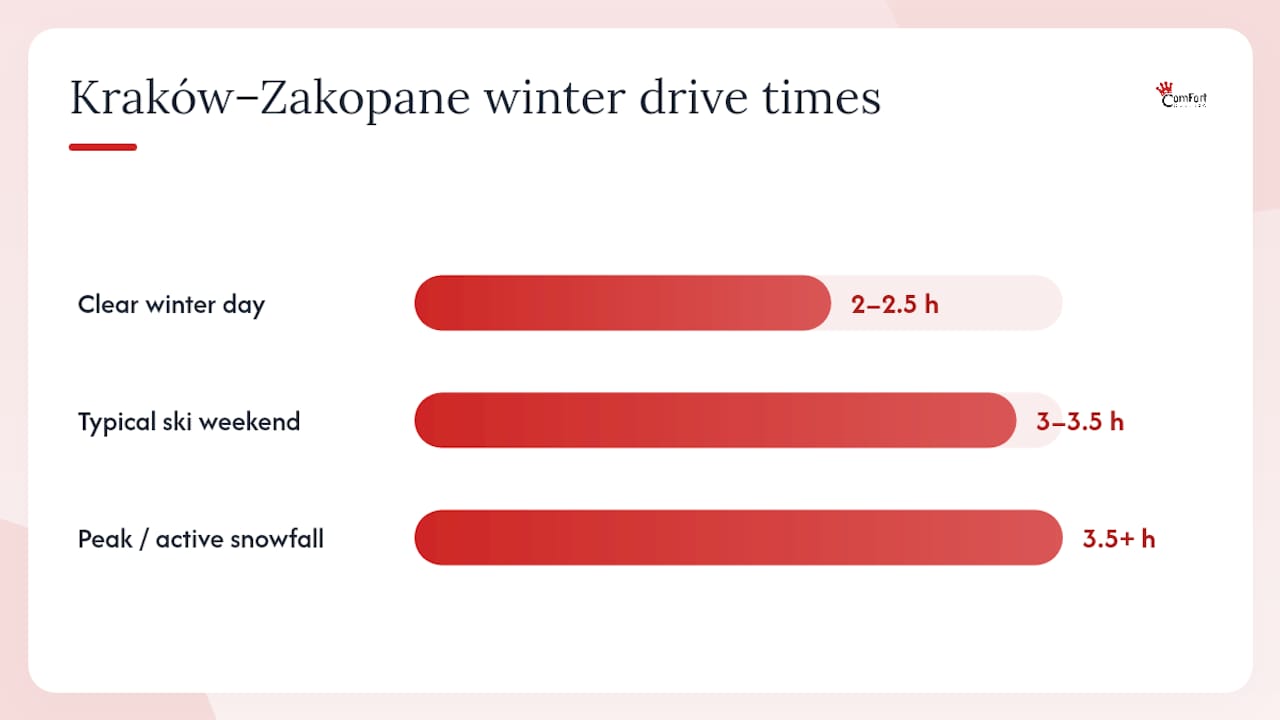
Realistic winter timings break down like this:
- Clear winter day, off-peak: 2 to 2.5 hours
- Typical ski weekend: 3 to 3.5 hours
- Peak holiday dates or active snowfall: 3.5 hours or more
Delays cluster around three things: town centre traffic on the Zakopianka, roadworks (which pop up even in winter months), and the final climb into Zakopane itself, where gradients and switchbacks slow everyone down regardless of vehicle. If you have time to spare, Myślenice and Rabka-Zdrój make sensible, safe stops for a coffee and a leg stretch, though every extra stop adds to your total journey time. Build that into your planning rather than fighting it.
What winter hazards should you expect on the Zakopianka?
Three hazards define winter driving on this route, and each changes how you should handle the car.
Black ice and freezing rain are the most dangerous because they’re often invisible until you’re already on them. Braking distances lengthen dramatically on ice compared with dry tarmac, and national guidance stresses that drivers need to compensate with slower speeds and much greater following distance well before reaching a hazard, not after spotting one.
Statistic to remember: Poland’s national weather institute notes that stopping distances on ice can run several times longer than on dry asphalt at the same speed. At 80 km/h, that’s the difference between stopping in time and not stopping at all.
Slush and packed snow narrow the usable width of the DK47 in a way the S7 rarely experiences, since the expressway gets priority gritting and ploughing. Expect the Zakopianka’s lanes to feel tighter than the map suggests, especially where snowbanks build up on the verges.
Thaw-freeze cycles are a quieter danger. A mild afternoon followed by an overnight freeze can expose potholes that weren’t there the day before, and wind-driven drifts on exposed stretches near Nowy Targ can catch out drivers who assume the road ahead is clear because the last few kilometres were fine.
Before setting off, check:
- Live road conditions through Poland’s national road authority (GDDKiA)
- Weather updates from IMGW, the national meteorological service
- Local news for convoy or closure notices during heavy snow, which authorities sometimes enforce on the higher approaches to Zakopane
In genuinely bad conditions, convoys led by a snowplough or gritter aren’t uncommon on the final stretch. Patience beats overtaking every time.
What should you check before driving a rental car in winter?
Preparation matters more on this route than on a flat motorway, because the terrain punishes small mistakes. Work through this before you leave Kraków:
- Fit or request winter tyres. Poland has no blanket legal requirement for winter tyres, but insurers increasingly treat driving on summer tyres in snow as gross negligence, which can mean a denied claim if you have an accident. Ask your rental company specifically for winter tyres, not just “all-season,” when booking for a Zakopane trip.
- Check the battery. Cold snaps drain batteries fast, and a rental left standing overnight in subzero temperatures can be sluggish to start.
- Top up antifreeze and winter screenwash. Standard summer washer fluid can freeze on the windscreen the moment you use it.
- Test lights and wipers. Poor visibility is common on the Zakopianka in low winter light; broken wiper blades are a false economy.
- Pack an emergency kit. An ice scraper, de-icer, a small shovel, a tow rope, a high-vis vest, a warm blanket, and a headtorch or power bank take up little space and solve real problems.
- Confirm insurance covers winter conditions. Some rental agreements exclude damage from “adverse weather driving” unless you’ve specifically flagged it.
- Ask about child seats and roof boxes. If you’re carrying skis or bulky luggage, confirm roof storage or ski racks are available before you arrive at the desk, not after.
Pro Tip: Ring the rental desk a day ahead and ask them to have winter tyres already fitted before you arrive. Turning up and requesting a swap on the spot often means a wait, or no stock left.
How do you drive the mountain approaches safely?
Technique matters more than horsepower on the Zakopianka. A few habits make the difference between a manageable drive and a stressful one.
- Slow down before you need to, not when you need to. Reduced speed and a longer following distance give you room to react to ice, slush, or a car ahead braking unexpectedly.
- Use lower gears on both climbs and descents. Engine braking on the way down saves your brakes from overheating and reduces the risk of a skid on a steep, icy gradient.
- Steer smoothly and avoid harsh braking. Sudden inputs are what break traction on packed snow. Plan your line well ahead of bends.
- If you feel the car start to slide, ease off the accelerator and steer gently into the direction of the skid, rather than braking hard or fighting the wheel.
- Know when to stop. If visibility drops to near zero or the road ahead looks impassable, pull over safely and wait rather than pushing on. Recovery services can reach a stationary car; they can’t help one that’s gone off the road.
- Give snowploughs and gritters space. They’re clearing the route for everyone behind them, and overtaking one is rarely worth the few minutes saved.
Pro Tip: Watch how local drivers handle a particular bend or junction before you attempt it yourself. Locals know which corners ice up first, and following their lead is often the safest cue you’ll get.
Where can you park once you reach Zakopane?
Krupówki, the main street, has paid parking zones that fill quickly in ski season, especially at weekends. Arriving after mid-morning often means circling for a spot, so an early start pays off twice over.
- Larger car parks near the railway station tend to have more availability than street parking on Krupówki itself.
- If snow makes walking with luggage difficult, ask your hotel about drop-off access before you arrive, many will let you unload directly outside even if you then have to move the car to a nearby lot.
- Choose accommodation with private parking if you’re travelling with skis or small children, since it removes one layer of hassle entirely.
- Don’t leave visible valuables or ski gear in the car overnight. Zakopane is generally safe, but a car park in the dark, snow-covered, is not somewhere to test that assumption.
Should you take the train, bus or a private transfer instead?
Self-drive isn’t the only sensible option, and for some travellers it isn’t the best one.
- Trains run in around 2 to 2 hours 15 minutes and avoid road congestion entirely, though they’re bound to a fixed timetable that won’t suit every arrival or departure time.
- Buses cover the same route with more frequent departures but can be caught in the same road delays as everyone else during peak weekends.
- Private transfers offer door-to-door convenience with a winter-ready vehicle and a driver who already knows the road, which matters most for families, late arrivals, or anyone without recent experience driving on snow and ice.
Cost is the trade-off. A transfer costs more than a train ticket, but for a family flying in late with luggage and skis, or a couple who simply don’t fancy learning mountain driving technique on a Zakopianka snowbank, the predictability is worth paying for. If you go this route, confirm child seats and a winter-ready vehicle when you book, not on the day.
Which dates and times should you avoid driving?
A little scheduling discipline avoids most of the stress on this route.
- Avoid Friday afternoon and Sunday evening departures during ski season and school holidays, when everyone else has the same idea.
- Build in 30 to 90 minutes of buffer beyond the standard winter estimate; add more during storms or the Christmas and New Year peak.
- Morning departures generally beat afternoon ones, both for daylight and for getting ahead of the weekend rush.
- Check forecasts and road advisories the morning you travel, not the night before. Conditions shift quickly this close to the mountains.
What does a local guide’s winter experience actually tell you?
Damian Fort, a local guide working across Kraków and the Tatra region, points to one pattern that catches out visiting drivers most: the Zakopianka is usually ploughed reasonably well through the day, but conditions can deteriorate fast after dark or during a sudden snow squall, when gritting crews simply can’t keep pace with every stretch at once.
His practical rule for families and first-time winter drivers is straightforward: if you’d hesitate to drive an unfamiliar hilly A-road in snow back home, don’t attempt the Zakopianka on your first Polish winter trip either. A private transfer removes that risk entirely and lets you watch the scenery instead of the road. For confident, experienced winter drivers with the right tyres, self-drive remains a perfectly reasonable choice, just one that rewards caution over confidence.
How does altitude change the driving experience near Zakopane?
Zakopane sits at 800 to 1,000 metres elevation, noticeably higher than Kraków, and that height difference matters more than most drivers expect. Temperature drops as you climb, often by several degrees between the lowlands and the town itself, which means a road that’s merely wet in Kraków can be icy by the time you reach the final approach.
The gradient itself demands a different driving rhythm. Long, steady climbs followed by equally long descents put more strain on brakes than flat driving does, particularly in an unfamiliar rental car. Use engine braking on the way down rather than riding the brake pedal continuously, which can cause it to overheat and lose effectiveness at exactly the wrong moment.
Fuel stations thin out the closer you get to the mountains. Larger towns along the S7 and the early stretch of the DK47, including Myślenice, have reliable options, but choices narrow past Rabka-Zdrój. Fill up before the final climb rather than assuming you’ll find a station near Zakopane itself.
Altitude also affects visibility. Cloud and fog settle lower on the approach roads than they would on flat terrain, sometimes reducing sightlines to a few dozen metres with little warning. Slow down at the first sign of mist rather than waiting to see how bad it gets.
What emergency numbers and roadside help should you save before you go?
Save these before you leave Kraków, not once you need them.
112 is the single emergency number across Poland and the EU, covering police, ambulance and fire services, and operators can generally assist in English. For breakdowns specifically, Poland’s major roadside assistance networks operate nationwide, and most car rental agreements include a dedicated assistance number printed on the rental documents or windscreen sticker, worth checking the moment you collect the car.
If you break down on the S7 or DK47, pull as far onto the hard shoulder or verge as conditions allow, put on your high-vis vest before stepping out, and place a warning triangle behind the vehicle if you’re carrying one. In heavy snow or poor visibility, staying inside the car with hazard lights on until help arrives is often safer than standing beside a busy road.
Keep your rental company’s helpline saved as well as 112. Many winter breakdowns on this route are tyre-related or battery failures triggered by cold, and rental firms can often dispatch help faster than a generic service if you call them directly.
Do you need snow chains for this drive?
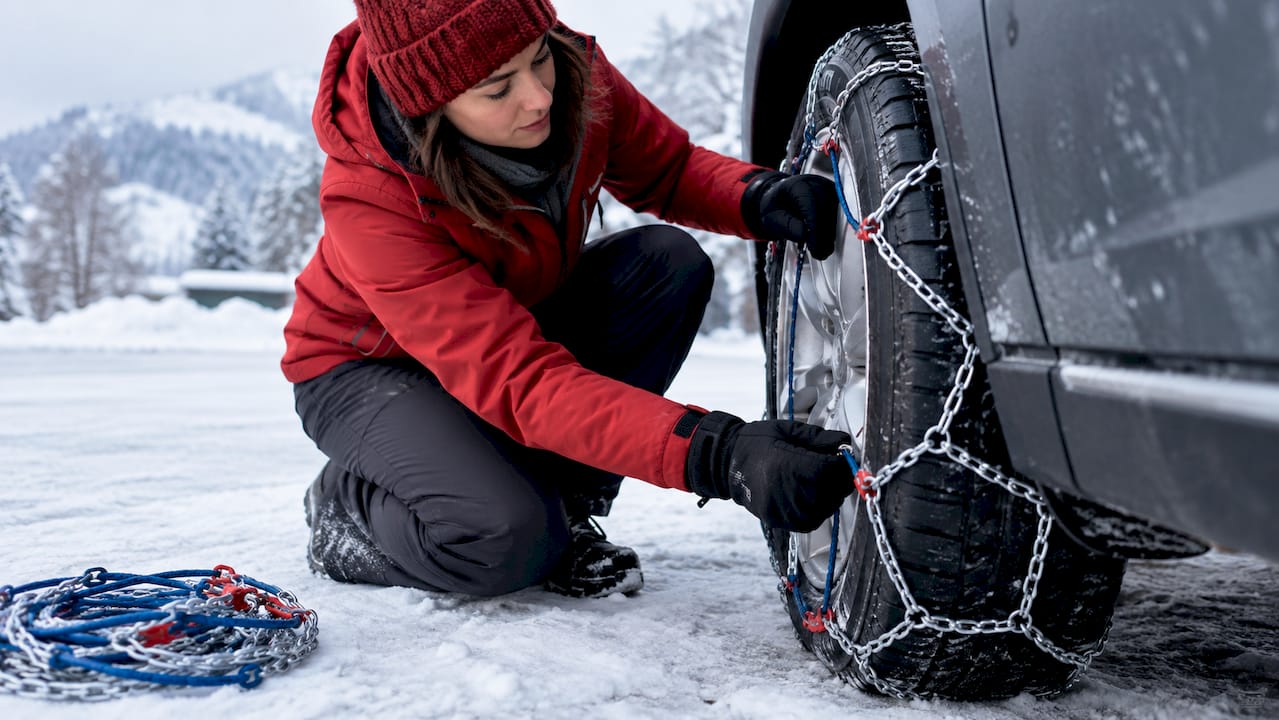
Snow chains are rarely necessary on the S7 or the main stretch of the DK47, since both are gritted and ploughed regularly during normal winter weather. Good winter tyres cover the vast majority of conditions you’ll meet driving from Kraków to Zakopane.
Chains become relevant only in genuinely severe conditions: heavy, unploughed snowfall, or if you plan to drive beyond Zakopane onto smaller, unmaintained mountain roads towards the ski resorts themselves. If you’re renting a car specifically for that kind of trip, ask the rental company whether chains are available and, crucially, whether your tyres and wheel arches are compatible with them, not every rental vehicle is.
If you do carry chains, practise fitting them at home or in a car park before you need them at the roadside in the dark and cold. Fit them only on the roads or signs that specifically call for them; using chains on clear tarmac damages tyres and road surfaces alike.
What winter driving laws apply on this route?
Poland has no blanket legal requirement to fit winter tyres between specific calendar dates, unlike some neighbouring countries. What the law does require is that your vehicle remains in a condition safe for the conditions you’re driving in, and that standard applies just as much to a UK-registered car brought over the border as to a Polish rental.
The practical risk sits with insurance rather than fines. Insurers increasingly treat driving on summer tyres through snow and ice as negligence, which can mean a rejected claim if you’re involved in an accident, even where no specific law was broken. That single fact should carry more weight in your planning than any statutory deadline would.
Dipped headlights are required at all times when driving in Poland, day or night, year-round, which catches out some UK visitors used to daytime running lights alone. Speed limits drop in built-up areas exactly where the Zakopianka narrows through towns, and enforcement in these stretches tends to be active during the winter tourist season.
Why the “just drive carefully” advice misses the point
Most guides to this route tell you to slow down and take it easy, which is true but incomplete. The more useful judgement is about matching the trip to the driver, not the weather.
A confident winter driver with proper winter tyres and a realistic time buffer will have a fine trip on the Zakopianka in December or February. The mistake isn’t attempting the drive; it’s underestimating how quickly conditions on this specific road can shift between Myślenice and Zakopane, then compounding that by rushing to make up time on the final climb.
What gets overrated is the idea that a rental car with “winter tyres fitted” solves everything. Tyres reduce risk, they don’t remove it, and the biggest variable left on the table is driver experience with snow and ice, something no amount of preparation checklists can substitute for. If you’re honest about lacking that experience, a transfer isn’t a compromise. It’s the more rational choice.
— Damian Fort
Want the mountain views without the mountain driving?
If reading through braking distances on ice and thaw-freeze potholes has you leaning towards letting someone else handle the wheel, that instinct is a sound one. Some local companies run private, winter-ready transfers between Kraków and Zakopane with drivers familiar with the route, door to door, with child seats available on request.
Booking is straightforward: confirm your pick-up time, flag how much luggage or ski equipment you’re bringing, and let the team know if you need a car seat. Everything gets arranged before you arrive, so there’s no roadside surprise waiting for you on the day. Check availability and book your Kraków to Zakopane transfer directly, and swap a stressful drive for a relaxed ride through some of Poland’s finest winter scenery.
Sources
Check IMGW for live weather, GDDKiA for road reports, and Winiety24 for current tyre-practice guidance before setting off.
- Krakow to Zakopane by car: Driving guide & tips | Kaizen REN
- Kraków to Zakopane: Day Trip Guide (2026) | Nomado Travel
- Winiety24
- Zimowe vademecum kierowcy (winter vade mecum for drivers) | IMGW
FAQ
What is the best way to travel from Kraków to Zakopane?
The best option depends on your comfort with winter driving. A self-drive works well for experienced drivers with winter tyres, while a train journey of about 2 to 2 hours 15 minutes suits those wanting predictability, and a private transfer such as ComFort Tours Cracow’s service suits families or anyone unfamiliar with snow driving.
Is it possible to drive from England to Poland?
Yes, driving from England to Poland is possible via ferry or the Channel Tunnel and a route through the Netherlands or Belgium and Germany, though it’s a long multi-day journey. Most UK travellers instead fly into Kraków and either self-drive a rental car or book a transfer for the onward trip to Zakopane.
Can Zakopane be a day trip from Kraków?
Yes, Zakopane works as a day trip from Kraków, though winter conditions make it a longer day than in summer. With driving times of 2.5 to 3.5 hours each way in winter, a day trip means an early start and limited time in the town itself.
How easy is it to get to Zakopane?
Getting to Zakopane is straightforward thanks to the S7 expressway and DK47 route, both well signposted from Kraków. Winter adds complexity through slower traffic and occasional hazards, which is why many UK travellers choose a private transfer or train over self-driving unfamiliar mountain roads.
Is driving from Kraków to Zakopane safe in winter?
Driving from Kraków to Zakopane is generally safe in winter provided the car has proper winter tyres and the driver adjusts speed for ice, slush and reduced visibility. Inexperienced winter drivers face higher risk on the narrower DK47 stretch, where a private transfer is often the more sensible choice.