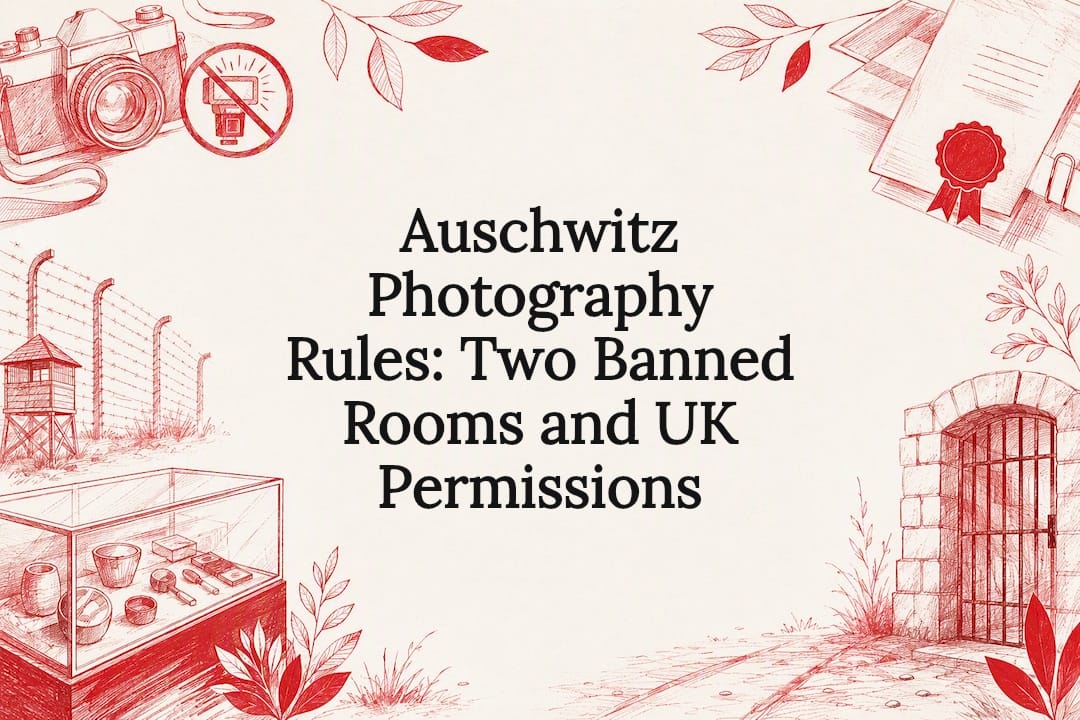
Yes, you can take photos at Auschwitz, but with firm limits. Personal photography is allowed across most of the Memorial’s public areas, provided you skip the flash and leave the tripod at home. Certain areas are completely off-limits to photography, including the Victims’ hair room in Block 4 and the basements of Block 11. Anything beyond a personal snapshot, including commercial filming, drone footage or press shoots, needs written approval from the Museum before you arrive.
TL;DR:
- Photography is permitted in most outdoor areas and indoor exhibitions except for the victims’ hair room in Block 4 and the basements of Block 11, where photo bans are absolute.
- No flash, tripods, or camera supports are allowed during visits, and photographing security checkpoints or staff luggage without permission is forbidden.
- Commercial filming or photography for monetized content requires prior approval, a minimum seven-day notice, and often Museum approval of final content.
- Drone use is nearly impossible due to restricted airspace; aerial filming is only granted in exceptional cases with explicit Museum consent and extra clearance.
- Booking private guides and preparing in advance simplifies permissions and ensures respectful adherence to photography rules during your visit.
Table of Contents
- Where you can and can’t photograph on site
- Equipment and conduct rules: flash, tripods and other visitors
- Filming for creators, press and commercial projects
- Drones and aerial filming: why the answer is almost always no
- How guided tours change the photography experience
- A UK visitor checklist for staying within the rules
- Why the rules matter more than most visitors expect
- Planning a respectful visit with ComFort Tours
- Sources
- FAQ
Where you can and can’t photograph on site
Most of Auschwitz-Birkenau’s outdoor grounds and public exhibition buildings allow visitors to take photographs for private use, without flash or a tripod. That covers the barrack rows, the railway tracks at Birkenau, the courtyards, and the majority of indoor exhibition spaces where personal history is presented through documents, maps and artefacts.
Two locations are named exceptions, and the Museum treats them as absolute rules rather than suggestions:
- Block 4, Room 5 — the room holding the victims’ hair, where photography is banned outright.
- The basements of Block 11 — the site’s former punishment cells, also closed to cameras.
The Museum’s visiting information states plainly that private photography is permitted almost everywhere else, but flash and supports are never allowed, and these two rooms carry a complete ban regardless of equipment.
The reasoning is straightforward once you think about what’s actually in those spaces. Human hair, taken from murdered prisoners, is a preserved physical remnant rather than a museum exhibit in the usual sense. Photographing it, however briefly, sits uncomfortably close to treating a person’s remains as a photo opportunity. The Block 11 basements carry a similar weight; they’re preserved as they were found, and the Museum’s priority there is conservation and dignity over documentation by visitors. Staff on the ground enforce both rules without exception, and they’ll ask you to put the camera away if you forget.
Equipment and conduct rules: flash, tripods and other visitors
The Museum’s official visitor regulations, effective from 1 May 2025, spell out exactly what’s banned beyond the two forbidden rooms. Break these down and they fall into three groups:
- Equipment restrictions — no flash photography anywhere on site, and no tripods, monopods or other camera supports inside the buildings.
- Prohibited subjects — you cannot photograph security checkpoints, staff hand luggage, or other security installations around the grounds.
- Conduct around other visitors — treat fellow visitors, and especially survivors or their families who sometimes attend, with the same care you’d want shown to you.
Selfies and posed group shots are not banned outright, but they’re widely considered poor form here, and Museum staff have been known to intervene when behaviour strays into disrespectful territory. Think about how a photograph will read once it’s out of context on a phone screen back home, because that’s exactly how it will be judged.
Violating these rules can lead to warnings and, in serious cases, removal from the Memorial grounds.
Pro Tip: Switch your phone’s flash and camera sounds to silent mode before you enter the grounds. Fumbling with settings inside the exhibition buildings draws attention and disrupts other visitors far more than a single missed photo ever will.
Filming for creators, press and commercial projects
Casual visitors taking photos for themselves don’t need paperwork. The moment a photo or video is destined for a monetised social channel, a documentary, a news report or any commercial output, the rules change entirely. The Museum’s press and filming guidance requires prior approval for any commercial use, and content must not compromise the dignity of victims at any stage of production or publication.
What the application process actually involves:
- Contact the Museum’s Press Office for journalistic or commercial shoots; documentary projects go through the Museum director directly.
- Submit your request at least seven days before the planned filming date for documentary work, since the director’s consent and a signed agreement are both required.
- Include the intended date, a script or concept outline, the channels where the material will appear, and how it will be used.
- Expect the Museum to review and approve final content, and in many cases to require that historical narration comes from a Museum representative rather than an independent presenter.
Creators sometimes assume a small production counts as personal use. It doesn’t, if there’s a commercial or monetised angle attached, and applying after the fact rarely goes well. Build the lead time into your itinerary from the start.
Drones and aerial filming: why the answer is almost always no
Auschwitz-Birkenau sits inside the EPP20 no-fly zone, which rules out routine drone photography for anyone, tourist or professional. The Museum’s filming and photography guidance confirms that aerial footage has been granted only in exceptional cases, typically for television or documentary productions with explicit Museum consent secured well in advance.
- Standard visitor drones have no legitimate use case here; don’t pack one expecting to fly it.
- Exceptional approval requires direct Museum agreement and almost certainly separate aviation clearance.
- If a UK production genuinely needs aerial shots, start enquiries months ahead, not weeks.
How guided tours change the photography experience
Photography on an organised guided tour works differently from an independent visit. Group tours generally don’t allow filming during the walk itself. Content creators who need footage are usually expected to book an individual guide and secure Museum permission beforehand, rather than trying to film alongside a standard group.
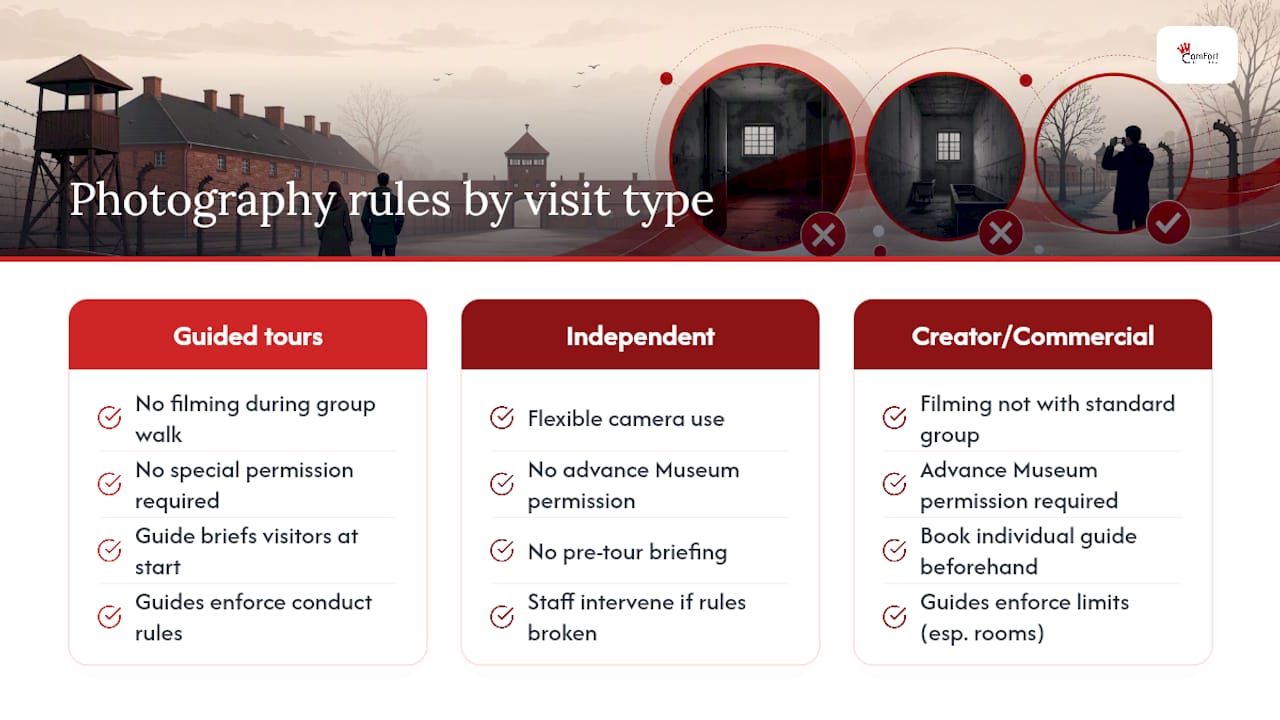
Independent entry gives you more flexibility with your camera, but Museum guides and educators still step in wherever conduct or photography strays from what’s acceptable, particularly near the two forbidden rooms and in crowded exhibition spaces. Guides brief visitors on these points at the start of a tour precisely because misunderstandings happen often, especially among first-time visitors unfamiliar with the site’s rules.
Small-group and private guides, including those working with operators like ComFort Tours, typically walk visitors through the photography restrictions before entering the grounds. That briefing alone resolves most of the confusion that trips up independent visitors on their first pass through Block 4.
A UK visitor checklist for staying within the rules
Before you leave the hotel, run through a short list rather than trying to remember scattered rules on the day.
- Disable your phone’s flash and check battery and storage space the night before.
- Carry a printed copy of any filming permission or confirmation email, since mobile signal on site can be patchy.
- Pack modest clothing that covers shoulders and knees, in line with the site’s dress code expectations.
- Leave selfie sticks and any camera supports at the hotel; they won’t get past the entrance checks.
If you’re applying for filming permission yourself, keep the request short: a one-paragraph concept, where the footage will be published, a brief script excerpt if relevant, your planned dates and direct contact details. Applications that ramble tend to sit in a queue longer than ones that get straight to the point.
Pro Tip: Booking a private guide through an operator familiar with the site removes most of this guesswork. A guide who visits regularly knows exactly which staff member handles filming enquiries and can flag likely delays before they cost you a filming slot.
Why the rules matter more than most visitors expect
Auschwitz-Birkenau exists to preserve memory, not to supply content. Every restriction on photography, from the ban on flash to the closed doors of Block 11, exists to stop a place of mass murder being reduced to a backdrop. Following the rules isn’t bureaucratic box-ticking. It’s the minimum a visitor owes to the people the site remembers, and it’s what keeps the images that do get taken meaningful rather than exploitative.
— Damian Fort
Planning a respectful visit with ComFort Tours
Getting the photography rules right is easier with someone briefing you before you walk through the gate. ComFort Tours Cracow runs small-group and private visits to Auschwitz-Birkenau with a pre-visit briefing covering exactly what you’ve read here: banned rooms, equipment limits, and how to behave around other visitors and survivors.
Private guides can also help creators plan realistic timelines for Museum permission requests, since the seven-day lead time for documentary filming catches out visitors who assume they can sort it on arrival. Logistics, including transfers from Kraków, may be handled as part of some tour bookings. If you’re ready to plan your visit, browse ComFort Tours’ available tours and get in touch about bespoke arrangements, including help with permissions planning for anyone filming beyond a personal camera roll.
FAQ
Are you allowed to take photos at Auschwitz?
Yes, personal photography is allowed in most public areas of the Memorial, but flash, tripods and photography in Block 4’s hair room and the Block 11 basements are strictly forbidden.
What are the rules at Auschwitz for photography specifically?
No flash, no tripods or stands, no photographing security checkpoints or hand luggage, and no filming or commercial shoots without prior Museum approval.
What not to do when visiting Auschwitz?
Avoid posed or playful selfies, loud conversation, casual dress that exposes shoulders or knees, and photographing in the two rooms where cameras are completely banned.
Can I wear jeans to Auschwitz?
Jeans are generally fine as long as they’re not ripped or overly casual; the Museum expects modest, respectful clothing rather than a strict dress code, as covered in ComFort Tours’ dress code guide.
Do I need permission to film for social media at Auschwitz?
Yes, if the content is monetised or intended for commercial use, you need prior written approval from the Museum’s Press Office before filming.