The Krakow ghetto sites are in Podgórze, on the south bank of the Vistula, not in the Jewish quarter of Kazimierz where most visitors start. The four places worth your time are Ghetto Heroes Square, the Eagle Pharmacy, the surviving fragments of the ghetto wall and the former Płaszów camp. You can see the first three on foot in a morning. I have walked this route with many guests, and I will tell you how I would do it.
Key Takeaways
- The wartime ghetto was in Podgórze, across the river from Kazimierz, and functioned from 1941 to 1943.
- Ghetto Heroes Square (Plac Bohaterów Getta) is the natural starting point, with the Eagle Pharmacy right on it.
- Wall fragments survive at Lwowska 25–29 and Limanowskiego 62, a short walk from the square.
- A Schindler’s Factory ticket also gives you entry to the Eagle Pharmacy and Pomorska Street within seven days.
- Płaszów is the natural extension of the route, but it is an open, outdoor memorial site, so dress for the weather.
Table of Contents
- Why the ghetto is in Podgórze, not Kazimierz
- Ghetto Heroes Square: start here
- The Eagle Pharmacy at number 18
- Fragments of the ghetto wall
- Płaszów: the natural extension
- Schindler’s Factory and how tickets work
- A half-day route I would walk
- Our perspective
- Plan it with a local guide
- FAQ
- Sources
Why the ghetto is in Podgórze, not Kazimierz
This is the question I am asked most, and it is the one that trips up first-time visitors. Kazimierz is the city’s traditional Jewish quarter. The US Holocaust Memorial Museum explains that in early March 1941 the German authorities ordered the ghetto to be established in Podgórze, a southern suburb, rather than in Kazimierz.
So the two districts are related parts of one story, but they are not the same place. Kraków’s official city service describes Kazimierz as a tourist district of galleries, churches and synagogues, while the wartime ghetto lay on the other side of the Vistula. The same page notes that the Jewish quarter of Kazimierz dates from the end of the 15th century, and that its preserved synagogues and the restored Remuh cemetery recall the people who lived around Szeroka Street.
If you have time for both, I suggest Kazimierz first, for the centuries of life, then Podgórze, for what was done to it. Our Kazimierz Jewish quarter visitor guide covers the first half of that walk.
Ghetto Heroes Square: start here
Ghetto Heroes Square is a public square in Podgórze that marks the heart of the wartime ghetto. Today it is called Plac Bohaterów Getta. Before that it was Zgody Square, and according to the city’s Memory Trail page it was the main concentration point for residents before deportations, and a place of mass violence against Jewish people.
The ghetto itself was set up in March 1941. Karnet Kraków notes that it functioned from 1941 to 1943, with borders running along streets including Lwowska and Nadwiślańska and reaching the square. In March 1943 the ghetto was liquidated, and, according to the city’s trail page, residents were sent to KL Plaszow, Bełżec and Auschwitz-Birkenau.

The empty chairs
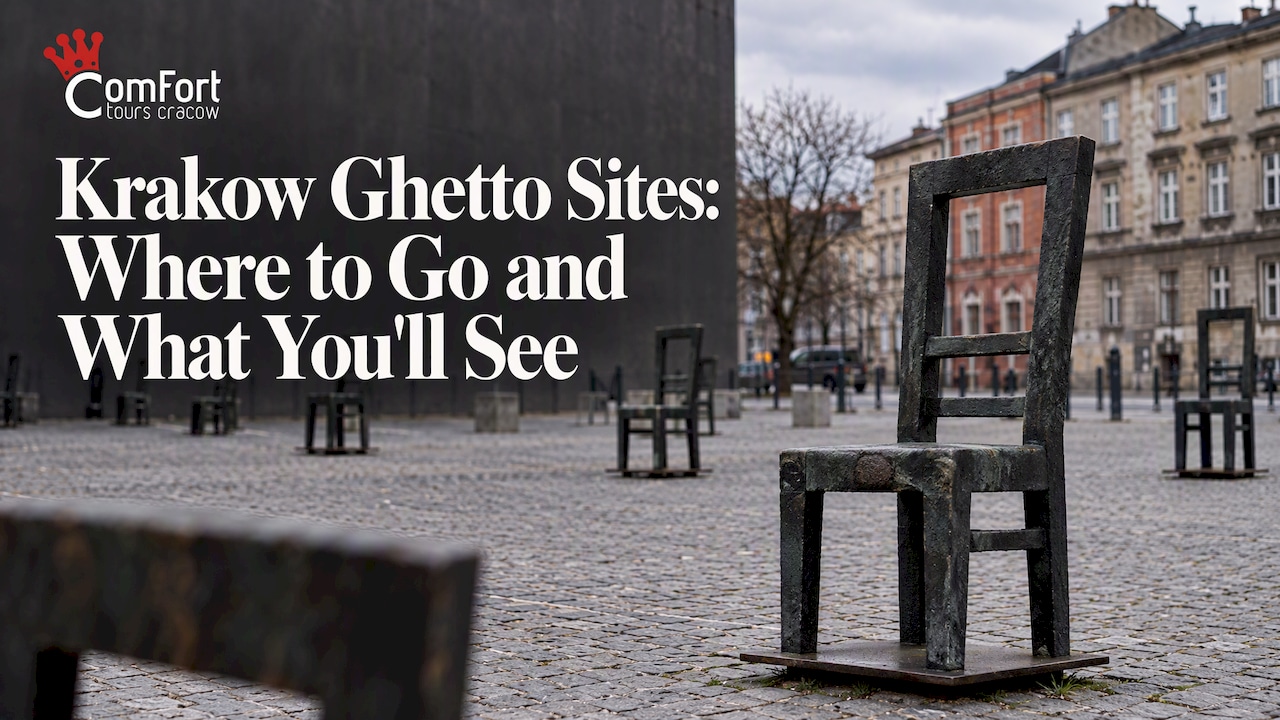
What you see today is a memorial of empty chairs placed across the square after its reconstruction. It is a very quiet design. The architect David Bravo Bordas, writing for PublicSpace, says it avoids traditional monumentality and uses everyday objects to make visitors face the absence of the lives destroyed here. The same page describes how the square, designed by Lewicki and Łatak, still works as an ordinary public space while remembering a tragedy.
My advice is to stand for a minute before you walk through. Locals cross it with shopping bags and coffee, and that ordinariness is the point. Photograph with care, and keep your voice low.
The Eagle Pharmacy at number 18
On the square itself, at Plac Bohaterów Getta 18, is the Eagle Pharmacy (Apteka Pod Orłem). The Museum of Krakow says it was the only pharmacy inside the ghetto, and that it gave residents medicines, hiding places, information and aid.
Its owner, Tadeusz Pankiewicz, was a witness to what happened here. The KL Plaszow Museum notes that he published one of the first postwar testimonies about the extermination of Kraków’s Jews. It is a small museum, so it feels intimate, and it rewards people who read as they go. Give yourself at least 45 minutes.
Fragments of the ghetto wall
From the square, it is a short walk to the places where the wall still stands. According to the city’s Memory Trail, preserved fragments are at Lwowska 25–29 and at Limanowskiego 62.
The wall fragment at Lwowska is the one most people photograph. The US Holocaust Memorial Museum records that between 15,000 and 20,000 Jews were confined in the ghetto, behind barbed wire and, in places, stone walls shaped to resemble Jewish tombstones. Seeing the curved top of the surviving stretch makes that sentence real in a way no guidebook can.

These fragments are easy to miss because they sit among ordinary streets and courtyards. If you are not sure where you are, ask a local or follow the signs of the Memory Trail.
Płaszów: the natural extension
The ghetto was not the end of the story. The KL Plaszow Memorial Museum manages the former camp site and the Grey House, and describes the site as the natural extension of the Memory Trail, with an open-air exhibition. It also says permanent exhibitions are planned for both, with the investment scheduled to finish in late 2027, so expect the visitor offer to keep developing.
Płaszów is a large, open landscape of grass, paths and hills rather than a conventional museum. That is what makes it affecting, and it is also why I tell guests to wear sturdy shoes. Many people know the site from the film Schindler’s List. The city says the film was shot in Kraków, including at the Liban Quarry beside the former camp, where a replica camp was built. Please remember the real place is a site of mass murder, not a film set.

If the film is what drew you, our guide to walkable Schindler’s List clusters shows how the filming locations and the real history fit together.
Schindler’s Factory and how tickets work
Oskar Schindler’s Enamel Factory, on Lipowa Street, is a short trip from the square and is the most popular combination with a ghetto visit. The Museum of Krakow states that a Schindler Factory ticket also admits you to the Eagle Pharmacy and Pomorska Street within seven days of the ticket date, during their opening hours.
The same page adds a few practical rules worth knowing before you plan:
- Tickets are limited, and online tickets can be bought up to 90 days before your visit.
- Entry is permitted within 15 minutes of the time printed on your ticket.
- If you buy a personal online ticket, bring original identification.
Because tickets sell out, I always say book the factory first and build the rest of the day around it. Check the museum’s page for current opening hours and prices, since these change. If you want the factory explained in more depth, our Schindler’s Factory page goes through what to expect.
A half-day route I would walk
Here is how I would plan a relaxed morning if you are staying near the Old Town.
- Cross the river. Walk over the Vistula from Kazimierz, or take a tram or taxi if the weather is poor. The walk helps you feel the distance between the two districts.
- Ghetto Heroes Square. Spend 15 to 20 minutes with the chairs before anything else.
- Eagle Pharmacy. Go in when it opens, while it is quiet, and allow about 45 minutes.
- Wall at Lwowska. A short walk away, and a good moment to talk through what you have seen.
- Schindler’s Factory. Book a timed slot, and keep a gap for a break beforehand.
- Coffee and a pause. Podgórze has plenty of small cafés. Take your time. This is heavy material, and it deserves a slow afternoon.
If you want the bigger picture over two days, including Płaszów, our Memory Trail route for UK visitors lays it out in order.
Getting there by car
Most visitors walk or use trams, but if you are driving, plan the parking before you set out. These strategies for parking near attractions are a good starting point, and they apply just as well to a busy city like Kraków. If you would rather not drive at all, a private driver can take you between the sites.
Our perspective
We have taken guests to Podgórze for years, and the thing we see most often is surprise. People arrive expecting the ghetto to be in the Jewish quarter, and they discover a quiet residential district with a square, a pharmacy and a wall that most passers-by hurry past.
That is why we keep our groups small. A square of empty chairs and a small pharmacy museum are not places for a crowd with headsets. They are places for a few people, a guide who knows the stories, and room to ask questions or say nothing at all.
We build the day around you: your pace, your language, your interests. Some guests want the full history from 1941 to 1943, others want to understand how Kazimierz and Podgórze connect, and some simply want a driver and a plan. Private transport between the sites means no tram timetables and no hunting for a street name with the clock running.
Whatever you choose, come with respect, and leave time afterwards to sit and talk it through.
Damian Fort
Plan it with a local guide
If you would rather not juggle tickets, trams and timings, we run private walking tours of Jewish Kazimierz and the ghetto, a private Oskar Schindler’s Factory tour and city tours with a local guide. We design them for small groups and can arrange transport and pickup. You can see everything on our main tours page, or look at our Kraków city tours if you want a wider introduction to the city.
Arriving by air? We also offer a transfer between Kraków and the airport, published at 100–150 PLN one-off; see our transfer page for details. For the wider story of Jewish life in the city, our UK visitor guide to Jewish Kraków is a good companion.
FAQ
Where is the Krakow ghetto?
The ghetto was in Podgórze, a district on the south bank of the Vistula. It was established in March 1941 and, according to Karnet Kraków, functioned until 1943. Its borders reached today’s Ghetto Heroes Square. It was not in Kazimierz, the traditional Jewish quarter.
Is there anything left of the ghetto wall?
Yes. The city’s Memory Trail lists preserved fragments at Lwowska 25–29 and Limanowskiego 62. They are a short walk from Ghetto Heroes Square, so you can fit them into the same outing.
Can I visit the ghetto sites and Schindler’s Factory on the same day?
Yes, and many visitors do. The Museum of Krakow says the factory ticket also admits you to the Eagle Pharmacy and Pomorska Street within seven days. Book the timed factory slot first, because tickets are limited.
Is there a Second World War museum in Krakow connected to the ghetto?
The KL Plaszow Memorial Museum manages the former camp site and the Grey House, and describes the site as the natural extension of the Memory Trail. It has an open-air exhibition, and permanent exhibitions are planned. Together with the Eagle Pharmacy and the Schindler factory, it gives a full picture.
Where was Schindler’s List filmed in Krakow?
The film was shot around the city, including at the Liban Quarry next to the former Płaszów camp, where the camp was recreated. The real Schindler factory is on Lipowa Street. Filming locations are not the same as historical sites, so a guide helps separate the two.
Sources
- Getto – Szlak pamięci 1941–1943, krakow.pl
- Getto – szlak pamięci 1941 – 1943, krakow.pl
- The Jewish ghetto in Kraków 1941-1943, Karnet Kraków
- The Krakow (Cracow) Ghetto, US Holocaust Memorial Museum
- Kazimierz and Podgórze, Kraków official city service
- History of the Eagle Pharmacy, Museum of Krakow
- Oskar Schindler’s Enamel Factory, Museum of Krakow
- KL Plaszow Museum, Memory Trail
- Plac Bohaterów Getta, PublicSpace
- 30 lat temu Steven Spielberg nakręcił w Krakowie Listę Schindlera, krakow.pl