
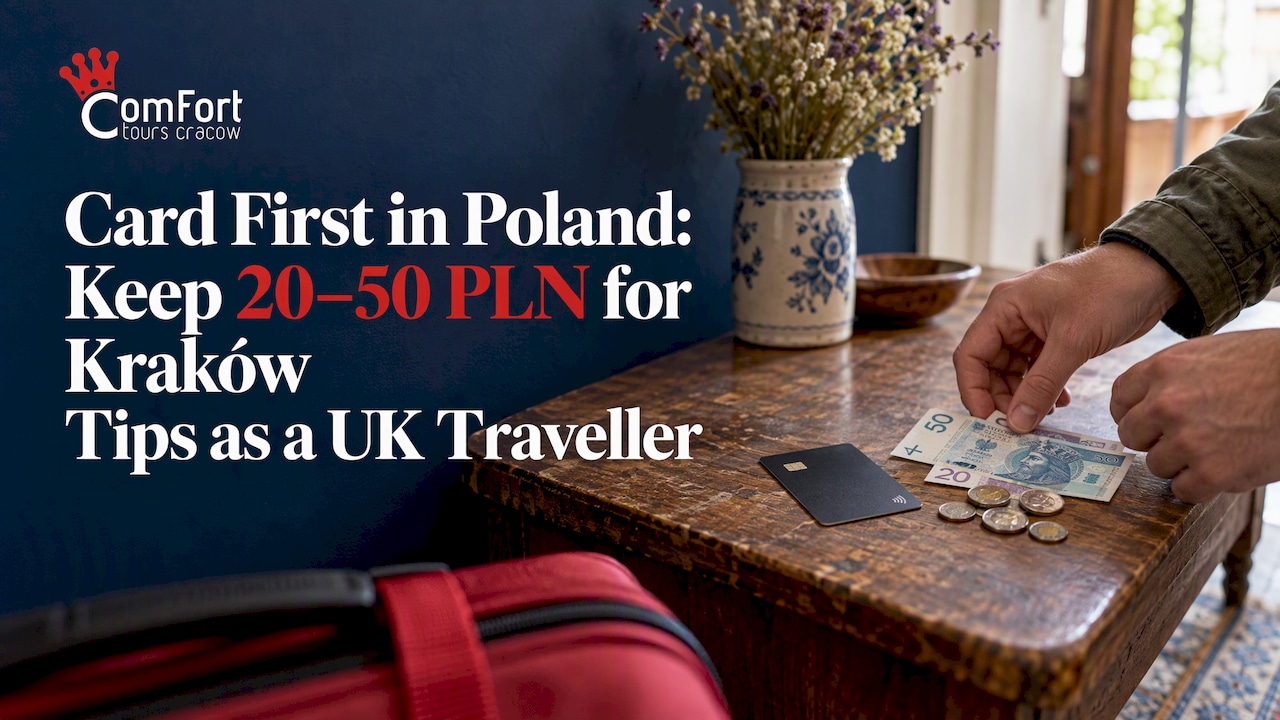
For UK travellers, the simplest approach works best: pay by card for most things in Poland, carry a modest reserve of złoty for tips, taxis and markets, and always choose PLN on the terminal rather than accepting a conversion to pounds. Before you fly, check your card’s foreign fees, pack a backup card, and withdraw a small emergency amount once you land.
Key Takeaways
UK travelers in Poland should primarily use cards for payments, carry a small amount of cash for tips and small purchases, and avoid dynamic currency conversion to save costs.
| Point | Details |
|---|---|
| Use cards for most payments | Contactless and mobile wallets are widely accepted in cities like Kraków, reducing the need for cash. |
| Carry small cash reserves | Keep a modest amount of złoty for tips, markets, taxis, and rural vendors, where cash is often required. |
| Avoid dynamic currency conversion | Decline offers to pay in pounds, as the rates are usually worse than your bank’s, increasing unnecessary costs. |
| Prepare for cash-only situations | Have small notes and coins ready for market stalls, small vendors, and independent taxi drivers who prefer cash. |
| Book transfers in advance | Pre-arranged transfers paid by card eliminate the need for cash upon arrival and reduce travel stress. |
Table of Contents
- Where card payments work best in Poland
- When you actually need cash in Poland
- Getting hold of złoty: ATMs, kantors and airports
- Dynamic Currency Conversion: the trap to avoid
- Card fees, ATM charges and working out the real cost
- What we’ve learned about payments on the ground in Kraków
- A traveller’s honest take: what actually matters
- How we help take the payment stress out of arriving in Kraków
- FAQ
- Sources
Where card payments work best in Poland
Kraków runs on cards. Cafés, restaurants, shops, museums and most trams and buses take contactless and mobile wallets without a second thought, and Wise’s guide to paying in Poland backs this up, recommending card as the primary method in cities while keeping a small PLN reserve on hand. Apple Pay and Google Pay are everywhere a card terminal exists, so you rarely need to dig your physical card out at all.
Your UK contactless limit should carry over, but it’s worth checking with your bank before you go, since some issuers cap contactless spending differently abroad and ask for a PIN above a certain amount or after several taps in a row. A few situations still catch cardholders out:
- Market stalls and small kiosks, especially food stands and local bazaars, often take cash only.
- Some independent taxi drivers, particularly outside the main apps, prefer cash.
- Rural vendors around the Tatras or smaller villages may have no card machine at all.
None of this should put you off relying on your card day to day. It just means a small cash buffer saves you an awkward moment.
When you actually need cash in Poland
Cash earns its place in a handful of specific situations, and knowing them before you arrive saves you fumbling for change at the wrong moment.
- Tipping: servers, guides and drivers in Poland commonly prefer cash tips, and our own tipping guide for Poland covers typical amounts so you’re not guessing on the spot.
- Markets and small purchases: a stall selling oscypek cheese or pierogi at a street market rarely has a card reader, so a few coins and small notes go a long way.
- Taxis and remote stops: if you’re hailing a cab off the street rather than booking through an app, ask upfront whether card is accepted; many drivers outside the big cities still run cash only.
Carrying a modest amount of złoty in mixed denominations covers most cash-only moments encountered on a typical trip, without leaving you holding more than you need.
Getting hold of złoty: ATMs, kantors and airports
Getting PLN into your pocket is straightforward once you know which sources actually give you a fair rate. Bank ATMs in the city centre are usually your best bet: withdraw from a machine tied to a recognised Polish bank, decline any on-screen currency conversion, and compare the final PLN credited against what you expected.
Kantors, Poland’s traditional currency exchange bureaux, are a good option for smaller cash top-ups if you pick ones in the town centre with clearly posted rates and no hidden commission. Walk past a couple before committing; rates can vary noticeably between neighbouring kantors on the same street.
- Avoid changing large sums at the airport: exchange counters there typically offer weaker rates than kantors or ATMs in town.
- Arrive with a small emergency amount in GBP or already converted into PLN, just enough for a taxi or transfer while you sort out a better rate.
- Treat your first withdrawal as a top-up, not your whole trip’s budget; you can always get more once you’ve found a fair-rate ATM.
Dynamic Currency Conversion: the trap to avoid
Dynamic Currency Conversion, or DCC, is the offer you get at a card terminal or ATM to pay in pounds instead of złoty. It sounds convenient, but the exchange rate is set by the merchant or ATM operator, not your card issuer, and it’s almost always worse than what your bank would give you.
Visa’s own guidance on DCC is clear: the terminal should show the local amount, the converted amount, the exchange rate and any extra fees before you confirm, and you should always have the choice to decline. If that information isn’t on screen, treat it as a red flag.
Pro Tip: If a terminal or ATM asks whether you want to pay in GBP or PLN, choose PLN every time unless you can clearly see a competitive rate and no hidden fee.
- Ask the cashier or check the screen for both the PLN and GBP figures before confirming anything.
- Decline conversion if the rate or fees aren’t shown, and select the local currency instead.
- Keep your receipt and note the amount charged, in case you need to query it with your card issuer later.
Card fees, ATM charges and working out the real cost
Before you travel, it’s worth a quick call or app check with your bank to see what a trip to Poland will actually cost you. Three things matter most: the foreign exchange margin added to the mid-market rate, a flat foreign-transaction fee per purchase, and a separate ATM withdrawal fee, which sometimes comes with a daily limit too.
Comparing card withdrawals against a kantor exchange is simple in principle: work out the final PLN you’d receive after your bank’s fees and margin, then compare that to the PLN a reputable kantor would hand over for the same amount of GBP. Say you’re changing £100: if your card issuer’s combined fees and margin come to 3%, you’d effectively receive the PLN equivalent of £97, whereas a transparent kantor with a small, clearly stated commission might land close to the same figure or slightly better, depending on the day’s rate.
- Ask your bank specifically about FX margin, transaction fees and ATM charges before you leave the UK.
- A low-fee travel card or specialist currency account can cut most of these costs, so it’s worth checking what’s currently available to you.
- Visa’s exchange-rate calculator gives an indicative figure, but your issuer may apply a different rate, so treat it as a guide rather than the final word.
What we’ve learned about payments on the ground in Kraków
Travellers who pre-book a card-accepting transfer often land without needing to scramble for cash the moment they step off the plane. Booking a transfer in advance means the payment is sorted before you’ve even packed your bags, which takes one source of airport-arrival stress off the table entirely.
Our guides are used to handling tips and group payments smoothly, and we’d suggest keeping somewhere between 20 and 50 PLN per person in small notes for tips across a full day out, plus a little extra for any market stop along the way. We’d also recommend packing a backup card separately from your main wallet, with a small concealed PLN reserve tucked somewhere else entirely, just in case one goes missing.

A traveller’s honest take: what actually matters

Having watched plenty of UK visitors fumble with currency on their first day in Kraków, our honest view is that the fee you worry about least, the ATM withdrawal charge, matters far less than the one you barely notice, the DCC conversion you accept without reading the screen. Card first, a little PLN in reserve, and a firm “no” to any currency conversion you can’t verify will serve you better than obsessing over which bank has the lowest headline fee.
Quick checklist: check your card’s fees before you fly, carry a small PLN reserve, pack a backup card, decline DCC every time, and book transfers in advance where you can. Keep cash out of sight in busy areas, since Gov flags petty theft around tourist spots and recommends care straight after withdrawing money.
— Damian Fort
How we help take the payment stress out of arriving in Kraków
Booking a transfer between Cracow and the airport before you fly means your first payment in Poland is already settled by card, with no need to hunt for a cash machine at arrivals while jet-lagged and disoriented. It’s the kind of small decision that makes the rest of the trip feel easier from the first minute.
Beyond the transfer, our Cracow city tours and private driver options put a local guide in charge of the day’s logistics, including advice on tipping and where cash will actually be needed, so you’re not guessing your way through it alone. If you’d rather sort out every practical detail before you land, including currency questions as they come up, support is often available when you book.
- Pre-booked transfers mean your arrival payment is settled by card, not cash, before you even touch down.
- Guided tours come with a driver or guide who knows exactly where card works and where you’ll need small notes.
- Private transport options let you plan tipping and payments around your own itinerary rather than guessing on the day.
Have a look at our tours and transfers to see what fits your trip, and get in touch if you’d like help planning the payment side before you arrive.
FAQ
Is it better to buy złoty in the UK or in Poland?
Buying a small amount of PLN in the UK before you travel can be handy for your first taxi or snack, but you’ll typically get a better rate once in Poland, using a bank ATM or a transparent kantor in town. Wise’s guide to cash versus card in Poland suggests arriving with a small reserve and topping up locally rather than exchanging a large sum before you leave home.
Is it better to take cash or card to Poland?
For most UK travellers, card is the better default for day-to-day spending in cities like Kraków, with a small amount of PLN kept aside for tips, markets and taxis. The Payments Europe market report on Poland notes that cash and card coexist widely there, so a mixed approach based on reliability beats picking one method exclusively.
Is it better to use card or cash in Kraków?
Card works for the vast majority of purchases in Kraków, from restaurants to trams to museum tickets, so it should be your main payment method. Keep a modest cash reserve for tips, market stalls and the occasional taxi that doesn’t take card.
Should I use cash or card in the UK?
This article focuses on payments in Poland, but the same core principle applies at home: card and contactless cover most UK spending, with cash still useful for smaller, informal transactions. Check your own bank’s fees and limits either way, since they can differ from what you’d face travelling abroad.
What is Dynamic Currency Conversion and should I accept it?
Dynamic Currency Conversion lets a merchant or ATM convert your bill into pounds at a rate they set, rather than your card issuer’s rate, and it usually costs more. Visa’s guidance on DCC recommends choosing the local currency, PLN in this case, unless the screen clearly shows a competitive rate and no hidden fees.
Sources
- Dynamic Currency Conversion | Visa
- Gov
- Cash or card in Poland: Which is the best way to pay? – Wise
- Poland payments report (Payments Europe)