
Yes, a wheelchair user can visit Auschwitz, though the experience will be a mix of genuinely accessible facilities and hard physical limits. The Visitors’ Service Centre works well for most mobility devices, but the historic grounds do not. Book your entry pass online first, then email the Museum’s accessibility team before you travel so staff can confirm equipment and route on the day.
TL;DR:
- Wheelchair users should book their entry passes early and confirm accessibility arrangements via email with Auschwitz’s staff before visiting.
- The Visitors’ Service Centre provides ramps, lifts, accessible toilets, and free wheelchair loans, but outdoor grounds and historic buildings have uneven surfaces and limited accessibility.
- Ground conditions, weather, and conservation restrictions mean most outdoor paths are navigable only with effort, and upper floors or original interiors are generally inaccessible.
- Private accessible transfers from Kraków or coordinated tours with operators like ComFort Tours Cracow offer the most reliable and stress-free way to visit the site comfortably.
- Digital virtual tours serve as useful supplements for exploring areas that cannot be physically accessed during an in-person visit.
Table of Contents
- Auschwitz wheelchair access: what the Museum actually provides
- What’s it like on the historic grounds?
- How do you get between Auschwitz I and Birkenau, and to the site from Kraków?
- Booking your visit and requesting assistance: a step-by-step checklist
- Practical tips for the day: clothing, pacing, and toilets
- Nearby accessible public transportation options to Auschwitz-Birkenau Museum
- Alternative virtual or digital tours for areas you can’t physically reach
- How a specialist operator like ComFort Tours Cracow helps UK visitors plan this properly
- Book an accessible Auschwitz day trip with ComFort Tours Cracow
- Sources
- FAQ
Auschwitz wheelchair access: what the Museum actually provides
The Visitors’ Service Centre at Auschwitz I is the accessible heart of the site. It has ramps, a platform lift, and accessible toilets, and the Museum’s own accessibility declaration confirms it was designed with mobility devices in mind. This is where you’ll pick up tickets, use the toilets, and start any guided route.
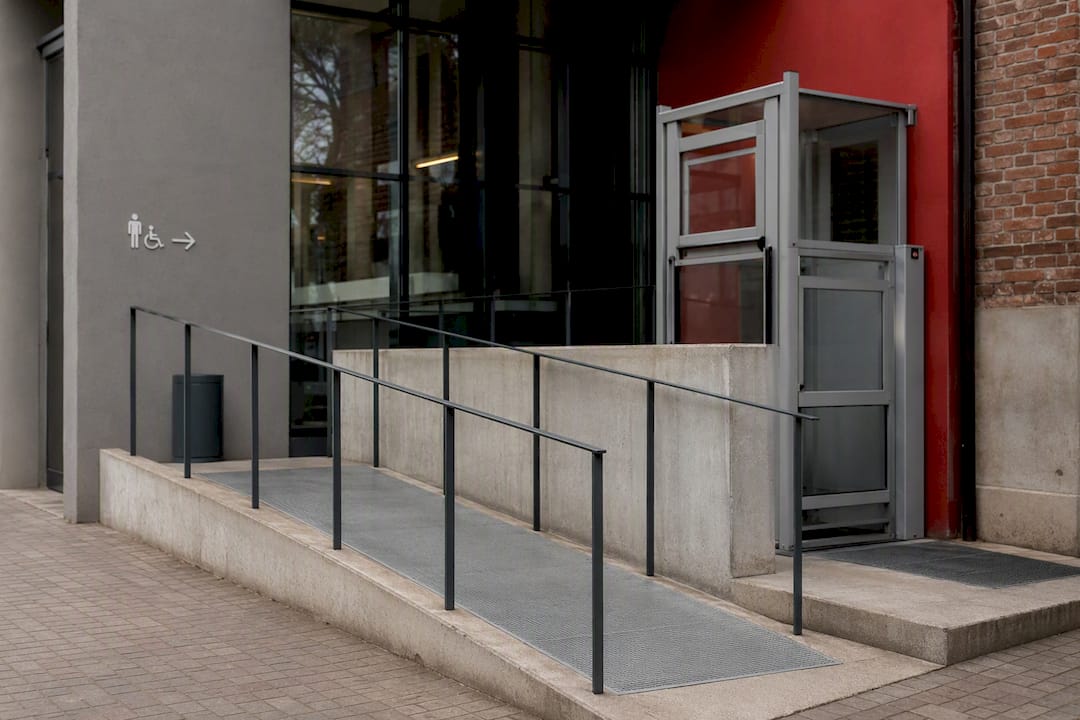
Beyond the centre, provision depends heavily on advance planning. The Museum lends wheelchairs and walkers free of charge, but only on a first-come, first-served basis. Request one by emailing reservation.office@auschwitz.org before your visit, stating the type of device you need.
What’s on offer:
- Accessible parking bays near the main entrance at Auschwitz I
- Ramped and lift access throughout the Visitors’ Service Centre
- Accessible toilets at the centre (limited provision at Birkenau)
- Free wheelchair and walker loan, subject to availability
- A ramp-equipped shuttle bus connecting Auschwitz I and Birkenau
Pro Tip: Turning up on the day and hoping a wheelchair is free is a gamble. Email ahead, get written confirmation, and bring a printout, since staff can’t always trace a verbal promise made weeks earlier.
On-the-day loan does happen, but it’s never guaranteed once the equipment on hand runs out.
What’s it like on the historic grounds?
Once you leave the Visitors’ Service Centre, conditions change fast. Auschwitz I and Birkenau sit on original 1940s ground, and the Museum’s accessibility page is candid about why: the site is a listed historic monument, so permanent adaptations such as ramps cut into original buildings are largely off-limits.
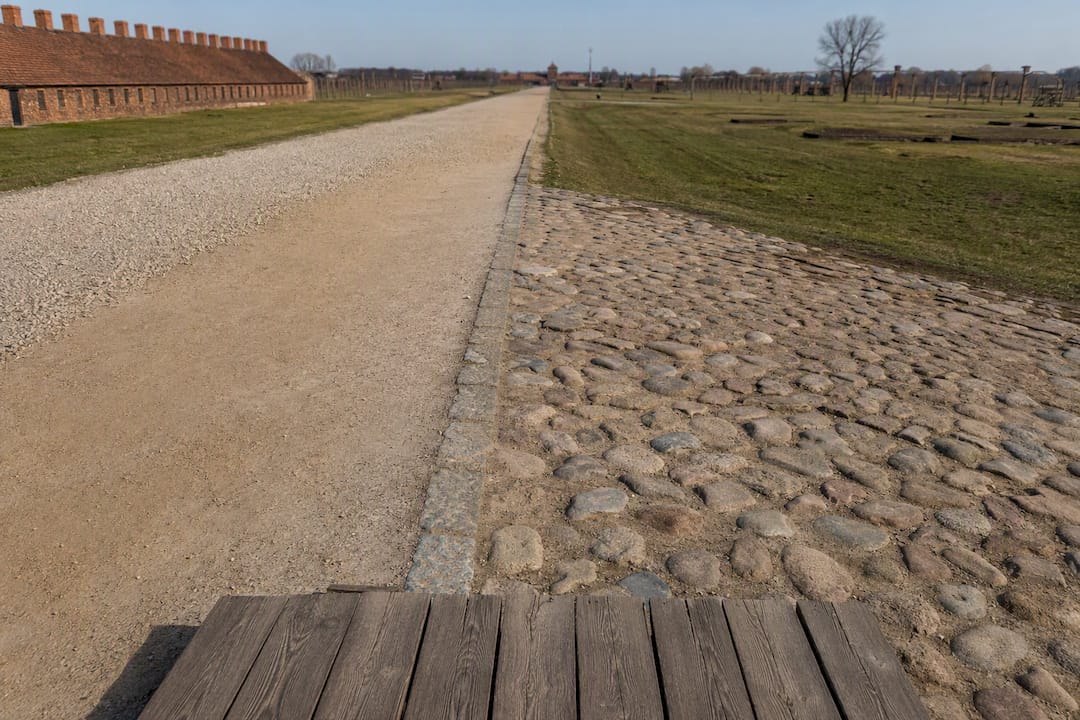
Expect a mix of gravel paths, compacted earth, old cobbles, and the odd stretch of wooden platform laid down for viewing points. None of it is flat in the way a modern pavement is, and the distances are real. You’ll cover several hundred metres within Auschwitz I alone, and Birkenau’s grounds are considerably larger. That matters for stamina and for battery range on powered chairs.
Interior access is the bigger constraint. Many original barrack blocks have narrow doorways, steps, or upper and lower floors that were never built with wheelchairs in mind, and conservation rules prevent the Museum from retrofitting them.
Realistic expectations:
- Outdoor paths and grounds: mostly navigable with effort, though uneven in places
- Ground-floor exhibition rooms: accessible in some blocks, not others
- Upper floors and cramped original interiors: generally closed to wheelchair users
- Wooden viewing platforms: give sightlines into areas you can’t physically enter
Pro Tip: Weather changes everything here. Dry summer ground is manageable for most manual chair users; wet spring mud or winter ice turns the same paths into a real obstacle, so plan the season if you have any flexibility.
How do you get between Auschwitz I and Birkenau, and to the site from Kraków?
- Private accessible transfer from Kraków is the most predictable option. It’s roughly a 90 minute drive door-to-door, and a driver who knows the site can drop you close to the Visitors’ Service Centre rather than a general car park.
- Regional bus or train to Oświęcim works too, but the final leg from the station to the Memorial can be inconsistent for wheelchair users. Arrange an accessible pickup at the station rather than relying on local taxis to have suitable vehicles on hand.
- The Memorial’s own shuttle bus between Auschwitz I and Birkenau is fitted with a ramp. Confirm departure times and boarding assistance with staff when you arrive, since it doesn’t run on a rigid timetable all day.
- Powered wheelchairs and mobility scooters need checking against your transfer operator’s vehicle capacity and any airline battery rules if you’re flying with a device, and it’s worth confirming charging points with whoever is driving you.
Third-party accessibility guides covering the site consistently point UK visitors towards booked private transport over public transport improvisation, and the logic holds up once you’ve seen how spread out the site actually is.
Booking your visit and requesting assistance: a step-by-step checklist
- Reserve your entry pass online through the Museum’s booking system as early as you can, particularly in peak season when passes sell out days ahead.
- Email reservation.office@auschwitz.org as soon as your dates are fixed, stating that you’re a wheelchair or walker user.
- Give specifics in that email: the type and dimensions of your device, whether you’re travelling with a companion, your planned arrival time, and your preferred language for any guided element.
- Ask the accessibility coordinator to confirm the day’s route, shuttle arrangements, and toilet locations before you travel, not after you arrive.
- Print or screenshot your confirmations and arrive with time to spare, since collecting loaned equipment takes a few extra minutes at the start of your visit.
Pro Tip: Mention exact wheelchair width and height in your email. Some lifts and internal doorways at the site have real size limits, and staff can only tell you in advance whether your device will fit if they know the measurements.
Practical tips for the day: clothing, pacing, and toilets
Wear supportive, weather-proof shoes and practical clothing. Jeans are fine; there’s no dress code beyond basic respect for what the site represents, so avoid anything overtly casual like beachwear or slogans.
Pace yourself deliberately. Trying to cover both Auschwitz I and Birkenau properly in one visit is a lot for anyone, let alone with the ground conditions described earlier. Break the visit into shorter stretches, use benches where they exist, and accept that you may not see everything in a single day.
A few things worth planning around:
- Bring a companion if transfers or uneven ground mean you’ll need physical help at any point
- Locate accessible toilets at the Visitors’ Service Centre before you set off, since Birkenau’s provision is more limited
- Carry water, particularly in summer, as shaded rest points are limited on the Birkenau grounds
- Build in slack time rather than a tight schedule, since assistance and shuttle waits add up
Nearby accessible public transportation options to Auschwitz-Birkenau Museum
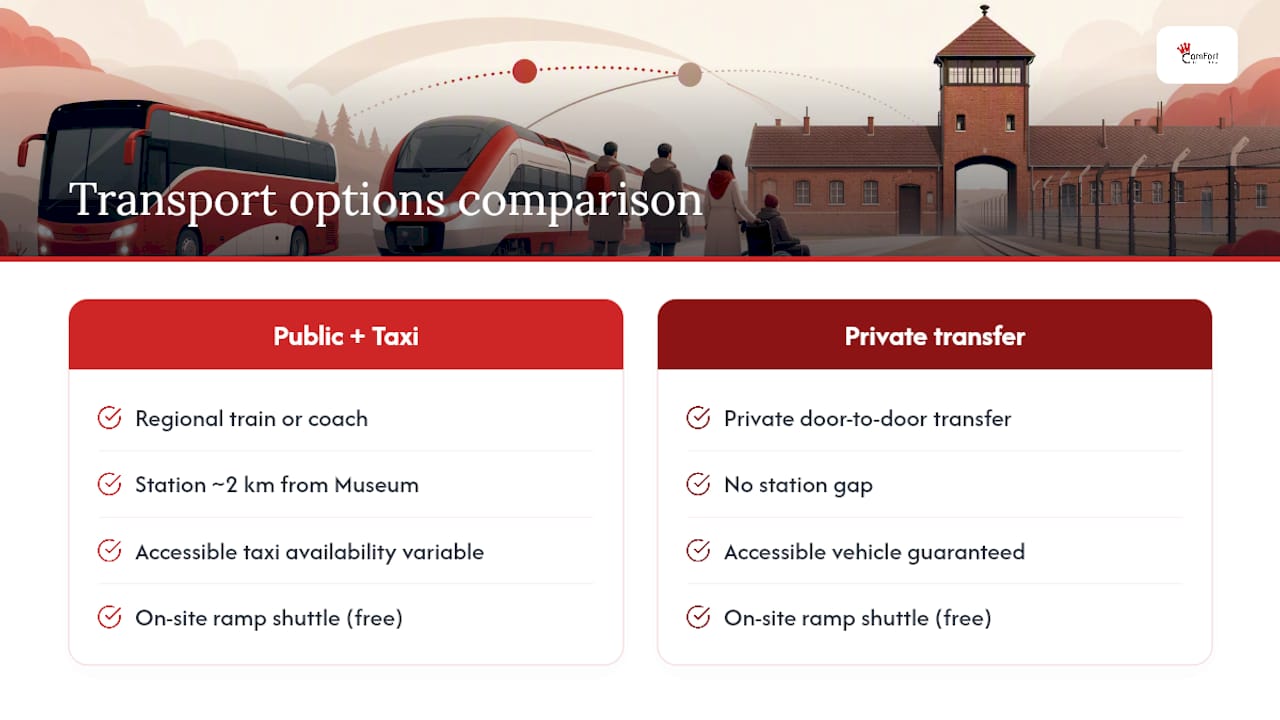
Public transport to the Memorial exists, but it’s worth being honest about its limits for wheelchair users. Regional trains from Kraków run to Oświęcim station, and regional coaches (often marketed as PKS or private operators) connect Kraków’s main bus station to a stop near the Museum entrance. Neither is purpose-built for wheelchair boarding in the way UK low-floor buses are, so accessibility varies by vehicle and by operator on any given day.
The gap that catches people out is the final stretch. Oświęcim’s train and bus stations sit roughly a couple of kilometres from the Museum entrance, and while local taxis operate in the town, availability of a wheelchair-accessible vehicle on demand is inconsistent. If you’re relying on public transport for the outward leg, it’s worth arranging an accessible taxi pickup at the station in advance rather than hoping one appears.
Once you’re at the Memorial itself, the ramp-equipped shuttle bus between Auschwitz I and Birkenau is the one genuinely reliable accessible public transport link on site, and it’s free to use with your entry pass.
For most UK visitors without a hire car, the practical choice comes down to two options: piece together trains or coaches and arrange local accessible transport for the final leg, or book a private accessible transfer that removes that uncertainty entirely. Given the distances and the value of arriving unhurried, a private transfer tends to be the less stressful route, particularly if you’re travelling with a powered wheelchair that needs specific loading arrangements.
Alternative virtual or digital tours for areas you can’t physically reach
If parts of the outdoor grounds or original interiors are out of reach, you’re not limited to secondhand descriptions from someone else’s visit. The Museum itself points visitors towards digital alternatives when an in-person visit to certain areas isn’t feasible, including the official accessibility guidance that promotes its “Auschwitz in Front of Your Eyes” online platform.
These resources let you see inside blocks and buildings that remain closed to wheelchair users on conservation grounds, filling in exactly the gaps that physical access can’t close. They’re also genuinely useful preparation before you travel, since they give you a sense of scale and layout that makes the in-person visit easier to plan around.
For UK readers weighing up how much of the site they’ll realistically cover, treating the digital platform as a companion to the physical visit, rather than a poor substitute, tends to work best. See the parts you can reach in person, where surfaces and shuttle access make it viable, and fill in the rest afterwards. Nobody, wheelchair user or not, sees the entire site in one visit, and there’s no reason a digital supplement should feel like a consolation prize rather than a legitimate part of understanding what happened there.
How a specialist operator like ComFort Tours Cracow helps UK visitors plan this properly
Getting Auschwitz wheelchair access right from the UK usually comes down to logistics nobody warns you about until you’re already there. That’s the gap a specialist local operator closes.
ComFort Tours Cracow arranges private accessible transfers, keeps groups small so pacing isn’t dictated by strangers, and liaises with the Museum’s accessibility coordinator before you arrive to confirm equipment and route. The practical payoff is straightforward: a guide who knows which paths are viable on the day, help managing a mobility device between vehicles and entrances, and someone chasing the loaner wheelchair booking so you don’t have to.
None of that overrides the Museum’s own conservation limits. No operator can open a building the Memorial has closed, and it’s worth being upfront about that. What good coordination does is remove the guesswork around transport, timing, and equipment, which is where most difficulty actually lives. You can request a tailored accessible visit directly through ComFort Tours Cracow’s enquiry pages ahead of your trip.
— Damian Fort
Book an accessible Auschwitz day trip with ComFort Tours Cracow
Piecing together trains, station taxis, and a hoped-for wheelchair loan is one way to do this. Booking a private accessible transfer and small-group tour that’s already coordinated with the Memorial is the other, and it’s the one that removes the parts of the day you can’t control from a distance.
ComFort Tours Cracow runs a dedicated Auschwitz day tour from Kraków built around exactly this kind of planning. What that gets you in practice:
- A private accessible vehicle with door-to-door timing, not a shared shuttle you’re waiting on
- Small groups or a fully private guide, so pacing is set by you, not a coachload of strangers
- Pre-arrival contact with the Museum’s accessibility coordinator to confirm route and equipment before you set off
- A guide who handles the practical side of the visit while you focus on the site itself
If you’re planning a wider trip around Kraków, the same accessible tours booking approach applies to other sites too. To lock in dates and confirm accessibility arrangements for your Auschwitz visit, get in touch through the tours booking page and mention your mobility requirements when you enquire.
Sources
Check the Museum’s accessibility declaration and accessibility overview for the latest rules on wheelchair loan and restricted areas. The on-site facilities guide covers café, toilet, and loan locations in more detail, and ComFort Tours Cracow’s own Auschwitz visiting guide adds practical trip context.
- Additional information for persons with mobility difficulties / Auschwitz-Birkenau
- Auschwitz-Birkenau accessibility — WheelieTravel guide
FAQ
Can you visit Auschwitz in a wheelchair?
Yes. The Visitors’ Service Centre is accessible, though the historic grounds have uneven surfaces and many original buildings remain closed to wheelchair users for conservation reasons.
Can I hire a mobility scooter at Auschwitz?
The Museum doesn’t hire mobility scooters on-site; it lends manual wheelchairs and walkers free of charge, subject to availability, so email ahead to request one.
Can I wear jeans to Auschwitz?
Yes, jeans are fine. There’s no formal dress code beyond dressing respectfully, so avoid beachwear or anything overly casual.
How much walking is required on an Auschwitz tour?
Expect several hundred metres of walking within Auschwitz I alone, with considerably more ground to cover if you also visit Birkenau, much of it on gravel, compacted earth, or old cobbles.
Can ComFort Tours Cracow arrange an accessible Auschwitz visit?
Yes. ComFort Tours Cracow organises private accessible transfers and small-group or private guided visits, liaising with the Museum’s accessibility coordinator ahead of your trip to confirm route and equipment.