

Anyone under 150 cm tall must travel in an approved child restraint in a private or hire car in Poland. Licensed taxis are legally exempt from this rule. Look for an ECE R44/04 or i-Size (R129) label on any seat before you rely on it.
TL;DR:
- Children between 135 cm and 150 cm can travel using an adult seatbelt in the rear seat only in limited, specific situations involving space constraints.
- Licensed taxis are exempt from the child restraint requirement, but safety experts recommend pre-booking a fitted seat for airport transfers and longer trips.
- Most car seats with EU approval labels (ECE R44/04 or R129) are compatible with Polish law, and bringing a UK seat usually meets legal standards without modification.
- Fines for unrestrained children under 150 cm typically start around PLN 300, with penalties increasing for multiple violations or more children affected.
- Properly fitting a child seat is your responsibility; ensure ISOFIX clicks in securely, or belt guides are correctly routed, to avoid dangerous looseness or incorrect angles.
Table of Contents
- What Poland’s Article 39 law actually requires
- Is it about my child’s height or their age?
- Do taxis in Poland need child car seats?
- What are the fines for breaking the child seat rules?
- Booking and fitting a hire car seat step by step
- Checking a seat meets the standard: ECE R44/04 and i-Size
- Are booster cushions legal for children in Poland?
- Which seat type does my child actually need?
- Will my UK child seat work in Poland?
- Where can UK travellers hire or borrow a child seat in Poland?
- Fitting a child seat correctly once you’re in the car
- Whose job is it to fit the seat in a rental car?
- Balancing legality and family comfort on the road
- A guaranteed fitted seat beats hoping the taxi rank sorts it out
- Where to check the latest rules before you travel
- Sources
- FAQ
What Poland’s Article 39 law actually requires
Article 39 of Poland’s Road Traffic Law is the legal foundation for every rule in this guide, and it’s worth knowing roughly what it says rather than just the headline figure. The statute sets 150 cm as the threshold below which a child restraint is mandatory in a car, whether that’s your own vehicle, a hire car, or a friend’s.
There’s flexibility built in for children between 135 cm and 150 cm. In that band, the law allows a child to travel using an adult seatbelt in the rear seat, but only in specific situations, such as when three child seats genuinely won’t fit across the back row together. It’s an allowance for tight logistics, not a general get-out.
Front-seat travel is where the rule tightens rather than loosens. A child under 150 cm cannot sit in the front passenger seat at all unless they’re using an appropriate restraint suited to their height and weight, and children under three face an outright ban from the front seat regardless of restraint.
Medical exemptions exist too. A child with a condition that makes a standard restraint unsuitable, such as a fitted cast or a specific physical disability, can travel without one if a doctor has issued written certification confirming the exemption.
The main points to hold onto:
- Under 150 cm: an approved child restraint is required in private and hire vehicles.
- 135 to 150 cm: rear-seat travel with an adult belt only is allowed in limited situations.
- Under 150 cm in the front seat: restraint required; under-3s barred from the front entirely.
- Medical exemptions need a doctor’s written certificate, not just a verbal explanation.
Is it about my child’s height or their age?
Height decides it, not age. That trips up a lot of UK parents, because British guidance leans heavily on age brackets, whereas Polish law cares only about the number on the tape measure.
As a rough guide for planning purposes, many children reach 135 cm somewhere around age nine or ten, and 150 cm around age twelve, though growth varies enormously between kids. A tall eight-year-old and a smaller twelve-year-old can land in completely different legal categories on the same car journey.
A few edge cases worth flagging before you travel:
- The 135–150 cm rear-seat belt allowance only applies in specific fit situations, such as three children needing to share a back row that can’t physically hold three restraints.
- If your child sits right on the 150 cm line, err on the side of using a restraint or booster. Enforcement doesn’t come with a tape measure, but a visible restraint removes any ambiguity if you’re stopped.
- Passport or ID documents rarely list height, so don’t rely on paperwork. Measure your child at home before you fly.
Pro Tip: Measure your child against a wall the week before you travel and jot the number down on your phone. It settles the height question in seconds if a rental agent or officer asks, and it means you’re booking the right seat size rather than guessing.
Do taxis in Poland need child car seats?
No. Licensed taxis are the one clear exception to the child restraint requirement, and that exemption is unconditional under Polish law. Adult seatbelt rules still apply to everyone in the vehicle, including children, but the specific requirement for a fitted child seat drops away once you’re in a licensed cab.
That’s the legal position. Whether it’s the sensible choice for your family is a separate question entirely.
Consider what a taxi exemption actually looks like in practice: a toddler on a parent’s lap in stop-start Kraków traffic, or a baby held loosely against an adult chest during a motorway airport run. The exemption exists because taxis operate under different regulatory assumptions to private cars, not because the underlying physics of a car crash changes when you’re in a cab.
For airport transfers and longer trips especially, most families are better off arranging a seat in advance. Here’s how:
- Pre-book a taxi or transfer with a fitted child seat specified at the time of booking, not requested on arrival.
- Bring a lightweight travel booster or seat from home if you’re only taking short, occasional taxi rides and want a consistent fallback.
- Use a private transfer provider that includes appropriate child seats as standard, particularly for airport pickups where luggage and tired children make an unplanned taxi rank scramble the worst possible start to a trip.
What are the fines for breaking the child seat rules?
Officers can, and do, fine drivers on the spot for failing to use a required child restraint, and visitors are generally expected to pay immediately rather than dispute it later by post.
Reporting around the penalty structure clarified in Poland’s 2022 update points to a fine in the region of PLN 300, with penalty points scaled to how many children are affected. Polish police road safety guidance reiterates that seatbelt use is compulsory front and rear, and restates the height rule as a standard part of roadside checks for foreign drivers.
The numbers that matter: a single unrestrained child under 150 cm typically carries a fine in the PLN 300 range and a points penalty; that scales upward when more than one child in the vehicle is affected.
If you’re stopped:
- Cooperate fully and have your driving licence, rental agreement, and passport ready to hand over.
- Pay the on-the-spot fine if that’s what’s requested. Arguing the point roadside rarely helps.
- Contact your rental company or travel insurer afterwards if you believe the seat supplied was faulty or wrongly fitted. That’s a paperwork issue for later, not a roadside negotiation.
Booking and fitting a hire car seat step by step
The single biggest mistake UK travellers make with Polish hire cars is assuming a child seat will simply be waiting for them. It usually isn’t, unless you’ve specifically requested and confirmed one.
- Book the seat when you book the car, not on arrival. Specify age, height, and weight so the rental desk can match the right category, and confirm whether it will be ISOFIX or belt-fitted.
- Test the installation yourself at the desk. Avis’s own guidance is explicit that fitting the seat correctly is the renter’s responsibility, not the rental company’s, so don’t assume staff will check it for you.
- Photograph the fitted seat before you drive off, including the ISOFIX connectors or belt routing. It’s a five-second habit that protects you if a dispute arises over fit or damage later.
- Ask for written confirmation of the seat type supplied if the rental company offers it. Not all will, but it costs nothing to ask.
If the rental company can’t supply an appropriate seat, you have three realistic options: bring a compact travel seat from the UK as backup, upgrade to a larger vehicle where a borrowed seat fits more easily, or sidestep the rental car entirely and pre-book a private transfer that guarantees a fitted seat before you land.
Pro Tip: Rental desks in Kraków and Warsaw can run short of child seats during peak summer weeks and Christmas markets season. Book the seat at the same time you book the car, ideally at least a fortnight ahead, rather than assuming one will be available on the day.
Checking a seat meets the standard: ECE R44/04 and i-Size
Every legally acceptable seat in Poland carries an orange approval label somewhere on the shell, usually stitched into the fabric or moulded into the plastic near the base. Look for either “ECE R44/04” or “R129,” which is the newer i-Size standard.
The label also shows a manufacture date. Seats don’t have an official Polish expiry date, but plastic degrades and impact protection weakens over years of sun exposure and use, so a seat manufactured more than six or seven years ago deserves a close look for cracks or brittleness before you trust it on a motorway.
- ISOFIX anchors give a more rigid, error-resistant fit than a belt-only installation, which matters most with an unfamiliar hire car.
- i-Size seats are grouped by height rather than weight, which tends to make sizing more intuitive for parents used to UK retailers.
- Belt-fitted seats need the lap and diagonal straps routed exactly per the seat’s own diagram. A twisted or slack belt defeats the seat’s protection even if the seat itself is correct.
- Walk away from anything with visible cracks, missing labels, or a harness that won’t tighten properly, and ask the rental desk for a straight swap.
Are booster cushions legal for children in Poland?
A backless booster cushion is legally acceptable in Poland, but only once a child has grown out of a full harnessed seat, which in practice means once they’re tall enough and mature enough to sit correctly with an adult lap-and-diagonal belt across their hips and shoulder rather than their neck and stomach.
There’s no separate age or height figure written into the law specifically for boosters. The same 150 cm threshold governs the whole restraint requirement, so a booster is simply one acceptable category of restraint within that limit, provided it carries the correct approval marking. A cheap inflatable cushion or a homemade seat riser bought at a market stall doesn’t count. It needs the same ECE R44/04 or i-Size approval label as any other child seat.
Where families get caught out is moving a child to a booster too early, purely because it’s smaller and easier to pack for a trip. Polish enforcement doesn’t test maturity or fit on the roadside, but a badly positioned belt over a child who’s really still harness-seat age offers far less protection in a crash, whatever the label on the cushion says. If your child is borderline, a high-back booster with side wings and a guide clip for the diagonal strap is a safer choice than a flat backless cushion, and it’s still classed correctly under the law provided it carries the right approval marking.
Which seat type does my child actually need?
Polish law doesn’t name specific product categories such as “Group 0” or “Group 2/3” the way UK retailers do. It works entirely off height and weight bands that map fairly closely to the UK’s own R129 groupings, which is useful, because it means the seat you already own or would buy in Britain is very likely to be the right type in Poland too.
In broad terms: infants who can’t sit unsupported need a rear-facing infant carrier or rear-facing convertible seat. Toddlers who can sit up but are well under 100 cm typically need a forward or rear-facing seat with an integral harness. Once a child passes roughly 100 to 135 cm, a combination seat with a harness or high-back booster is appropriate, and above 135 cm, the flexibility around belt-only travel in the rear seat starts to apply, subject to the specific-fit conditions covered earlier.
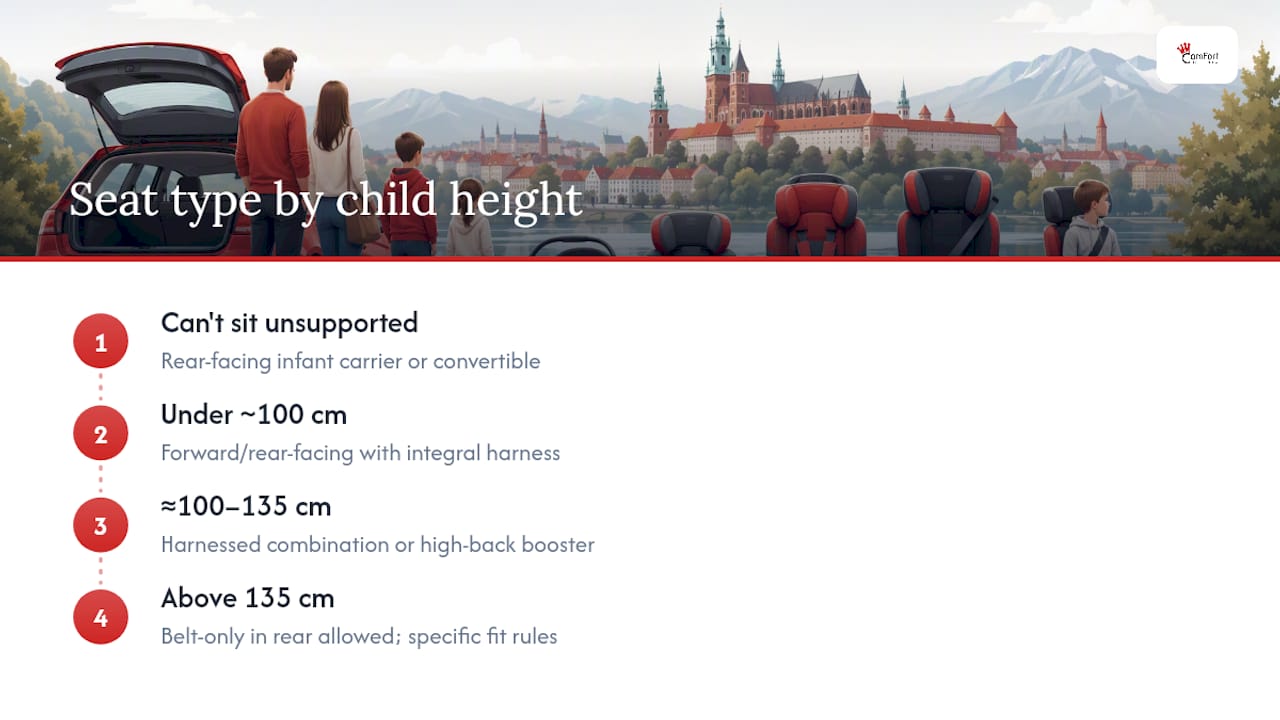
Weight is still referenced on many seats sold under the older R44/04 standard, typically in bands like 0 to 13 kg, 9 to 18 kg, and 15 to 36 kg. Newer i-Size seats under R129 drop weight entirely in favour of the child’s height, which Polish authorities and most EU guidance now treat as the more reliable measure. If you’re shopping for a new seat before travelling, buying to height rather than weight will keep you compliant for longer and match how Poland’s own law is framed.
Will my UK child seat work in Poland?
Almost certainly, yes. Any UK seat carrying an ECE R44/04 or i-Size (R129) approval label meets exactly the same standard Poland requires, because both are EU-wide vehicle safety regulations rather than country-specific rules. There’s no separate Polish certification to chase and nothing to buy or swap before you fly.
The practical adjustments sit around hardware, not legality. UK cars have historically leaned toward belt-fitted seats more than some EU markets, so if your seat is ISOFIX-only, check the Polish hire car or the vehicle you’re borrowing actually has ISOFIX points fitted, rather than assuming it. Most cars registered in Poland from the mid-2000s onward have them, but older vehicles occasionally don’t.
Bringing your own seat on a flight avoids the rental-desk uncertainty entirely, and it means your child travels in a seat they’re already used to, which matters more than people expect on a long transfer with a tired toddler. The trade-off is baggage hassle: airlines vary in how they handle car seats as hold luggage, so check your airline’s specific policy before booking. If you’d rather travel light, a seat that meets UK standards will satisfy Polish rental desks and traffic police equally, so there’s no compliance reason to leave it behind versus renting locally.
Where can UK travellers hire or borrow a child seat in Poland?
If you’re not bringing a seat from home, you have three realistic routes, and they’re not equally reliable.
Car hire desks at Kraków, Warsaw, and Gdańsk airports all offer child seats as an add-on, but availability isn’t guaranteed on the day, particularly during summer and the Christmas market season. Booking the seat when you book the car, and getting written confirmation where possible, is the only way to avoid arriving to a “sorry, none left” conversation at the counter.
Private transfer and tour operators are the second route, and often the more dependable one for a single airport run or a day trip, since the seat is fitted and checked before you even land rather than assembled at a counter while you’re queuing with jet-lagged children. A private transfer booked with the seat specified in advance removes the rental-desk gamble entirely.
Retail options exist too, mostly larger supermarkets and baby-goods chains in city centres, but buying a seat for a week’s holiday is an expensive and wasteful solution compared with hiring or booking one included. For larger families needing multiple seats across a bigger vehicle, a minibus hire comparison service can be worth checking, since fitting three child seats across a standard hire car’s rear bench is often physically impossible regardless of what the law allows.
Fitting a child seat correctly once you’re in the car
A seat that meets every standard on paper still offers poor protection if it’s fitted loosely or at the wrong angle, and this is where most roadside problems and most real safety risk actually sit.
Start with the anchor points. If the car has ISOFIX, the seat should click firmly into both lower anchors with no side-to-side movement once seated; give it a firm shake test at the base after fitting. If you’re using a belt-fitted seat, the diagonal strap must sit exactly where the seat’s own guide clip or channel indicates, never loose across the stomach and never twisted.
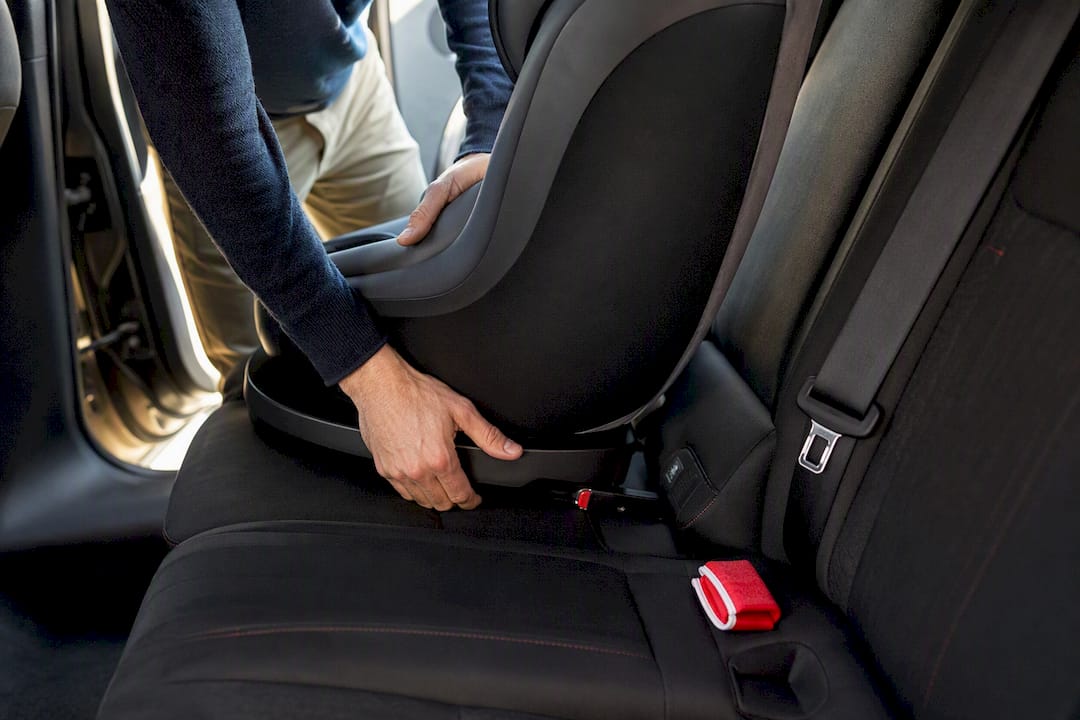
Recline angle matters more for rear-facing seats than most parents realise. A rear-facing infant seat fitted too upright doesn’t support a young baby’s head and airway properly on a long motorway stretch; most seats have a built-in level indicator, usually a small bubble or line on the side, that shows the correct angle for the vehicle it’s fitted in.
Check the harness height too, particularly with a hire seat that’s been adjusted for a previous family. Straps should sit at or just above shoulder height for a forward-facing child, and at or just below for rear-facing. It’s a thirty-second check that a rushed rental handover often skips entirely.
For airport transfers specifically, ask whoever supplies the seat to walk you through the fitting rather than fitting it themselves and driving off. You want to know it’s right before the car moves, not hope it is.
Whose job is it to fit the seat in a rental car?
It’s yours, not the rental company’s. That single point catches out more UK travellers than any other part of this law, because British experience with car hire rarely puts the fitting responsibility so explicitly on the customer.
Avis’s own guidance for Poland states plainly that it’s the parent or guardian’s job to fit the child seat correctly, not the rental desk’s. Staff will usually hand over the seat, sometimes still boxed, and expect you to install it yourself in the car park before driving off. If nobody offers to check your work, that’s normal, not a sign something’s been forgotten.
This matters legally as much as practically. If you’re stopped by police with a seat that’s present in the car but incorrectly fitted, loose harness, wrong angle, unbuckled ISOFIX, you’re still exposed to the same fine and points as if you had no seat at all. The presence of a seat in the boot isn’t compliance; a correctly fitted seat is.
Given that responsibility sits squarely with you, it’s worth building in ten extra minutes at the rental desk specifically for fitting and checking, rather than treating it as something to sort out once you’re already on the road with a tired child in the back seat.
Balancing legality and family comfort on the road
Most UK families I hear about travelling through Poland get the law right and the comfort wrong. They know a taxi doesn’t legally need a child seat, so they take the taxi option at face value without weighing up what an unrestrained toddler in fast-moving airport traffic actually feels like from the back seat.
Pre-booked private transfers are often recommended for infants and toddlers precisely because the legal exemption for taxis was never designed as a safety recommendation, just a regulatory carve-out. Small-group transport gives more room to fit seats properly and check them before departure, rather than negotiating with a stranger’s cab at an airport rank. Seats used across such transfers meet recognised ECE and i-Size standards covered earlier in this guide, checked at the point of booking rather than assumed on arrival.
— Damian Fort
A guaranteed fitted seat beats hoping the taxi rank sorts it out
Compare that against arriving at Kraków Airport at midnight with two exhausted children and hoping the taxi rank has something suitable. ComFort Tours Cracow runs private transfers and small-group tours across Kraków and the surrounding region, including Auschwitz-Birkenau and the Wieliczka Salt Mine, with the option to request a fitted child seat at the time of booking rather than negotiating for one on arrival.

When you book, confirm three things: the vehicle size relative to your luggage and pushchair, the seat standard being fitted (ECE R44/04 or i-Size), and whether the driver installs and checks it before you set off. A licensed taxi might be legally exempt from carrying a child seat, but it also can’t promise a fixed price, a set pickup time, or space for a double buggy alongside your cases. A private tour and transport booking with the seat specified in advance solves all three at once, and it’s worth doing before you land rather than after.
Where to check the latest rules before you travel
Rules and fine amounts can shift, so confirm the current position shortly before your trip using the EU’s Your Europe road rules for Poland, the Polish Road Traffic Law text itself, and Gov.
This article is general information, not a substitute for advice from a qualified lawyer. Consult a qualified legal professional about your own circumstances before acting on anything here.
Sources
- Road rules and safety|Poland – European Union
- Korzystanie z pasów bezpieczeństwa – Art. 39. – Prawo o ruchu drogowym. – OpenLEX
- Gov
FAQ
What are the child seat rules in Poland?
Children under 150 cm must use an approved child restraint carrying an ECE R44/04 or i-Size (R129) label in private and hire vehicles, with limited flexibility for 135 to 150 cm children in the rear seat under specific fit conditions.
Does a 7-year-old need a car seat in a taxi in Poland?
No. Licensed taxis are exempt from the child restraint requirement under Polish law, though the child must still wear an adult seatbelt where one is fitted.
Does my 7-year-old legally need a car seat in Poland?
It depends on height, not age: if your seven-year-old is under 150 cm and travelling in a private or hire car, an approved restraint is legally required, regardless of how old they are.
Can I drive in Poland with my UK driving licence?
Yes, a full UK driving licence is valid for driving in Poland; gov.uk’s foreign travel advice recommends checking current entry and driving requirements before you travel, since rules can be updated.
What happens if I’m stopped without a proper child seat?
Police can issue an on-the-spot fine, in the region of PLN 300, along with penalty points that scale with the number of unrestrained children in the vehicle, and visitors are generally expected to pay immediately.