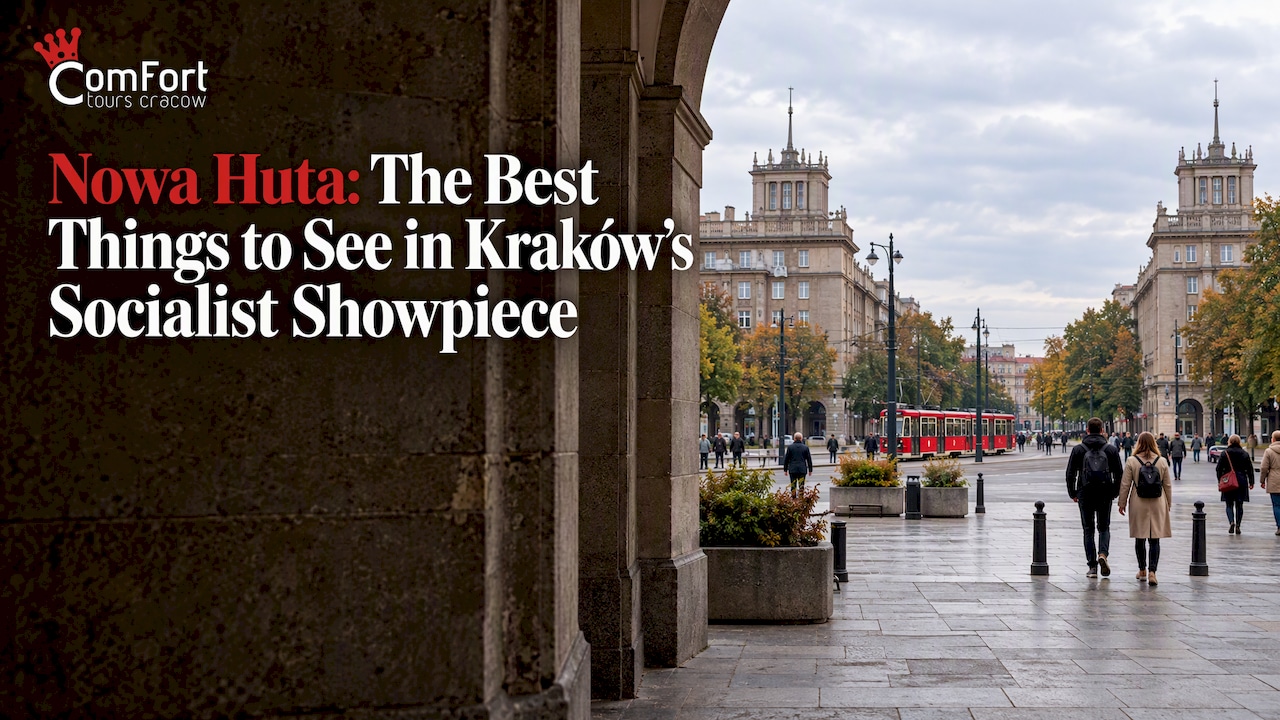
The best things to see in Nowa Huta are Plac Centralny and the avenues around it, the former steelworks administration building, the Cold War bunker under os. Szkolne 37, the Ark of the Lord church, the Museum of Nowa Huta, Mogiła Abbey and the green shores of the Zalew Nowohucki reservoir. Give it half a day and you will see a side of Kraków that most visitors miss entirely. We guide here every week, and it is still the district that surprises our guests most.
Key takeaways
- Nowa Huta is worth the trip if you like 20th-century history, bold architecture or simply want a break from the Old Town crowds.
- The core sights sit close together around Plac Centralny, so half a day is plenty. Add a full afternoon if you want the bunker, the reservoir and a milk bar lunch.
- The Podziemna Nowa Huta bunker is closed on Mondays and Tuesdays, so plan your day around that.
- You can do it independently by tram, but a guide brings the stories behind the facades to life, especially with children or limited time.
Table of Contents
- What is Nowa Huta, and is it worth visiting?
- The main sights, in a sensible walking order
- Green and cultural corners
- A suggested half-day route
- Getting there and getting around
- When a guided tour is worth it
- Our perspective
- Seeing Nowa Huta with us
- FAQ
- Sources
What is Nowa Huta, and is it worth visiting?
Nowa Huta is a planned socialist-realist district in eastern Kraków, incorporated in 1951 and built around a vast steelworks. The name means “New Steelworks”. It was designed as a model city for the workers, with wide avenues, symmetrical squares and plenty of greenery. The BBC describes it as one of only two planned socialist realist settlements of its kind, the other being Magnitogorsk in Russia.
So, is it worth visiting? Yes, if you are curious. Nowa Huta is not pretty in the way the Main Market Square is pretty. It is something different: an open-air museum of Polish architectural history, as the Newtown Institute’s travel guide puts it, and a place where you can feel how planners tried to engineer a new kind of society. What I love most is that people still live here, shop here and queue for bread here. It is a real neighbourhood, not a theme park.
If you want the full backstory first, our piece on Nowa Huta history for UK visitors goes into the workers, the plans and the protests.
The main sights, in a sensible walking order
The landmarks are spread across the district, but the heart of it is compact. Here is how we would string them together.
Plac Centralny and the avenues
Start at Plac Centralny (Central Square), the socialist-realist centrepiece of the district. Wikipedia lists it among the main landmarks, alongside the Steelworks Headquarters, Wanda Mound, Mogiła Abbey and Arka Pana. Stand in the middle and look at how the avenues radiate outwards. The plan was deliberate: grand, ordered and meant to impress.
The buildings around the square have courtyards, arcades and decorative details that are easy to miss if you rush. Look up, look into the archways, and notice the oval corner staircases and theatre hall in the surrounding blocks. Nowa Huta rewards slow walking.
The steelworks administration building
The former Administrative Building of the Steelworks is the best-known architectural statement here. The BBC and The Guardian both single it out as a signature piece of the district. Its façade looks a bit like a palace for clerks, which was rather the point: the workers’ state wanted to look grand. It is now used by other organisations, but you can still admire the exterior and the sense of scale. The huge steelworks beyond was the reason the whole district existed.
The Museum of Nowa Huta
The Museum of Nowa Huta opened in 2019 in a former cinema. It is a good place to put the buildings into context: the idea, the promises, the everyday reality and the reactions. Opening hours and ticket prices change, so check the museum’s official page before you go.
Podziemna Nowa Huta: the Cold War bunker
This is the one that most guests remember. Nowa Huta has more than 250 protective structures beneath blocks of flats, schools, kindergartens, health centres and cultural venues. The branch run by Kraków Museum, Podziemna Nowa Huta at os. Szkolne 37, lets you step into one beneath a school building and imagine how the city prepared for an atomic attack.

According to Kraków’s official culture listings, it is open Wednesday to Sunday, 10:00 to 17:00, closed Monday and Tuesday, with tickets listed at 22 zł (adult), 16 zł (reduced) and 44 zł for a family. Those details can change, so confirm them before you set off.
The Ark of the Lord (Arka Pana)
The planners of Nowa Huta did not include a church. The residents wanted one anyway, and the long fight to build it became a defining story of the district. Arka Pana, the Ark of the Lord church, is now one of the landmarks that most clearly shows how Nowa Huta shifted from Stalinist ambition to anti-communist religiosity. The BBC article traces that arc, mirroring Poland’s wider post-war story. Inside, the building is dramatic and unlike a conventional church. Dress respectfully and keep your voice down, because services take place here.
Mogiła Abbey and Wanda Mound
Nowa Huta is not only a story of the 1950s. Mogiła Abbey was founded in 1222, so the district’s land holds centuries of history underneath the concrete and brick. The Cistercian abbey is quiet and rewarding if you enjoy medieval architecture. Wanda Mound, an ancient earthen mound tied to the legend of Princess Wanda, is also in the district. It is the kind of contrast that makes a visit here so interesting: medieval monks, a legendary princess and a Stalinist steel town within a few kilometres.

Green and cultural corners
The district is much greener than most people expect. That was part of the plan.
Zalew Nowohucki reservoir
The Zalew Nowohucki reservoir and park cover 15 hectares. There is a small island called Małpi Gaj (Monkey Grove), canoe, boat and pedalo hire, cycle paths, and free admission. On a warm afternoon it is a lovely place to rest your feet after the architecture, and it works well if you are travelling with children who have run out of patience for history.
Łaźnia Nowa Theatre
If you like theatre, check the programme at Łaźnia Nowa. It has operated in Nowa Huta since 2005 as a cultural institution of the City of Kraków, in the former workshop halls of a mechanical school complex. It has produced over a hundred performances, and its flagship project is the Divine Comedy International Theatre Festival. Many productions are in Polish, so look for ones with surtitles or a physical, visual style.
A milk bar lunch
Nowa Huta is a good place to try a bar mleczny, or milk bar: a no-frills canteen serving traditional Polish food at modest prices. Visit Kraków notes that the district has local milk bars with authentic canteen food. Try pierogi, a bowl of żurek or a plate of potato pancakes. Eat with the locals, and do not worry if the menu is only in Polish. Pointing is fine, and the staff are used to it.

A suggested half-day route
Here is a simple plan if you want to see the best of it without rushing.
| Time | What to do | Notes |
|---|---|---|
| 10:00 | Arrive at Plac Centralny | Walk the avenues, look at courtyards and arcades |
| 10:45 | Steelworks administration building | Exterior views and photos |
| 11:30 | Museum of Nowa Huta | Context for everything you have just seen |
| 12:30 | Milk bar lunch | Cash and a bit of curiosity help |
| 13:30 | Podziemna Nowa Huta bunker | Wednesday to Sunday only, check times |
| 15:00 | Arka Pana | Respectful dress, services may be on |
| 16:00 | Zalew Nowohucki | Easy stroll to end the day |
This is a full day if you do everything. For half a day, pick the square, the museum, the bunker and a milk bar, and leave the rest for another trip.
Getting there and getting around
Nowa Huta is in the east of Kraków and regular city trams and buses run there from the centre. The ride takes around half an hour, depending on where you start. Use the city’s journey planner app or ask your hotel which line suits you, and buy the right ticket before boarding. Tram routes and fares change, so check them locally.
Once you are in the district, the main sights around Plac Centralny can be covered on foot. The bunker, the reservoir and Mogiła Abbey are farther apart, so you may want a tram, a taxi or a driver for those. Plan for comfortable shoes: the avenues are long and the pavements are wide, but there is little shade in summer.
Is Nowa Huta suitable for families and independent visitors?
Yes to both, with some planning. Independent visitors will find it easy to navigate and much calmer than the Old Town. Families will enjoy the reservoir, the bunker (the family ticket is a nice touch) and the wide open spaces. The history is serious in places, so judge it by your children’s ages. Older children and teenagers often find the Cold War story gripping. Younger ones will mostly care about the pedalos.
When a guided tour is worth it
You can see Nowa Huta alone. But a lot of what makes it fascinating is invisible from the pavement: who lived behind that façade, why the church mattered so much, what the planners hoped for, what happened when the steelworks changed. A guide fills those gaps and links the dots between sites. It also saves you the faff of working out transport between the farther-flung stops.
Our Nowa Huta Crazy Communism Private Tour is built around exactly that approach, and you can read more on our page about exploring Kraków’s Nowa Huta. If you would rather combine the district with other parts of the city, our Kraków walking tours guide shows how the pieces fit together, and the Jewish Kraków guide is a good companion for a second day.
Our perspective
We are a family-run team, and Nowa Huta is one of the places we most enjoy showing people. It has a reputation for being grey and grim, and we understand why. But spend an hour in the courtyards, talk to a resident, and the picture changes. This is a place where ideology, faith, daily life and quiet humour all collided.
We keep our groups small for a reason. You cannot properly tell the story of Nowa Huta to thirty people at once, over the noise of a tram. In a small group, or privately, you can stop where the story is, answer questions, change the pace if the weather turns or someone is tired. We also arrange private transport and tailored itineraries, so if you want Nowa Huta in the morning and something quite different in the afternoon, we can build that day around you.
Our advice? Do not treat it as a box to tick. Treat it as the chapter that explains the rest of modern Poland.
— Damian Fort
Seeing Nowa Huta with us
If you would like someone else to handle the logistics and the storytelling, we offer a private Nowa Huta tour with knowledgeable local guides, and we can include transport so you are not wrestling with timetables. You will find it, along with our other tours around Kraków, on our main tours page. Tell us your interests and how long you have, and we will shape the day. Need a lift from the airport first? See our airport transfer page, which lists a transfer at 100-150 PLN one-off.
FAQ
Is Nowa Huta worth visiting?
Yes, particularly if you like history, architecture or want something different from the Old Town. It is one of the largest surviving examples of socialist-realist urban planning anywhere. Half a day is enough for the highlights.
How long do you need in Nowa Huta?
About three to four hours covers Plac Centralny, the museum and a bunker visit. Add the reservoir, Arka Pana and Mogiła Abbey and it becomes a comfortable full afternoon. A guided tour usually shapes the time for you.
Can you visit the Cold War bunkers?
Yes. The Podziemna Nowa Huta branch of Kraków Museum at os. Szkolne 37 is open to visitors, currently Wednesday to Sunday, and closed on Mondays and Tuesdays. Check the museum’s page for current hours and prices before going.
Is Nowa Huta safe and suitable for families?
It is an ordinary residential district, and visitors generally explore it without difficulty, using the usual city common sense. Families tend to enjoy the reservoir and the bunker. Think about your children’s ages for the heavier historical themes.
Do I need a guide for Nowa Huta?
Not strictly, as trams and signs make independent visits workable. A guide adds the stories, the context and easy transport between the farther sites. It is especially helpful if time is short.
Sources
- Nowa Huta: The city that went from communism to capitalism (BBC Travel)
- Nowa Huta (Wikipedia)
- Nowa Huta: Kraków’s Communist District Guide (Nomado Travel)
- The Nowa Huta travel guide (Newtown Institute)
- Schrony w Nowej Hucie
- Podziemna Nowa Huta, os. Szkolne 37 (Muzeum Krakowa)
- Podziemna Nowa Huta (Kraków Travel)
- Zalew Nowohucki reservoir (Kraków Travel)
- About Teatr Łaźnia Nowa
- Things to do in Kraków (Visit Kraków)