
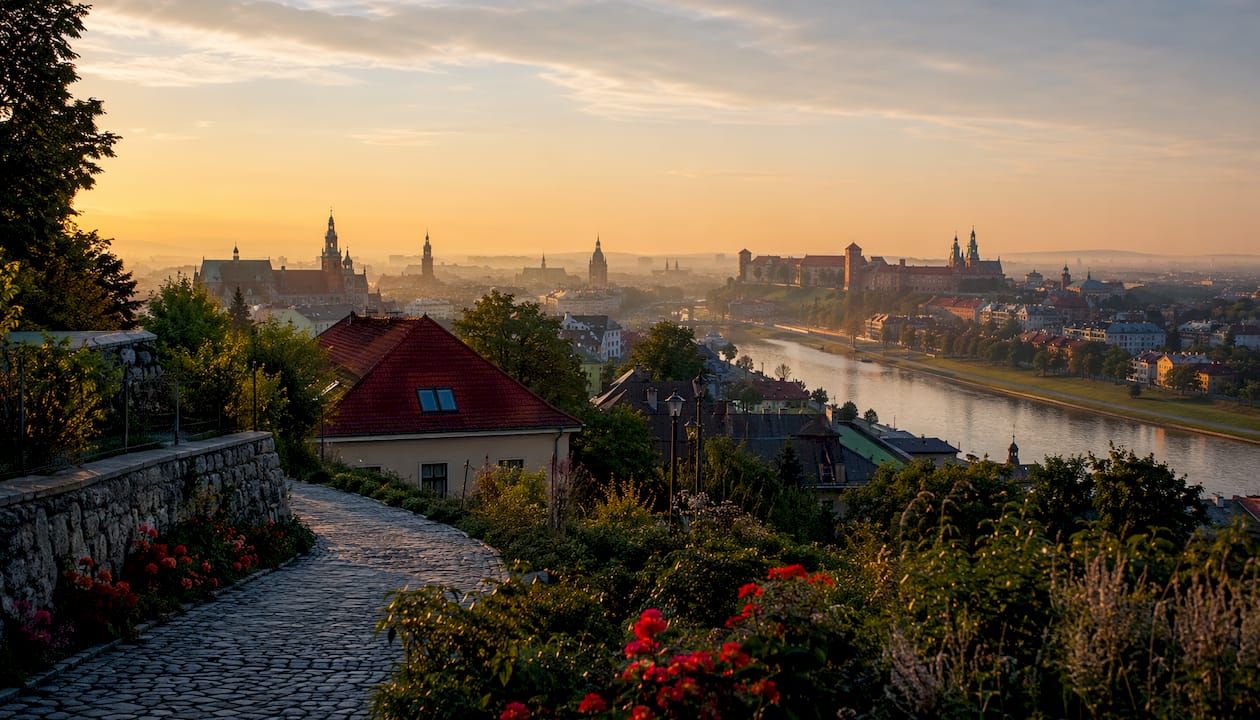
Krakow’s most rewarding places rarely appear on the first page of a travel brochure. The city’s Krakow hidden gems range from a turquoise limestone quarry-turned-swimming park to a rooftop bistro above a music academy where you can watch the sun set over Wawel Castle with a glass of wine in hand. Here is a quick map of what this article covers:
- Krakus Mound — free panoramic views from the city’s oldest earthen mound, dating to the 7th–10th centuries
- Zakrzówek Park & Lake — a former quarry now holding five connected swimming pools of crystal-clear water
- Botanical Garden of the Jagiellonian University — over 5,000 plant species on a campus founded in 1783
- Metrum Restobistro — a rooftop café on the Academy of Music with unobstructed Old Town views
- St. Joseph’s Church — a neo-Gothic landmark in Podgórze that most first-time visitors walk right past
- Galeria LueLue — a Kazimierz boutique specializing in vintage photography prints and Krakow-themed art
- muWi Stained Glass Museum — Poland’s oldest stained glass workshop, operating continuously since 1902
- Tyniec Abbey — a Benedictine monastery perched on a cliff above the Vistula River, reachable by boat
- Stary Kleparz Market — Krakow’s oldest market, a short walk from the Main Market Square
- Liban Quarry & Płaszów — an overgrown quarry where Spielberg filmed Schindler’s List, adjacent to the real camp remains
The sections below go deep on each one, then cover the districts, street art, culinary secrets, rooftop views, folklore events, galleries, and artisan workshops that round out a genuinely local Krakow experience.
Table of Contents
- What are the best Krakow hidden gems worth visiting in 2026?
- How do you experience Krakow like a local?
- Why guided tours reveal more of Krakow’s off-the-beaten-path side
- Where are Krakow’s secret rooftop viewpoints?
- What folklore and cultural events does Krakow keep quiet?
- Which small galleries and art studios are worth finding?
- Where can you find local artisan workshops in Krakow?
- Key Takeaways
- Why Krakow’s hidden places matter more than the famous ones
- Comforttours brings Krakow’s secret spots within reach
What are the best Krakow hidden gems worth visiting in 2026?
Krakus Mound
Krakus Mound is the oldest of Krakow’s five earthen mounds, believed to date somewhere between the 7th and early 10th century, and entry is completely free. The climb takes about ten minutes from the base, and the reward is a 360-degree view of the city that rivals anything you’d pay for at an observation tower. Bring a blanket. The meadow around the summit is genuinely picnic-friendly, and on a clear day you can pick out the Tatra Mountains on the southern horizon.
Most visitors skip it because they assume it’s far out or costs something. Neither is true.
Zakrzówek Park & Lake
What used to be a forbidden quarry swimming spot — locals sneaking in despite the hazards — is now a managed public park with five enclosed swimming pools connected by wide wooden floating docks. The water stays cool year-round thanks to natural springs, and the color is an almost unreal shade of blue-green against the limestone cliffs. Hiking trails circle the perimeter for those who’d rather walk than swim.
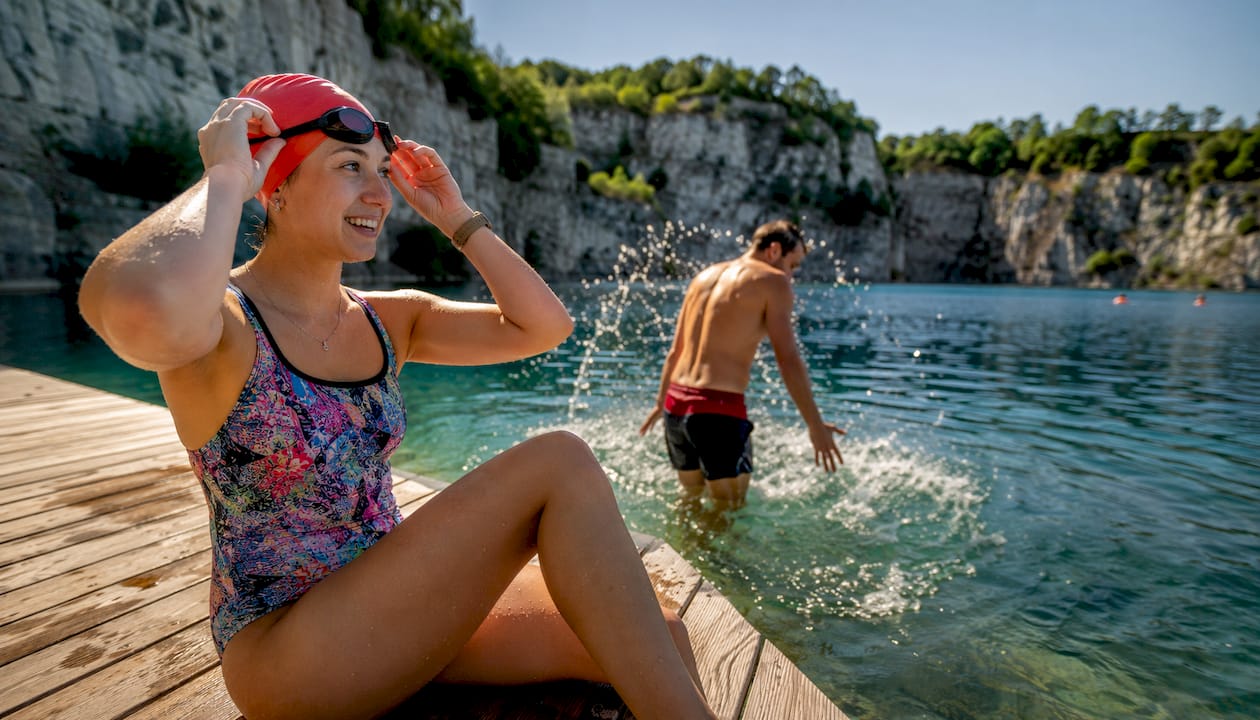
One firm rule: stay in designated swimming areas. The cliffs are still hazardous, and local authorities enforce the boundaries strictly. Respect that, and Zakrzówek is one of the most beautiful spots within city limits.
Pro Tip: Arrive before 10 AM on summer weekends. By noon, the docks fill up fast and the trails get crowded.
Botanical Garden of the Jagiellonian University
Founded in 1783, this is Poland’s oldest botanical garden, and it sits just far enough from the Old Town that most tourists never make the walk. The garden holds over 5,000 plant species from around the world, including greenhouses full of orchids and tropical plants that feel genuinely surprising in a Central European city. There’s a small café on the grounds where you can sit with a coffee under flowering trees. It’s the kind of place that slows you down in the best way.
Metrum Restobistro
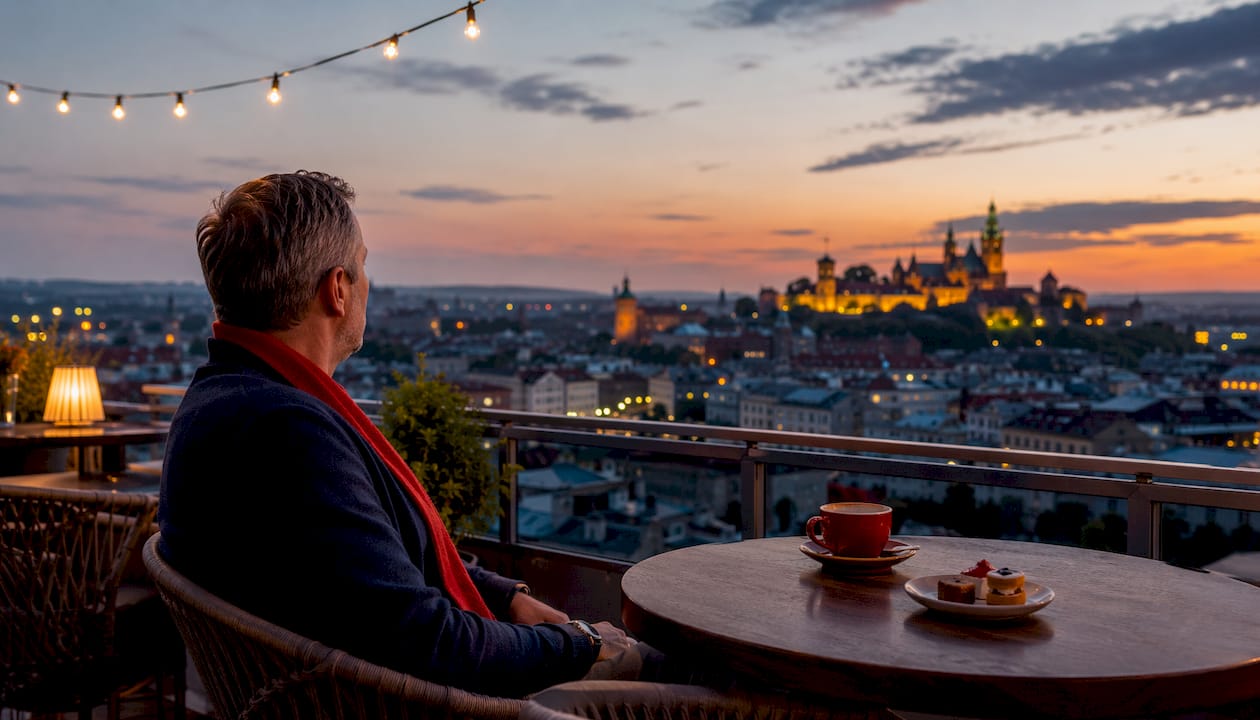
Set on the rooftop of Krakow’s Academy of Music, Metrum Restobistro is one of those places locals take visiting friends specifically to watch their reaction. The view stretches from Wawel Castle on one side to the Vistula River balloon on the other, with church spires filling the middle distance. It opens from morning and runs until 6:00 PM daily, which makes it ideal for a long lunch rather than a dinner reservation scramble. The food is solid Polish-European bistro fare, but the view is the real reason to go.
St. Joseph’s Church
The Church of St. Joseph in Podgórze is a neo-Gothic structure with spires, ornate stained glass, and a façade detailed enough to stop you mid-stride. It sits in a neighborhood that was once the Jewish Ghetto, which gives the surrounding streets a layered, complicated history worth understanding before you visit. Most first-time visitors to Krakow miss it entirely because it’s not on the standard Old Town circuit. If you’re walking along the river toward Kazimierz, it’s a ten-minute detour that’s genuinely worth it.
Galeria LueLue
Tucked beside the Tempel Synagogue in Kazimierz, Galeria LueLue specializes in vintage-style photography, art prints, and postcards drawn from Krakow’s history. The atmosphere inside is warm and a little chaotic in the best sense — walls covered in black-and-white images, bins of prints sorted by neighborhood, shelves of stickers and small originals. Even if you don’t buy anything, it’s worth ten minutes of browsing. It’s the kind of shop that makes you feel like you’ve actually found something.
muWi Stained Glass Museum
The muWi Stained Glass Museum has operated in the same building since 1902, making it Poland’s oldest continuously operating stained glass workshop. The museum isn’t just a display case — it’s a working studio where you can watch craftspeople produce the same kind of large-scale ecclesiastical and decorative glass that once went into Polish castles and grand mansions. The range of unconventional Krakow attractions favored by travelers consistently includes muWi, and it’s easy to see why. There’s nothing else like it on the standard tourist route.
Tyniec Abbey
The Benedictine Abbey of Tyniec sits on a limestone cliff above the Vistula River about 12 kilometers from the city center, and you can enjoy its unique setting by booking a weekly private cruise to experience the local waterways and views. Getting there by boat along the river is half the experience — the approach from the water, with the medieval walls rising above you, is one of those images that sticks. The abbey has been continuously inhabited since the 11th century, and the monks still produce honey, liqueurs, and cosmetics sold in the small shop on-site. It’s a genuinely peaceful half-day trip that most Krakow visitors never take.
Stary Kleparz Market
Stary Kleparz is Krakow’s oldest market, a short walk north of the Main Market Square, and it’s exactly the kind of place that disappears from tourist maps despite being completely accessible. Fresh flowers, locally grown vegetables, aged cheeses, smoked meats — the stalls change with the season, and the prices are what locals actually pay. Go on a weekday morning for the full selection and the least amount of foot traffic.
Liban Quarry & Płaszów
Liban Quarry sits directly adjacent to Krakus Mound, now largely overgrown with trees and rusting industrial structures. Steven Spielberg used it as a filming location for Schindler’s List, constructing a replica of the Kraków-Płaszów Concentration Camp here. The replica is gone, but the quarry’s atmosphere is still striking. Follow the path from Krakus Mound along the quarry’s edge and you’ll reach the actual remains of the Płaszów camp — a sobering, important site that deserves more attention than it gets.
Pro Tip: The path from Krakus Mound to the Płaszów remains is uneven and not always marked. Wear decent shoes and give yourself at least two hours to take it seriously.
How do you experience Krakow like a local?
Podgórze and Nowa Huta: the districts that tell the real story
Podgórze is where Krakow’s complicated 20th-century history is most physically present. The remains of the Ghetto wall — fragments of stone designed to look like tombstones — still stand in a quiet corner of the neighborhood. The Eagle Pharmacy (Apteka pod Orłem), the only pharmacy inside the wartime ghetto, operated by Polish pharmacist Tadeusz Pankiewicz, is now a museum. Walking Podgórze without a guide is possible, but the layers of history here reward context.
Nowa Huta is a different kind of revelation. Built in the 1950s as a model socialist industrial city, it sits about 8 kilometers from the Old Town and feels like a separate world. Wide Soviet-era boulevards, grand realist architecture, and green spaces like Zalew Nowohucki lake make it visually unlike anything else in Krakow. The Arka Pana Church, built by residents who defied communist authorities to construct it, is one of the more quietly remarkable buildings in Poland.
Street art beyond the tourist circuit
Krakow’s street art scene concentrates in less-visited neighborhoods, particularly around Zabłocie and parts of Podgórze. The murals here aren’t the sanitized, Instagram-ready variety — many carry political and historical weight, referencing the city’s wartime past or commenting on contemporary Polish life. A dedicated street art trail through these areas covers pieces that most visitors walking the Old Town never encounter.
Authentic food and drink: where locals actually go
- Milk bars (bary mleczne): These communist-era canteens still operate across the city, serving traditional Polish food at prices that feel almost impossibly low. Milk Bar Miła is one of the most authentic, cash-only, with a rotating menu of soups, pierogi, and bigos that hasn’t changed much in decades.
- Stary Kleparz Market: The best place in the city to buy fresh produce, local cheeses, and smoked meats directly from the people who made them.
- Hidden courtyard cafés: Tartelette Café serves seasonal breakfasts and organic wines in a quiet courtyard setting. Żarówka Cafe, in the Old Town, does warm Krakow bagel sandwiches (obwarzanki) in a cozy interior that feels nothing like the tourist-facing spots on the main square.
- Underground cellar pubs: Krakow’s Old Town sits on a network of medieval cellars, many of which operate as bars. Pod Wawelem Kompania Kuflowa serves famously large portions in a Bavarian-style setting that draws more locals than tourists.
- Judah Food Market and Plac Izaaka Street Food: Two food truck clusters in Kazimierz that rotate vendors and cuisines, worth checking on a weekend evening.
Pro Tip: At a milk bar, point at what you want if the menu is Polish-only. The staff are used to it, and the food is worth the mild awkwardness.
For a deeper look at Krakow’s culinary geography, the Krakow 3-day itinerary guide from Comforttours maps these spots into a practical visiting sequence.
Why guided tours reveal more of Krakow’s off-the-beaten-path side
There’s a specific kind of frustration that comes from standing in front of a historically significant place and not quite knowing what you’re looking at. Krakow has more of those moments than almost any city in Europe — the Płaszów remains, the Ghetto wall fragments, the communist-era architecture of Nowa Huta — and the difference between a meaningful visit and a confused walk-through usually comes down to who’s explaining it.
Small-group and private tours focused on Krakow’s lesser-known sites combine historical storytelling with hands-on local experience, giving travelers the context that turns a location into a memory. The most effective approach pairs an expert local guide with a genuinely flexible itinerary — one that can pivot to a hidden courtyard café or an unexpected mural without losing the thread of the day.
ComFort Tours Cracow specializes in exactly this kind of local city tour experience, with small group sizes that keep the experience personal rather than performative. Their guides cover the full range of Krakow’s off-the-beaten-path sites — from Krakus Mound and Zakrzówek to the Ethnographic Museum and Nowa Huta — and can build itineraries around historical interest, art, culinary exploration, or natural sites depending on what the group actually wants.
Pro Tip: Book a private tour for Nowa Huta specifically. The district’s history is dense enough that a self-guided walk misses most of what makes it remarkable.
Where are Krakow’s secret rooftop viewpoints?
Metrum Restobistro gets the most attention among locals, and for good reason — the Academy of Music rooftop gives you a clean sightline to Wawel Castle without any obstruction. But it’s not the only option.
The Ethnographic Museum’s square, Plac Wolnica, offers elevated sightlines across Kazimierz’s roofline from ground level — not a rooftop, but the perspective from the square’s upper edge is genuinely good for photography. Several of the Old Town’s church towers open to visitors on specific days; St. Mary’s Basilica tower is the most famous, but the lesser-visited St. Andrew’s Church, one of the oldest buildings in the city dating to the 11th century, offers a quieter experience of Krakow’s Romanesque past.
For a more unconventional high point, the hill above Wojciech Bednarski Park in Podgórze gives views across the river toward the Old Town that most visitors never find. The 19th-century Villa Matula nearby is worth the walk up on its own.
What folklore and cultural events does Krakow keep quiet?
Krakow’s folk calendar runs deeper than the Christmas markets that draw international crowds. A few events worth knowing:
Lajkonik Pageant: Every year after Corpus Christi, a costumed figure representing a Tatar horseman parades from the Norbertine Convent to the Main Market Square, collecting “tribute” from spectators along the route. It’s one of Poland’s oldest folk traditions and draws a mostly local crowd.
Wianki (Midsummer Wreath Festival): Held on the banks of the Vistula in late June, Wianki involves floating flower wreaths on the river, live music, and fireworks. The tradition predates Christianity in Poland and has been revived as a genuine community celebration rather than a tourist event.
Szopka Competition: Every December, Krakow’s residents build elaborate nativity scenes (szopki) modeled on the city’s Gothic and Baroque architecture. The competition, held at the base of the Mickiewicz statue on the Main Market Square, is recognized on UNESCO’s Intangible Cultural Heritage list. The winning szopki go on display at the Historical Museum of the City of Krakow.
Ethnographic Museum seasonal exhibitions: The Seweryn Udziela Ethnographic Museum on Plac Wolnica runs rotating exhibitions on Polish folk costume, craft traditions, and regional ritual. The permanent display of a traditional cottage interior and craftsman’s workshop is one of the more quietly affecting museum experiences in the city.
Which small galleries and art studios are worth finding?
Krakow’s independent gallery scene clusters in Kazimierz and Podgórze, away from the commercial galleries near the Main Market Square.
Galeria LueLue (covered above) is the most accessible entry point — low-pressure, browsable, and genuinely local in its inventory.
Galeria Starmach in Kazimierz is one of the city’s most respected private galleries, showing Polish modern and contemporary art with a particular focus on the postwar avant-garde. It’s not hidden exactly, but it sits well outside the tourist circuit and draws a serious art audience.
Cricoteka is the museum and archive of Tadeusz Kantor, one of the most significant theater directors of the 20th century. The building itself — a striking contemporary structure cantilevered over the Vistula — is worth seeing from the outside. Inside, the archive documents Kantor’s Cricot 2 theater company with original costumes, set pieces, and documentation that’s unlike anything else in the city.
The Jagiellonian University Museum (Collegium Maius) houses one of Europe’s oldest university collections, including scientific instruments used by Copernicus. It’s technically a university museum rather than a gallery, but the collection of historical artifacts and the Gothic courtyard make it one of the most atmospheric spaces in Krakow.
Where can you find local artisan workshops in Krakow?
The craft tradition in Krakow runs from medieval guild work to contemporary makers, and several workshops still operate in ways that welcome visitors.
Stained glass workshops: The muWi Museum is the most prominent, but smaller studios in Kazimierz offer hands-on workshops where you can cut and solder your own piece. Sessions typically run two to three hours and require no prior experience.
Pottery and ceramics: Several studios in the Podgórze district offer drop-in wheel-throwing sessions. The quality varies, but the better ones are run by working potters who teach technique rather than just supervising a tourist activity.
Amber jewelry: Krakow’s connection to Baltic amber runs deep — it’s been a trade commodity here for centuries. The free Amber Museum near the Cloth Hall is more of a showroom than a museum, but it gives you a baseline for quality before you shop. For a hands-on experience, a few jewelers in Kazimierz offer workshops where you can set your own piece under guidance.
Traditional textile crafts: The Ethnographic Museum periodically runs craft workshops tied to its exhibitions — weaving, folk embroidery, and paper cutting (wycinanki) sessions that connect the museum’s collection to living practice. Check the museum’s schedule before you visit.
For travelers who want to combine craft experiences with broader cultural exploration, ComFort Tours offers customized local tours that can incorporate artisan visits alongside historical and natural sites.
Key Takeaways
Krakow’s most rewarding experiences sit outside the standard tourist circuit, and the city rewards travelers who look past Wawel Castle toward its quarry parks, communist-era districts, and working craft studios.
| Point | Details |
|---|---|
| Free highlights exist | Krakus Mound offers panoramic city views at no cost, dating to the 7th–10th centuries. |
| Safety at Zakrzówek | Swim only in designated areas; cliffs remain hazardous despite the park’s redevelopment. |
| Local food culture | Milk bars, Stary Kleparz Market, and courtyard cafés deliver authentic Polish food at local prices. |
| Cultural depth in districts | Podgórze and Nowa Huta hold layers of 20th-century history that reward guided exploration over self-guided walks. |
| ComFort Tours Cracow for guided access | ComFort Tours Cracow runs small-group and private tours covering Krakow’s off-the-beaten-path sites with expert local guides. |
Why Krakow’s hidden places matter more than the famous ones
The conventional travel advice for Krakow is to see Wawel Castle, walk the Main Market Square, and take a day trip to Auschwitz. All of that is worth doing. But the city’s character — the thing that makes Krakow feel different from Prague or Vienna or Budapest — lives in the places that don’t appear on that list.
Nowa Huta is a city built on an ideology that failed, and walking its boulevards makes that failure legible in a way that no museum exhibit quite manages. The Ghetto wall fragments in Podgórze are more affecting than many purpose-built memorials because they’re just there, in a quiet street, with no interpretive apparatus around them. Zakrzówek is beautiful in a way that feels almost accidental — a quarry that became a lagoon that became a park — and the fact that most tourists don’t know it exists makes the experience feel genuinely personal.
Slow travel, the kind where you spend a morning at a market and an afternoon in a neighborhood you didn’t plan to visit, is how you actually learn something about a place. Krakow is built for it. The city is compact enough to walk, layered enough to reward attention, and generous enough that its best places don’t charge admission.
The hidden gems aren’t hidden because they’re obscure. They’re hidden because most visitors don’t give themselves enough time or enough curiosity to find them. That’s the only thing standing between a standard Krakow trip and a genuinely memorable one.
ComFort Tours Cracow brings Krakow’s secret spots within reach
Knowing a place exists and actually understanding it are two different things. Krakow’s off-the-beaten-path sites — the Płaszów remains, the communist architecture of Nowa Huta, the stained glass workshops of Kazimierz — carry histories that take real local knowledge to convey properly.
ComFort Tours Cracow tours runs small-group and private tours built specifically around Krakow’s lesser-known side. Their guides are local experts who combine historical storytelling with genuine flexibility — if the group wants to spend an extra hour at Zakrzówek or detour through a Podgórze courtyard, the itinerary moves with them. Tours cover historical sites, art and craft experiences, culinary stops, and natural landmarks, and can be customized to match what you’re actually interested in rather than a fixed script.
For travelers who want to cover more ground, ComFort Tours Cracow also handles day trips from Krakow to sites like Tyniec Abbey and beyond, with private transport included. Browse the full range of options and book directly at ComFort Tours Cracow .