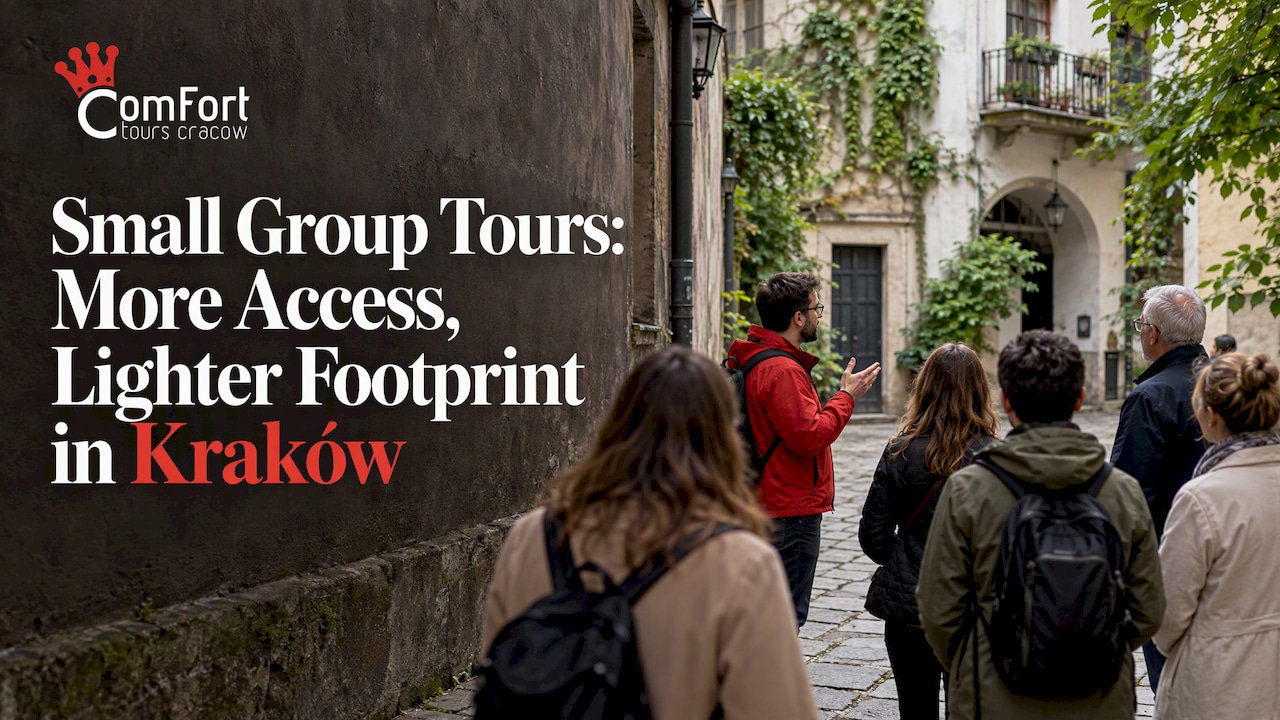
Small group tours usually win on the things that matter most: personal attention from your guide, easier access to places large coaches cannot reach, less time standing around waiting for stragglers, and a lighter footprint on the places you visit. We build our entire offer around this idea, keeping groups small so each traveller gets more than a glance at Kraków’s history. The benefits below cover the practical gains you will notice on the day, and the choices worth making before you book.
Key Takeaways
Small group tours provide personalized, flexible, and accessible experiences that large coach tours cannot match, enriching the travel experience in Kraków.
| Point | Details |
|---|---|
| Personalized attention | Small groups allow guides to tailor the day, answer questions, and adapt the pace to the travelers’ needs. |
| Exclusive access to venues | Small groups can enter smaller venues, private sites, and behind-the-scenes locations unavailable to large groups. |
| Flexible itineraries | Travelers can linger at viewpoints or skip stops, making each trip more customized and responsive. |
| Local and responsible travel | Small groups with local guides and regional providers help reduce environmental impact and support the local economy. |
| ComFort Tours Cracow approach | We keep group sizes small, guides local, and itineraries flexible to ensure an engaging and tailored experience. |
Table of Contents
- 1. The core benefits of travelling in a small group
- 2. How do you choose the right small-group tour?
- 3. Sustainability and local economic benefits of smaller groups
- 4. Small group tours versus private tours and large coach tours
- 5. Health and safety considerations specific to small group tours
- 6. Unique experiences only a small group can unlock
- 7. Why small groups sit at the heart of what we do
- See the benefits for yourself with ComFort Tours Cracow
- FAQ
- Sources
1. The core benefits of travelling in a small group
A small group changes the texture of a trip in ways that show up almost immediately, often within the first hour of a tour.
Personalised attention and a day that bends to you. When a guide is speaking to eight people instead of forty, they can read the room. They slow down at the courtyard you lingered in, skip the explanation everyone already understood, and answer the question you were too shy to ask in a crowd. That flexibility is the single biggest difference between a small group and a coach tour, and it is a key reason some operators keep their groups small.
Access to places a large group simply cannot enter. A family-run vineyard, a workshop tucked behind a Kazimierz courtyard, a narrow chamber in the Wieliczka Salt Mine: these spaces have physical limits. Industry reporting on the format notes that small-group tours are a growing part of the business precisely because operators can offer special-access experiences that larger formats cannot match.
Itineraries with room to breathe. A smaller group can decide, on the spot, to stay an extra twenty minutes at a viewpoint or cut a stop that is not landing. Large groups run on fixed timetables because forty people cannot make a collective decision in under a minute.
Logistics that someone else handles. Entry tickets at Auschwitz-Birkenau, parking near the Tatra Mountains, luggage between transfers: a well-run small group absorbs all of this quietly, which matters more than it sounds on a trip with several moving parts.
Companionship without the crowd. You are travelling with a handful of people rather than disappearing into a sea of name tags. Consumer research on group travel suggests many travellers, particularly older cohorts, choose guided small-group trips for the sense of security and the lighter planning burden that comes with someone else managing the day.
Storytelling that goes deeper. A guide who can see your face can tell when a story has landed and when it needs a different angle. That back-and-forth is where the real learning happens, far more than any audio guide achieves.
Time and cost trade-offs worth knowing. A small group tour usually costs more per head than a seat on a forty-person coach, but it often costs less than arranging the same access, transport and guiding yourself. Booking separate entry tickets, a driver and a guide independently takes hours of planning that a packaged small-group tour removes entirely.
- Personal attention from a guide who adapts the day as it unfolds.
- Entry to smaller venues and producers that large tours cannot accommodate.
- Fewer hours lost to queues, headcounts and group logistics.
Pro Tip: Ask whether your tour guarantees a maximum group size in writing. “Small group” without a number can mean anything up to thirty.
2. How do you choose the right small-group tour?
Not every tour calling itself “small group” delivers the same experience, so it helps to check a few things before you pay.
Group size is the first filter. Expect genuinely personal attention at small numbers that generally range from around half a dozen to just over a dozen participants, a still-manageable dynamic up to somewhat larger groups, and something closer to a mini coach tour beyond that. UK travellers researching Auschwitz tour sizes will find expectations vary widely between operators, so it is worth confirming the number rather than trusting the label.
Balance matters as much as size. A good itinerary mixes guided highlights with unscripted time, rather than cramming in stops back to back. Ask what happens if you want to linger somewhere unplanned.
Guide quality is worth probing directly: ask about language fluency, local residence and how long they have been guiding in the region. Confirm what the price includes before assuming, since extras like entry fees, lunch or hotel pickup vary between operators.
Questions worth asking before you book:
- What is the maximum group size, confirmed in writing?
- How much free or flexible time does the itinerary include?
- Does the guide speak your language fluently and live locally?
- What transport, pickup and luggage arrangements are included?
- What happens if you need to cancel or change dates?
- Is travel insurance recommended or required?
- Check the cancellation policy before paying a deposit.
- Confirm pickup points and transfer times in writing.
- Ask what is excluded from the headline price.
A little pre-trip homework pays off here. The UK government’s own travel safety guidance recommends checking exactly this kind of detail before departure, and for group trips specifically, managing expectations in advance avoids most of the friction that crops up mid-trip, a point echoed in Fox Hostel’s guide to smoother group travel.
3. Sustainability and local economic benefits of smaller groups
Fewer people moving through a fragile site leaves a lighter mark, and the economics work in the destination’s favour too.
Smaller groups reduce footfall pressure at sensitive sites and spread visitor numbers more evenly across the day rather than arriving in one large wave. The GSTC Tour Operator Standard sets out criteria for exactly this: operators are encouraged to limit group size to reduce impact and to prefer local procurement and local hiring wherever practical.
That local procurement point has a direct financial effect. Guidance on responsible tour operations explains that designing a holiday around local suppliers, drivers and guides, rather than imported services, increases both the direct and indirect economic benefit to the destination.
A smaller group travelling with local guides and local transport channels more of its spending directly into the destination it visits, according to sustainable tour operation guidance, rather than leaking out to large, externally owned coach fleets or catering chains.
Signals worth looking for in an operator:
- Local guides hired and trained locally, rather than flown in.
- Transport and catering sourced from regional, independently owned businesses.
- A stated limit on group size at sensitive or fragile sites.
4. Small group tours versus private tours and large coach tours
Each format suits a different traveller, and the differences are mostly about control, cost and company.
A private tour gives you complete control of the schedule and no one else’s preferences to accommodate, which suits families or travellers with specific interests. It costs more per person than a small group, since you are covering the guide and transport alone rather than sharing it.
A large coach tour costs the least per head and suits travellers who want a well-trodden route with minimal planning, but it trades away flexibility and the personal rapport with a guide that smaller formats offer. Entry to tighter venues, like a small chamber in the Wieliczka Salt Mine or a family-run workshop, is often simply unavailable to a forty-seat coach.
A small group tour sits between the two: it keeps much of the personal attention and access of a private tour, at a price closer to a shared experience, with the bonus of travelling alongside a handful of people rather than alone. For most independent travellers who want genuine engagement with a destination without covering the full cost of a private guide, this middle format tends to deliver the strongest balance.

5. Health and safety considerations specific to small group tours
A smaller group is, in practical terms, easier to keep safe, mainly because there are fewer people to lose track of.
Guides leading six to twelve travellers can do a visual headcount in seconds, notice if someone is struggling on a hike near the Tatra Mountains, or react quickly if a member of the group feels unwell. That responsiveness is harder to maintain at scale.
Before booking, it is worth checking whether the operator carries appropriate insurance, whether guides hold first aid training, and what the plan is for activities with physical demands, such as rafting or mountain hikes. The UK government’s travel safety guidance recommends travellers confirm their own insurance covers the specific activities planned, since standard policies do not always include adventure activities by default.
Smaller vehicles used for transfers and day trips also simplify safety: fewer passengers means faster boarding, easier seatbelt checks and more legroom, which matters on longer journeys such as the drive to Zakopane or the Dunajec River.
6. Unique experiences only a small group can unlock
Some experiences are only possible because the group stays small, not despite it.
A private walking tour through Kazimierz can slip into a courtyard synagogue or a family-run bakery that would never accommodate a coach party. A visit to the Wieliczka Salt Mine’s quieter chambers, a horse ride by a lake, or a private wine tasting at a small vineyard near Kraków all depend on numbers staying low enough for the venue to say yes.

Industry commentary on the format backs this up directly: operators report that small groups unlock access to boutique stays, local producers and special-access experiences that larger tours cannot offer, simply because the venues involved cannot host large numbers.
A folk evening with dinner and drinks, an off-road run across the Błędowska Desert, or a guided visit to Oskar Schindler’s Factory with room for genuine conversation along the way: each works because the group is small enough for the experience to stay personal rather than becoming a queue.
7. Why small groups sit at the heart of what we do
We built ComFort Tours Cracow around the belief that a trip to a place as layered as Kraków deserves more than a seat on a crowded coach. Keeping our groups small is not a marketing line for us, it is the mechanism that lets our guides adapt each day, answer the questions that matter to the people in front of them, and get everyone through entry points at Auschwitz-Birkenau or the Wieliczka Salt Mine without the wait that larger groups create.
Tailored itineraries mean a family wanting more time at a single stop, or a traveller tracing their own family history, can have a day shaped around that interest rather than a fixed script. If this approach appeals to you, the booking details below will take you straight to it.
— Damian Fort
See the benefits for yourself with ComFort Tours Cracow
We keep our groups small, our guides local, and our itineraries flexible enough to bend around what you actually want to see in and around Kraków.
- Browse our full range of small-group and private tours, from Auschwitz-Birkenau to the Tatra Mountains.
- Explore our Kraków city tours for a flexible, personal introduction to the city.
| What you get | Why it matters |
|---|---|
| Small, confirmed group sizes | More attention from your guide, less queuing |
| Tailored itineraries | A day shaped around your interests, not a fixed script |
| Local, multi-language guides | Deeper storytelling and practical help throughout the day |
Check availability for your dates, ask us any pre-trip questions directly, and we will talk you through a sample itinerary before you commit to anything.
FAQ
What are the five benefits of travelling?
Travel commonly brings personal attention and learning when guided well, easier access to local culture, companionship, reduced planning stress, and a lighter environmental footprint when groups stay small. These benefits tend to be strongest on small-group and private tours, where guides can adapt to the people in front of them.
What does “group tour” mean?
A group tour is a trip where a guide leads multiple travellers together through a fixed itinerary, sharing costs for transport, entry and guiding. Group sizes vary widely, from six or eight on a small-group tour to forty or more on a large coach tour, and that number changes the experience considerably.
What are the pros and cons of group travel versus solo travel?
Group travel offers companionship, shared costs, and a guide handling logistics such as tickets and transfers, while solo travel offers total control over pace and destination. The trade-off is flexibility against convenience: a small group tour sits closer to solo travel’s flexibility while keeping most of the logistical ease of a larger group.
Why is a tour package important?
A tour package bundles transport, entry tickets and guiding into one booking, removing hours of independent planning and reducing the risk of queuing or missing a reservation. For destinations like Auschwitz-Birkenau or the Wieliczka Salt Mine, where entry is time-slotted, a package also guarantees your place on the day you choose.
Sources
- GSTC Tour Operator standard (PDF)
- Who, where and why: Small-group tours are big business for agents and tour ops – Travelweek
- Integrating sustainability into business management: guide for responsible tour operations (OnePlanet/UN)
- Considering group travel? Read these 5 expert tips before you book – Forbes
- Travel Aware (UK government travel safety advice)